Sydney FC: Lessons from the Asian Champions League
Sydney had what’s becoming a fairly typical Asian Champions League campaign for them - performing well but still not getting results. This time it meant that they played good football but didn’t have much to show for it; collecting a single win, a draw and two losses, ending up on the bottom of their group. It’s inevitable that we’ll get into a discussion about finishing and missed chances, but first let’s look at the main positive.
New Kid on the Block
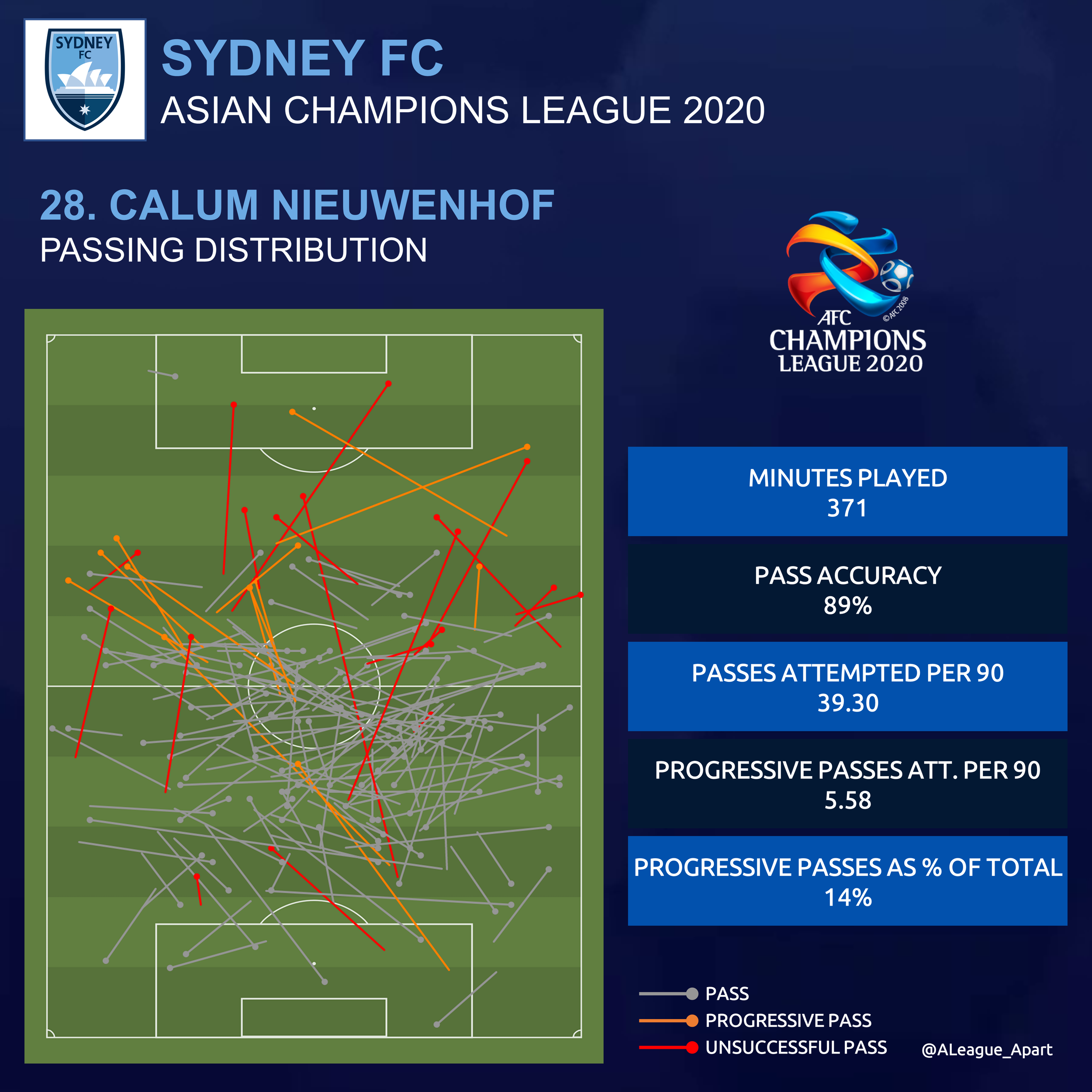
The 19-year-old debutant Calum Nieuwenhof received a lot of the plaudits from his performances in the Champions League, and rightly so. He’s shown he’s got quite a few tools in his locker including an ability to retain possession through simple passes, tight control to dribble out of sticky situations and a bit of physicality that helps him stay on the ball and also to regain possession.
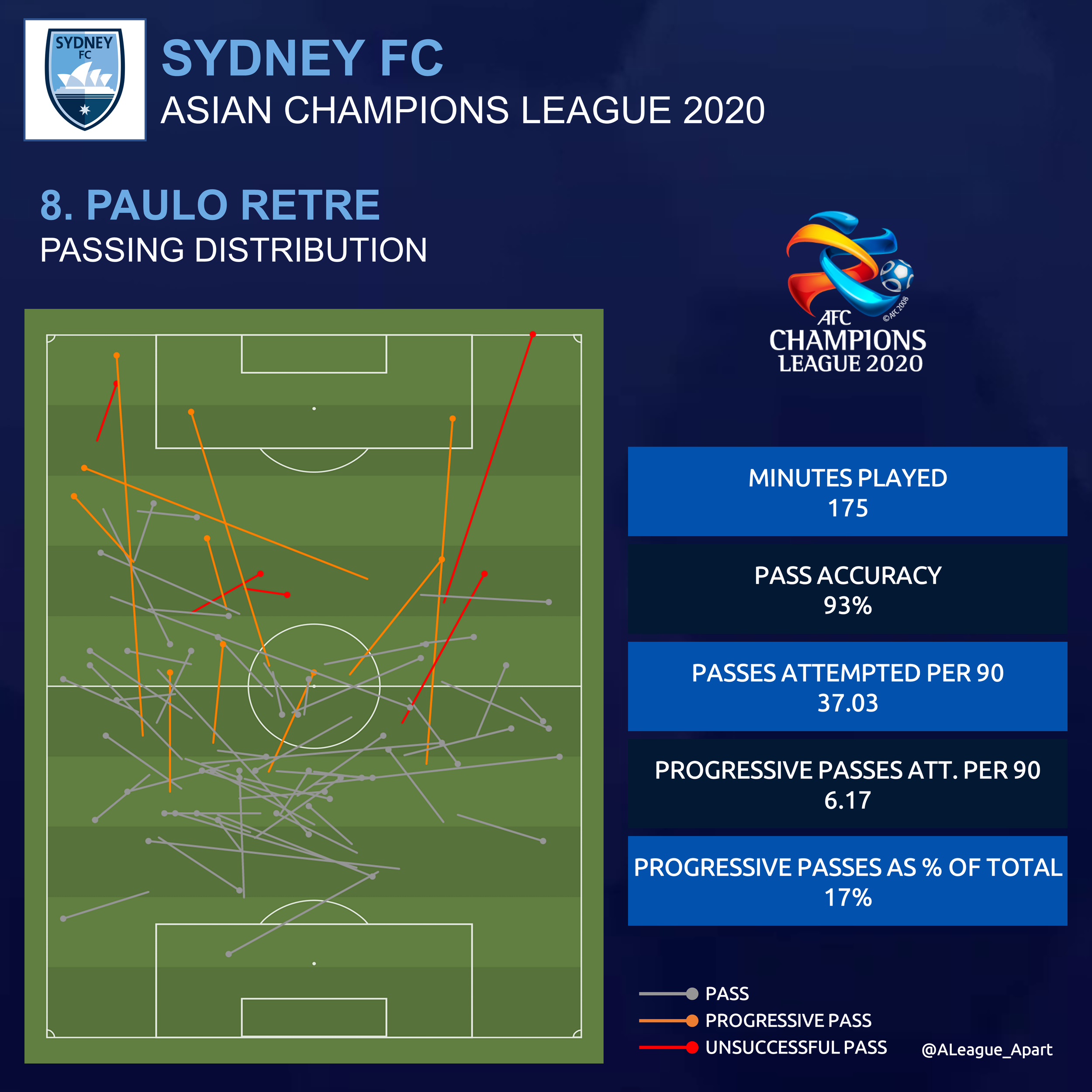
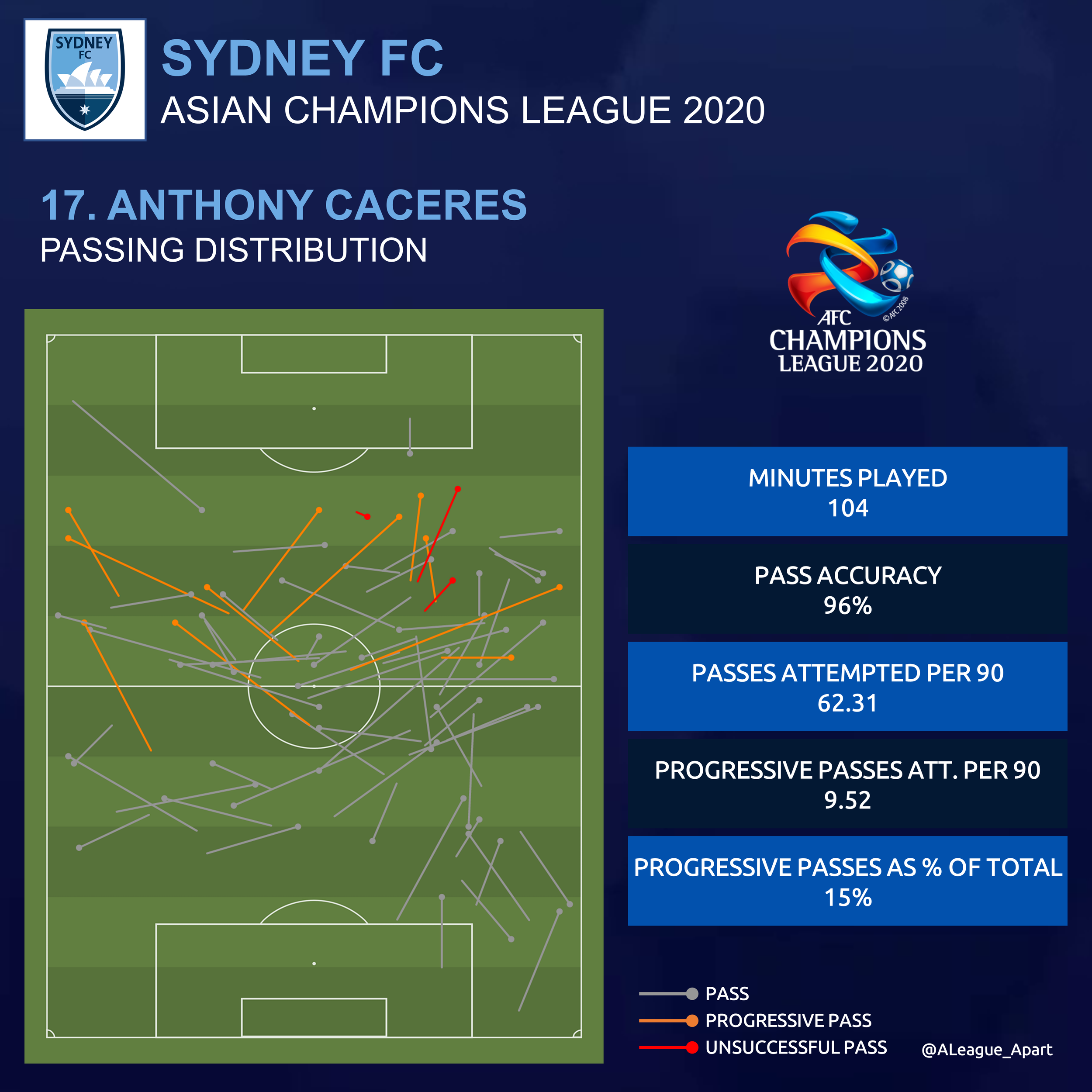
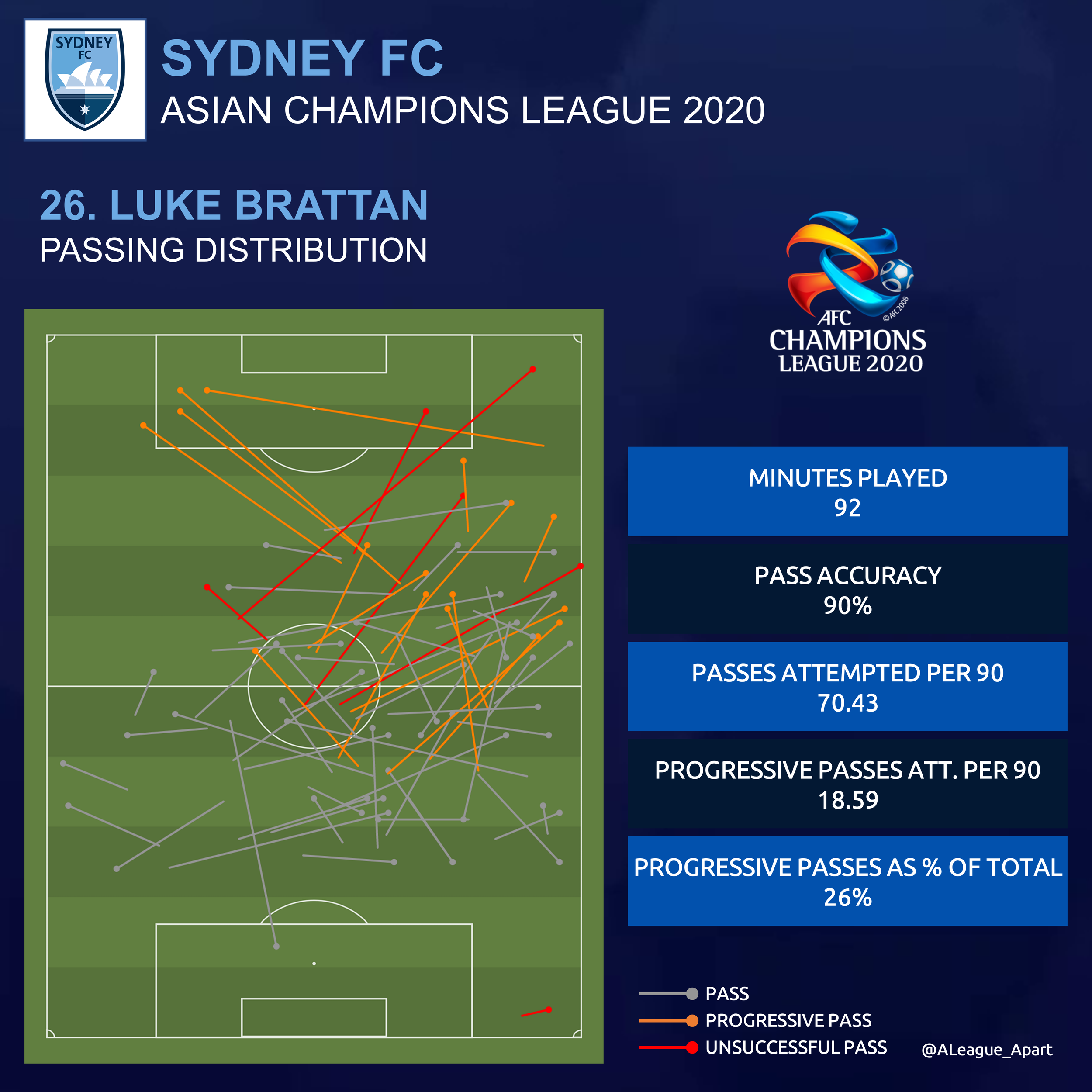
He ended up playing all available game time in Doha, with the other three central midfielders Paulo Retre, Anthony Cáceres and Luke Brattan sharing minutes in the other central midfield role. Note, keep the amount of playing time he had compared with the others in mind for later.
However, he is currently not a progressive passing playmaker in the same mould as Brattan, and he’s probably not yet ready to play in that role either but he does have a lot to offer Sydney FC. Let’s take a closer look by examining Sydney’s central midfielders’ passing over their games in the Asian Champions League.
The first thing that you’ll notice is how crowded Nieuwenhof’s pass map is compared with the others, but don’t forget, he played twice as many minutes as Retre, and almost 4 times as many minutes as Brattan & Cáceres .
And here’s the data in table view for better comparison:
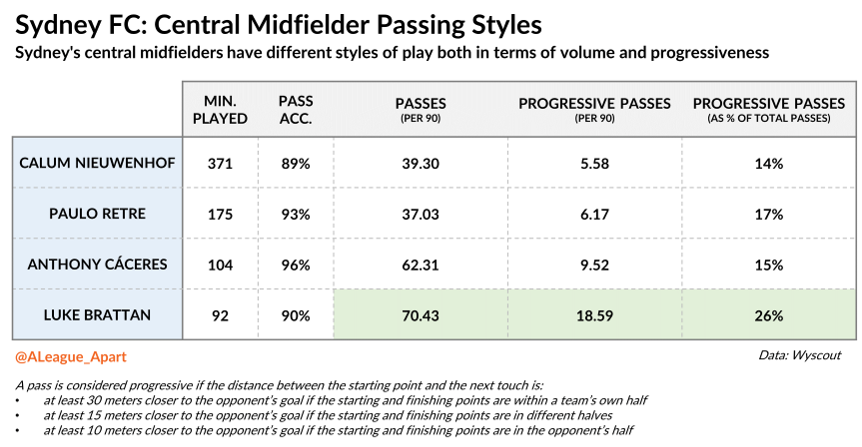
Nieuwenhof and Retre have a similar passing mix - lower volumes and lower levels of progressive passes. Brattan, on the other hand, shows his playmaking prowess - he passes the ball more than his teammates and much more frequently attempts progressive passes. Cáceres finds himself somewhere in between, but is still some way short of Brattan when it comes to progressing the ball.
While he doesn’t have the same driving power and box-to-box engine of Brandon O’Neill (who’s recently joined Buriram United in Thailand), Nieuwenhof’s emergence has quelled any concern about depth in midfield. With Chris Zuvela also capable of playing at central midfield (although his appearances in Doha were on the wings), Sydney have a good core group of midfielders that should be able to take them through the congested season. One thing’s for sure though, Brattan is still the key driver of play while in possession.
Finishing Woes
I have previously tried to answer the question of how Sydney might replace Adam Le Fondre. Trent Buhagiar stepped up and emulated him in the Asian Champions league, ending as Sydney’s (and the rest of the Australian teams) top goalscorer in Asia with a total of five goals - four being across their four appearances since the restart.
That’s not to say that their attack was particularly potent - rather, the main criticism of Sydney’s campaign was their inability to finish the chances that they created. Barbarouses in particular bore the brunt of this, missing a couple of one-on-ones in their first game and ending the campaign goalless. It was a pronounced difference to the finishing that Sydney have been used to with Le Fondre, who had a knack of being in the right places and finishing chances clinically.
The reason that they depend on a clinical finisher is because Sydney’s style of play isn’t as a relentless attacking/shooting team, as the 2019/20 A-League season stats show.
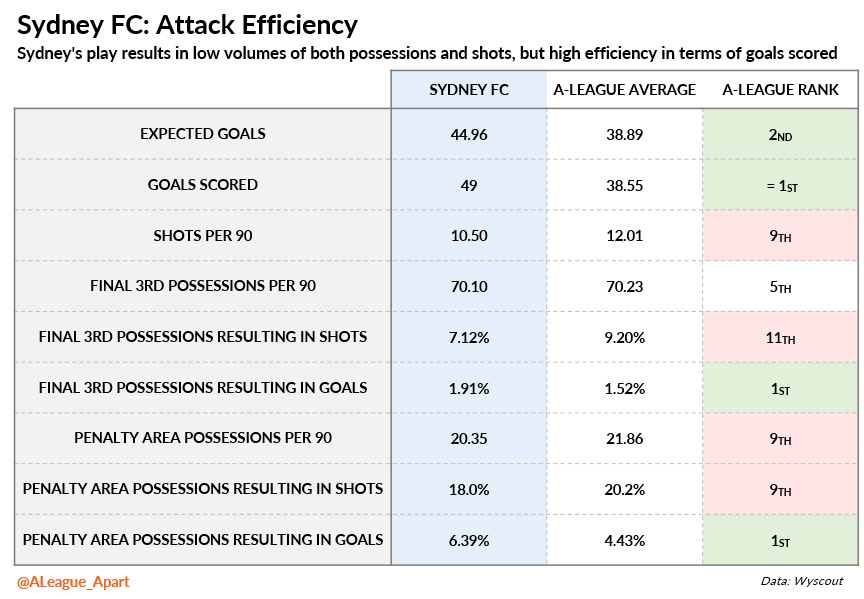
Expected goals is an often misunderstood concept, but it basically boils down to putting a numerical value on the chance quality - it follows that better chances have a higher expectation of being able to be converted into goals. With Sydney scoring goals at a higher rate than expected based on the chances that they created (49 goals scored compared with 44.96 xG), we can see that they were able to finish quite efficiently.
The data also shows that in comparison to the rest of the A-League, they have few possessions reaching the final third (5th in the league) and the penalty area (9th in the league). Off these possessions, they have fairly low rates of converting them into shots (11th F3 and 9th Penalty Area). which is also reflected in the low shots per 90 stat.
To put it simply, when compared with the rest of the A-League, they don’t take shots, they don’t get the ball into dangerous areas and take fewer shots in dangerous areas, but somehow still manage to score the most goals in the league with 49, tied for first with Melbourne City.
Great Expectations
Finally, because I’ve got the data handy, let’s have a look how xG values have looked for Sydney, compared with all other 2019/20 A-League matches.
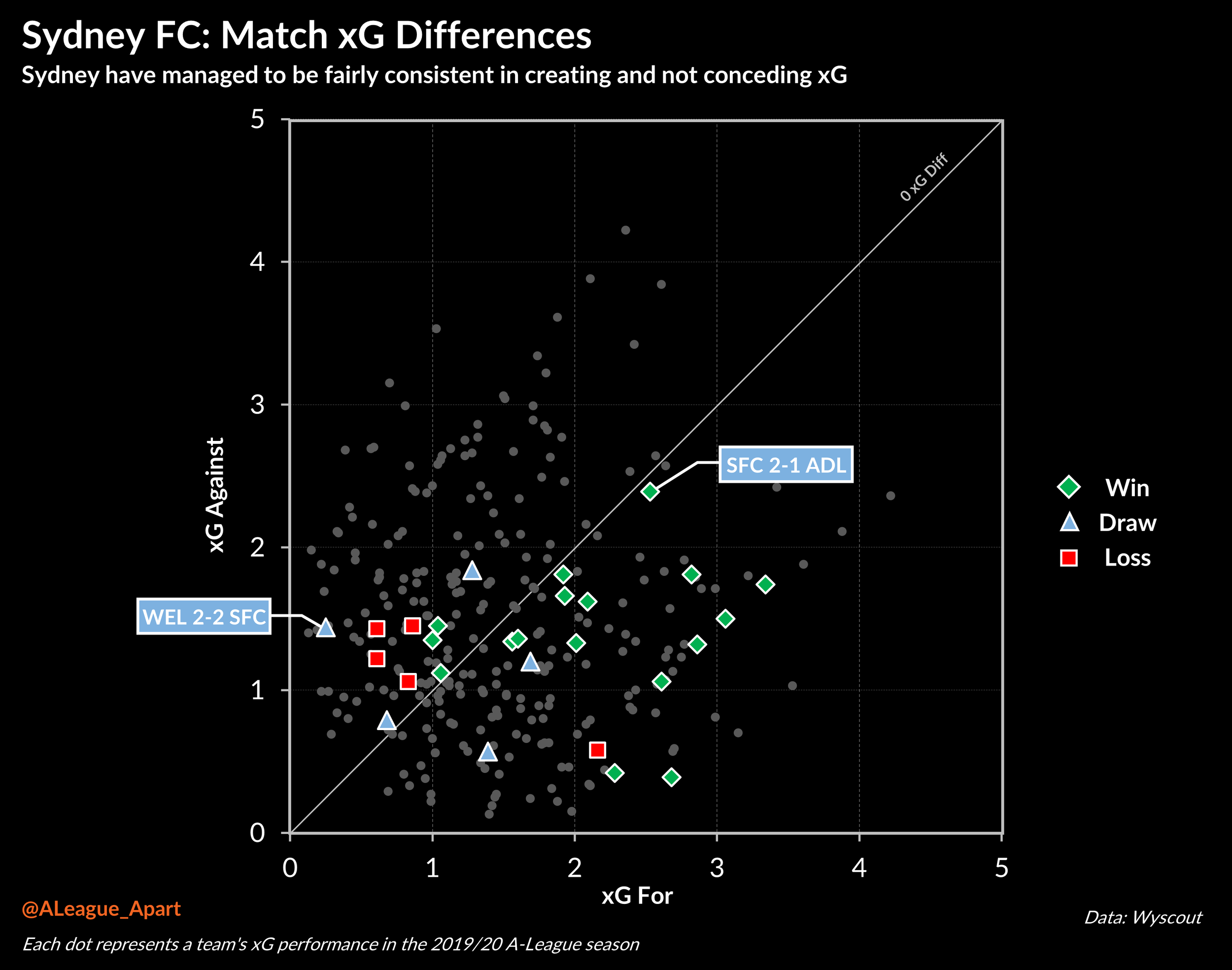
These insights might be quite obvious for the team who ended up topping the A-League, but here we go:
Sydney managed to consistently create more xG than their opponents - denoted by their matches’ data points appearing below the diagonal line
They only had one game where they conceded more than 2.0 xG to their opponents (they still won: Sydney 2-1 Adelaide)
They only had one game with an xG difference greater than -1.0xG (they still drew: Sydney 2-2 Wellington)
They had 10 games with an xG difference greater than +1.0 xG (the average A-League side managed this in just over 5 games).
Sydney’s defence hasn’t changed, so you’d expect them to continue to run a tight ship at the back, but if they are to have similar levels of success, they’ll need to find clinical finishing, or otherwise, increase the volume of attacks and goal scoring chances that they create.
It all comes back to a familiar conclusion: Sydney really just need someone to convert their chances into goals.
This article was originally published on The Reserve Team.