Perth Glory: Lessons from the Asian Champions League
With all the drama surrounding Perth Glory’s offseason, it was a relief to see them return to the pitch and put up a good fight in their Asian Champions League games. While the results didn’t really fall their way in Qatar, they return to Australia with minutes under their belts and excellent competitive exposure for Perth’s upcoming talent pool.
Transition to Youth
The spine of Perth Glory’s team has really fallen apart over this offseason, with seven senior squad players departing the club: Gregory Wüthrich, Ivan Franjic, Joel Chianese, Jake Brimmer, Jacob Tratt, Tomi Mrcela and Juande. As such, while the squad that Richard Garcia chose to take to Qatar had a few familiar names, the rest of the squad was almost unrecognisable - with an injection of youth.
Six players within the squad: Bryce Bafford, Giordano Colli, Cameron Cook, Joshua Rawlins, Mason Tatafu & Nicholas Walsh were promoted from the Perth’s Academy side and three had recently been involved in NPL WA (Luke Bodnar, Declan Hughes & Daniel Stynes). Each of them, bar the goalkeeper Cook, made multiple starting appearances over the five games of Perth’s campaign and didn’t look particularly out of their depth. Even the players who had joined from other A-League clubs are quite youthful, with Carlo Armiento, Jon Aspropotamis, Nick Sullivan, and Brandon Wilson all 24 or under.
This is particularly noteworthy for Perth, whose squad was the oldest amongst all A-League clubs over the 2019/20 season. One question was how effectively they might be able to transition from their aging squad, and it looks like much of the answer might already exist from within Perth’s own youth setup.
Back 4 or Back 5?
In terms of tactics, Perth lined up in a 4-4-2 across all of their games which was somewhat unexpected, considering Perth’s usual set up in a 5-at-the-back system under Tony Popovic. Richard Garcia doesn’t have any senior coaching experience to draw any patterns from, but an Adam Peacock interview with Brandon Wilson on the Fox Football Podcast mentioned Garcia’s preference for a 5-at-the-back, keeping continuity with the previous regime.
So why the change? It might have to do with the number of options they have at the back. With departures, injuries and non-inclusions in the squad, Perth only had four natural centre backs to choose from (Osama Malik, new signings Darryl Lachman & Jon Aspro, and Luke Bodnar from the academy), with Brandon Wilson (midfield) and Mason Tatafu (full back) filling in on occasion.
Their depth at full back is not particularly strong either. With previous first choice options of (Ivan Franjic and James Meredith departing and the collapse of Nathaniel Atkinson’s transfer to Perth, there’s a significant gap in first-team ready options. Meanwhile, Tarek Elrich deputised on both flanks last season, but was omitted from the ACL squad and mysteriously didn’t appear in any news communications, until his confirmed departure from the club on Tuesday.
This leaves the only senior option from last season as Dane Ingham, who provides a great threat going forward through his pace and ability on the ball, able to both provide an overlap and also cut inside to shoot or combine with teammates. To free up Ingham from his defensive responsibilities, and with the relative inexperience of their other full back options (16-year-old Jason Rawlins, 18-year-old Mason Tatafu & 18-year-old Nick Walsh), we might see a return of the 5-at-the-back, in order to provide increased defensive protection.
The return of Alex Grant from injury will increase the depth of options at the back to a total of five (four senior, one academy) for Garcia to choose from, which might allow him to find a better balance of three centre backs to anchor the defence.
Perth’s final game against FC Tokyo saw them switch to a 5-at-the-back system for the last 15 minutes or so, with Ingham playing at left wing back, Rawlins at right wing back, and Tatafu dropping back to play in the right-sided centre back position alongside Aspro and Bodnar. Perhaps this might be something we’ll see more of in the upcoming A-League season.
Attacking Penetration
Unsurprisingly, Diego Castro and Bruno Fornaroli were central to the few attacking forays that Perth managed to create over their games. Both of their natural games are to play in between the lines; Fornaroli by coming short to receive the ball and looking to turn or lay off to teammates, and Diego Castro by roaming in between the lines to find pockets of space.
Diego Castro’s return to the squad is a welcome relief for Perth Glory as a key contributor to Perth’s attack.
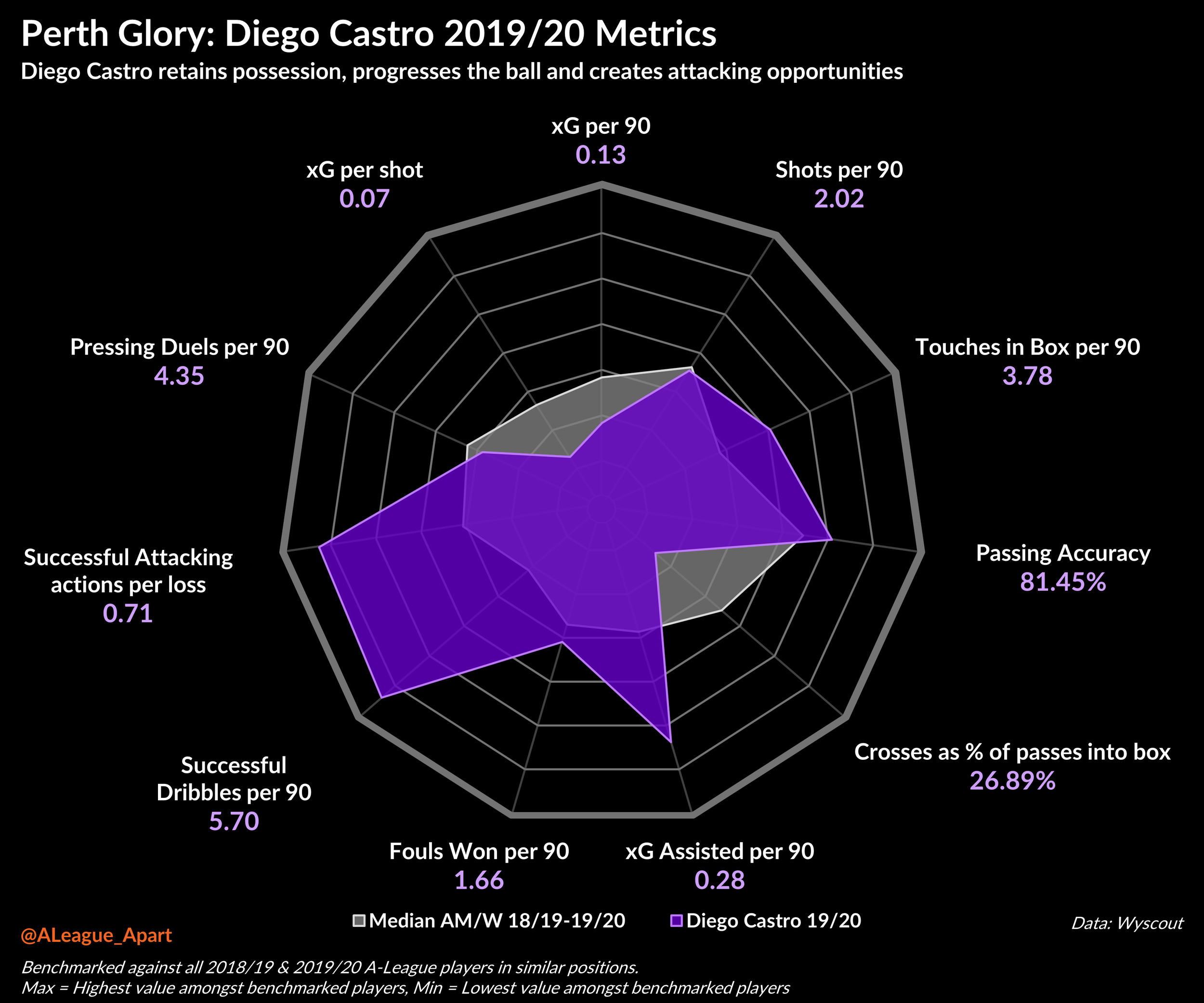
His metrics from 2019/20 show a solid contribution to attacking play, with an ability to help progress the ball in the final third through dribbles (2nd highest per 90), and also providing key passing with assists.
The collapse of Andrew Nabbout's move to Perth, departure of Joel Chianese to the Indian Super League and the continued injury of Chris Ikonomidis means that his retention has become all the more important to support Bruno Fornaroli and Andy Keogh in attack.
The system Perth set up in was a 4-4-2 (or 4-2-2-2) with the wide midfielders coming more narrow to combine with the forwards and also looking to run in behind. As such, and especially in their first outing against Shanghai Shenhua, their attacks were at times fairly congested in central areas, with Fornaroli and Castro occupying similar areas in transition and buildup, and D’Agostino and Bafford drifting inside from central areas.
As they went through the games, it seemed that Perth got more fluent with their positionings and movements. With the ball in midfield Fornaroli would stay central and Perth’s other attackers would rotate freely, making runs to drag defenders across the pitch. The wide players in particular would start on one flank, and then drift over towards the centre and opposite flank, finding pockets of space in between the opposition’s defensive coverage. They’d also continuously make runs in behind, looking to take advantage of positional rotations and gaps in the defence.
One of the best examples of this was Ingham in the 3-3 draw against Shanghai Shenhua, who drifted from his initial position on the left wing (and later from left back), appearing in central areas and even on the right, making runs off the last defender to get into excellent shooting positions.
There’s a bit of fluency still to come, but I’d expect these attacking movements to bear some fruit against the A-League’s (generally) less structured and well organised defences. The addition of Andy Keogh up front will add a finishing touch that was missed in Qatar, while the upcoming returns of Nick D’Agostino and Chris Ikonomidis (who’s just finished up his quarantine in Perth) will no doubt add further pace and directness to the squad.
Positives from Perth’s Pre-season Prep
While Perth Glory were never expected to reach the knockout stages of the Asian Champions League, they were unlucky to come out of Qatar with only a single point to their name. Dogged defensive displays against Ulsan Hyundai and FC Tokyo ended up falling just short, while their games against Shanghai Shenhua were punctuated with lapses both defensively and in front of goal.
Richard Garcia’s side will have taken the positives from this; a perfect opportunity to bed in youngsters against strong opposition, developing chemistry between a new squad and getting an opportunity to build fitness. Perth’s quarantine situation is a bit less forgiving than Sydney FC and Melbourne Victory’s, but hopefully they’ll be back to competitive fitness for the start of the A-League season.
This article was originally published on The Reserve Team.