Asian Champions League: Yokohama F-Marinos 4-0 Sydney FC
Ange Postecoglu’s Yokohama F-Marinos produced a fantastic display that completely outclassed the A-League leaders Sydney FC.
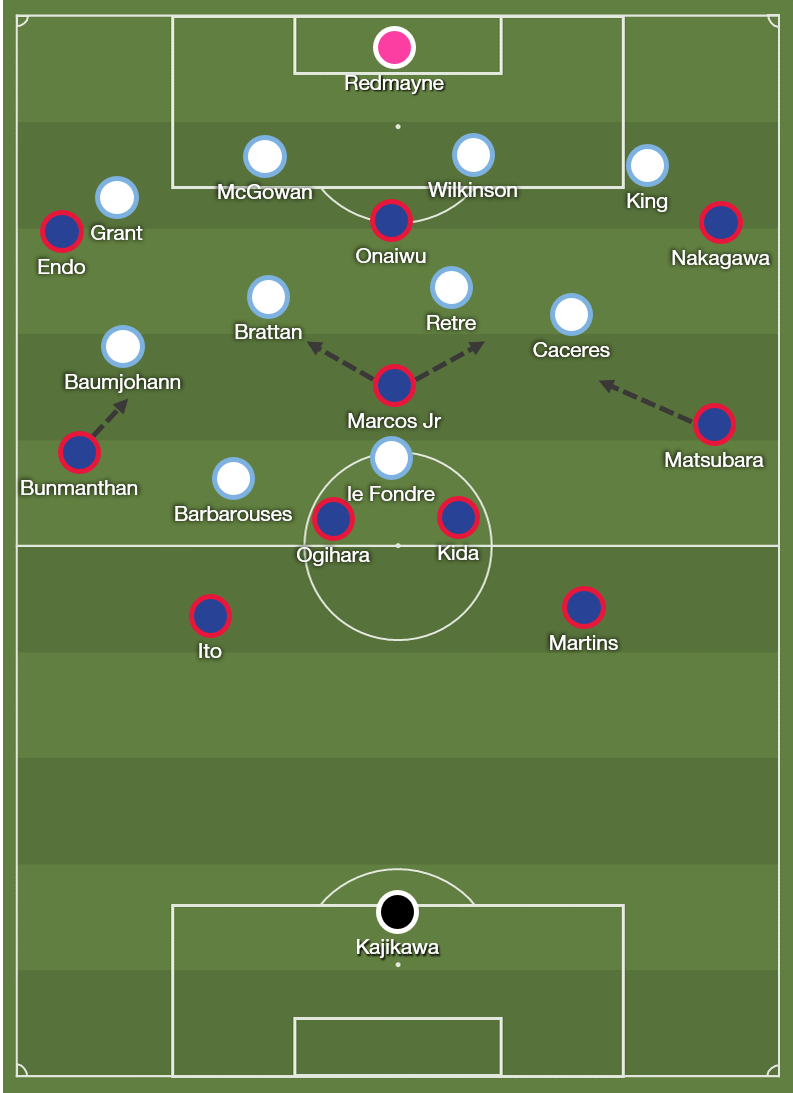
Marinos lined up in a very flexible 4-2-3-1, with the main fixed points being Onaiwu leading the line, Endo and Nakagawa playing high and wide, and the two centrebacks Ito and Thiago Martins generally staying back. The rest of the five players had a lot of positional flexibility and combined in very fluid rotations.
Sydney FC played their usual 4-4-2 shape - compact in defense, but then looking to quickly break forward with pace through the front four players. They focused play down the right hand side as usual, with Grant bombing forwards in attack and Barbarouses looking to spring the offside trap with balls in behind.
Marinos: Methodical creation of space in between the lines
The Marinos gameplan was all about creating space in between Sydney’s lines - both vertically and horizontally. They did this using 5 principles:
1. Front three players pin the Sydney back four
Onaiwu stayed central and kept the centrebacks busy with his movements, meaning that they could not easily come out to cover the space behind the midfield.
Endo and Nakagawa both played very wide, hugging the touchlines even when the ball was on the other sides. When the ball was played to them, the fullbacks had to come out to close them down, opening up a channel between the fullback and centreback.
This meant that the back four were always kept busy, and were not able to easily help out the midfield by covering without leaving space for the attackers to exploit.
2. Underlapping fullbacks
The fullbacks Bunmanthan and Matsubara both had license to join the attack. While they were happy to join the attack on the outside of Endo and Nakagawa when they were positioned slightly narrower, their main contribution to attacking moves was more towards the centre of the pitch.
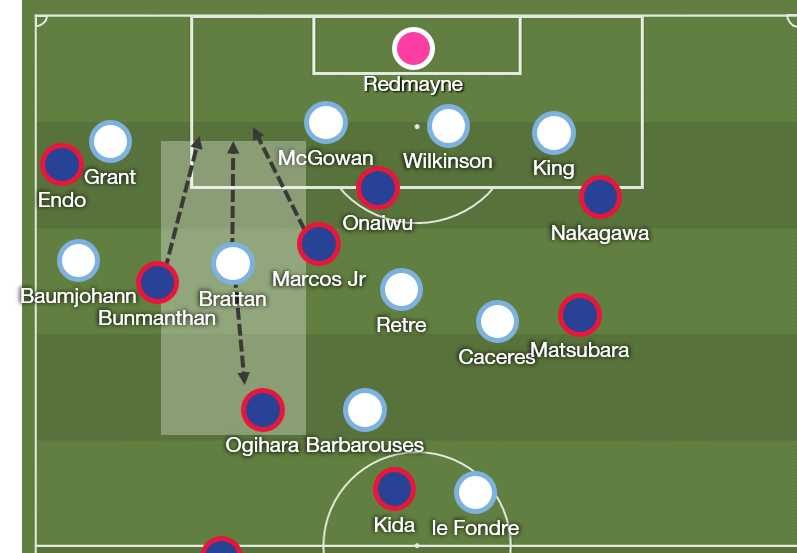
They came central to provide numbers in the middle of the pitch for circulating the ball, or to cover for the central midfielders when they ventured forwards to supplement the attack. It’s important to note that they weren’t simply filling in space in midfield - they were extremely capable of playing passes into dangerous areas.
Here’s an early example:
3. Pop up in between the lines
With the back four pinned back and spaces being created in between the lines, Yokohama players always looked to take advantage by taking up positions in between the lines. All of the players took turns in finding spaces in between the lines - even the fullbacks.
By playing in between the lines, Sydney constantly had decisions to make - do they close the ball carrier or do they keep the shape compact? When the ball is played, who should be tracking the player in between the lines, the defender or the midfielder?
With the back four pinned and the strikers not providing a lot of defensive resistance, the Sydney midfield could be isolated and overloaded.
4. Draw out the press
Marinos played simple and patient passes around the back/in midfield to draw the Sydney press out. Their build up always had three players at the back, with either a defensive midfielder or fullback sitting deep to help circulate the ball.
It should also be noted that the Sydney press was not particularly well organised - at times the strikers would press on their own and get easily bypassed as the midfield line would be hesitant to be drawn all the way up to join the press. Meanwhile, Brattan had a high pressing work rate, and would frequently move out to press, but without support from his teammates, this was often in vain.
5. Attack the space
With space in between the lines and overloads being created, Marinos then combined well to penetrate the back line.
A particular common pattern was to overload the half space, which zonally ends up being the central midfielder’s responsibility. He had to cover in behind, while also pressing players who would enter the space in front. These overloads meant that the midfielders could be easily pulled out of position to create space for attacks.
Sydney’s blunt attack
Sydney were extremely one-dimensional in the first half. Whenever they got the ball, the first thought was to deliver a pass over the top on the right flank. It made sense - Yokohama played a very high line (at the halfway line) with a high press, and Sydney had pacey players that could take advantage, namely Barbarouses (and later Buhagiar) and Grant. However, their timings were off all game and they were caught offside numerous times, but even when they managed to play the ball well, Thiago Martins’ pace made it difficult, while Kajikawa was on hand to sweep up any overhit passes.
It’s also worth pointing out that another reason why the forwards were unable to get on the end of many balls is because they were pinned in their own half for the vast majority of the game (possession YFM 65% - 35% SYD), which meant that the long passes behind the defence were not available until the strikers’ had managed to make their way forwards. There was space in behind, but it wasn’t able to be used.
Sydney weren’t able to get much decent possession either, with Marinos counter pressing hard when they lost the ball. Their narrow offensive structure meant that they would always have numbers in the middle of the pitch, and their players were able to quickly collapse on the ball carrier in an organised fashion, squeezing out the space and options that they had to play, while the attackers also contributed by pressing from behind to help dispossess Sydney quickly. The intensity of the press was extremely high, and throughout the game Sydney only managed an average of 4.96 passes before a defensive action was made (Sydney, in contrast, allowed Yokohama an average of 17.88 passes).
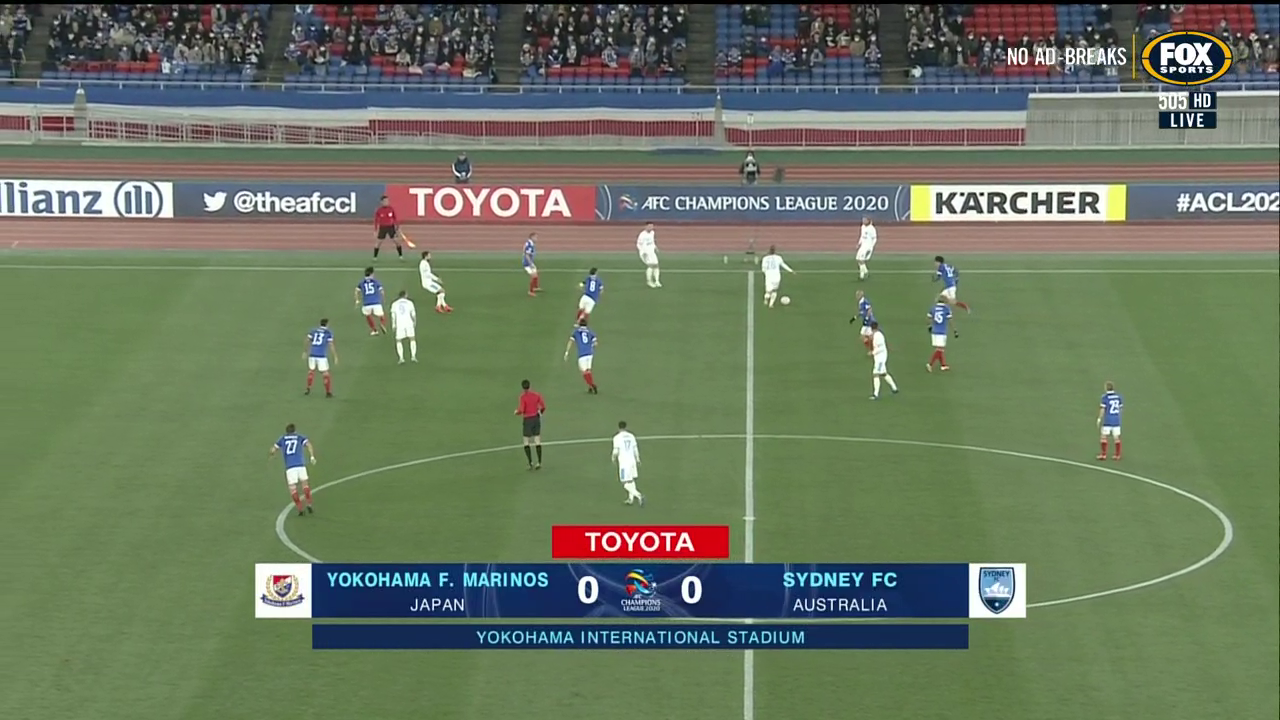
The game was over by the first half, but Sydney were not able to stamp any authority on the game in the second half. They did manage to get some crosses in and had their shot on goal from a free kick, but they still weren’t able to spring the offside trap or get the attacking midfielders on the ball in space. Buhagiar again showed why he frustrates - his blistering pace isn’t complemented by clever movement or strength to hold off the defender.
While Yokohama played some excellent football, it’s important to note that Sydney’s gameplan appeared to be completely unprepared for this. It looked like Sydney aimed to come and play their normal game - Brattan and Retre’s strengths lie more as playmakers rather than in the defensive side of the game, and neither Caceres nor Baumjohann (especially) have the defensive work rate to track back. In addition, there wasn’t enough positional and defensive discipline from Sydney (particularly from the forwards and wide players), while neither Barbarouses nor le Fondre managed to get involved in the game defensively or offensively.
It will be interesting to see how Steve Corica adjusts his gameplan for their next encounter in Sydney - whenever that may be.