Analysis of the A-League’s Average Age
Last week saw news stories of two interesting reports: Professional Footballers Australia’s 2019-20 A-League report and Football Federation Australia’s Performance Gap Report, which both highlighted a number of interesting stats on the season just past.
One of the headline stats in the PFA’s report that caught my eye detailed the average squad ages for each club in the A-League, and gave a handsome league average age of 25.
In contrast, the FFA’s report made mention of how old the A-League was.
As per Dominic Bossi’s reporting:
“Of that [senior professional game time in Australia] game time – which is comprised of the matches played in an A-League season – the report indicates the majority is taken up by players over 30.”
And as Joey Lynch reported:
“With the disclaimer that data collection concluded prior to its COVID-effected run-home, the A-League was classified as an “Experienced Player” league: players who turned 32 years old during the 2019-20 season playing the greatest number of minutes over the past five seasons – the oldest dominant age cohort of all 35 leagues examined.”
These two themes – the A-League’s average age is 25 (PFA) and the A-League is an “Experienced Player” league with players turning 32 (FFA) – seemed to be in stark contrast with each other so I decided to take a closer look.
Defining the definitions
To clear up one thing off the bat, the FFA report isn’t saying that the average starting player’s age is 32 – it’s a bit of a clunky definition:
“Players who turned 32 years old during the 2019-20 season playing the greatest number of minutes over the past five seasons.”
Rather, what this means is players who were born in 1986/87 played the most minutes out of the past five seasons in the A-League.
Another interesting point that the FFA report brings up is the following:
“A benchmark of 2250 minutes in a season – or 25 complete matches of 90 minutes – was a significant indicator for positive career progression.”
While I was looking at squad ages, I also had a look at the magic 2250 minute benchmark – more on that a bit later.
Is the A-League’s average age actually 25?
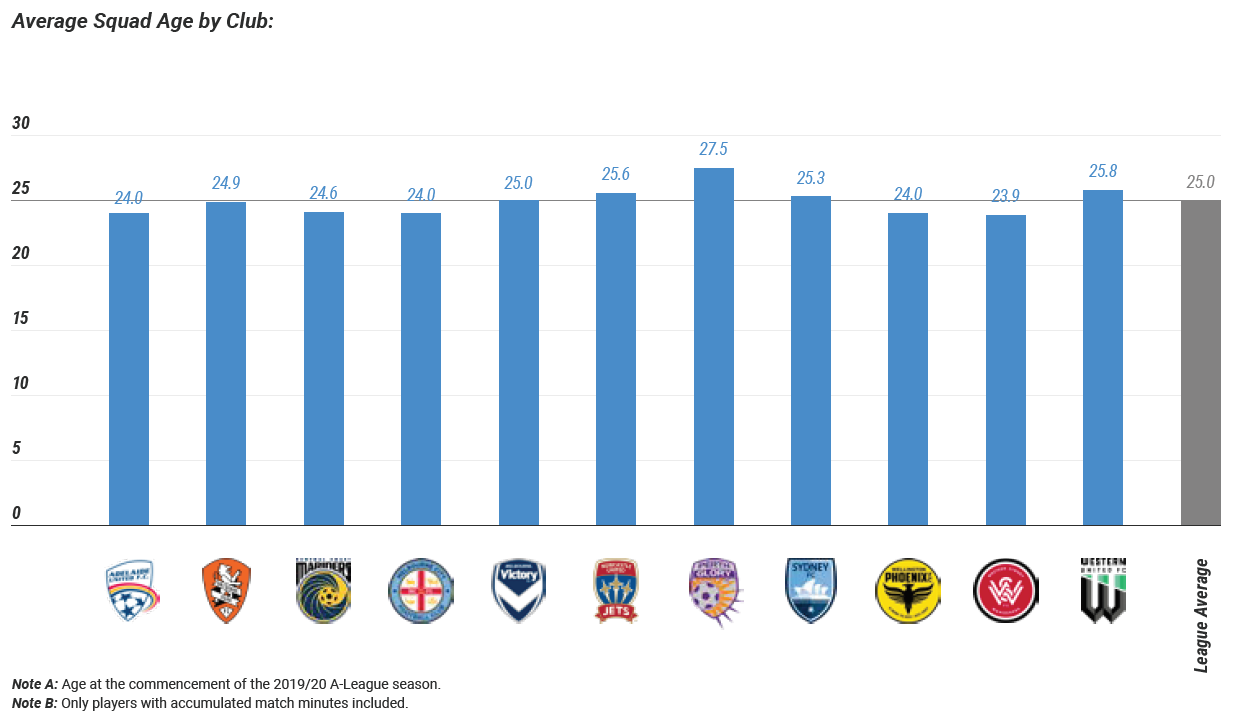
The PFA reports that the League Average age is 25.0, which looks like great news for the A-League.
However, it doesn’t meet the eye test in terms of the mix of youth and experience that we’ve seen in games in the A-League and it also seems like it doesn’t agree with the FFA report.
One thing about how the PFA chose to represent this data is that it shows average age, with a player needing to record only a single minute to be included.
This means it doesn’t take into consideration how much they are playing, or with what regularity – just that if they’ve made an appearance, they are included in the average.
Let’s look at an example: Melbourne City’s 16-year-old Raphael Borges recorded just five minutes of game time in the A-League. Based on the methodology, it seems like he would be included in the calculations, and his inclusion would bring City’s average squad age down.
This is fairly common, with younger players only being involved in cameo appearances towards the end of games. 33 players ended the season with less than 100 minutes of game time and the average age of these 33 players was 19.
This data would be more valuable if it took playing time into consideration to get an indication of the average ages of players who are actually playing.
Average ages of players who are actually playing
I did exactly that and adjusted the averages based on the amount of playing time they saw. This adjustment should give us a better indication of the playing squad’s average age, and should reduce the impacts of youth cameo appearances on average squad ages.
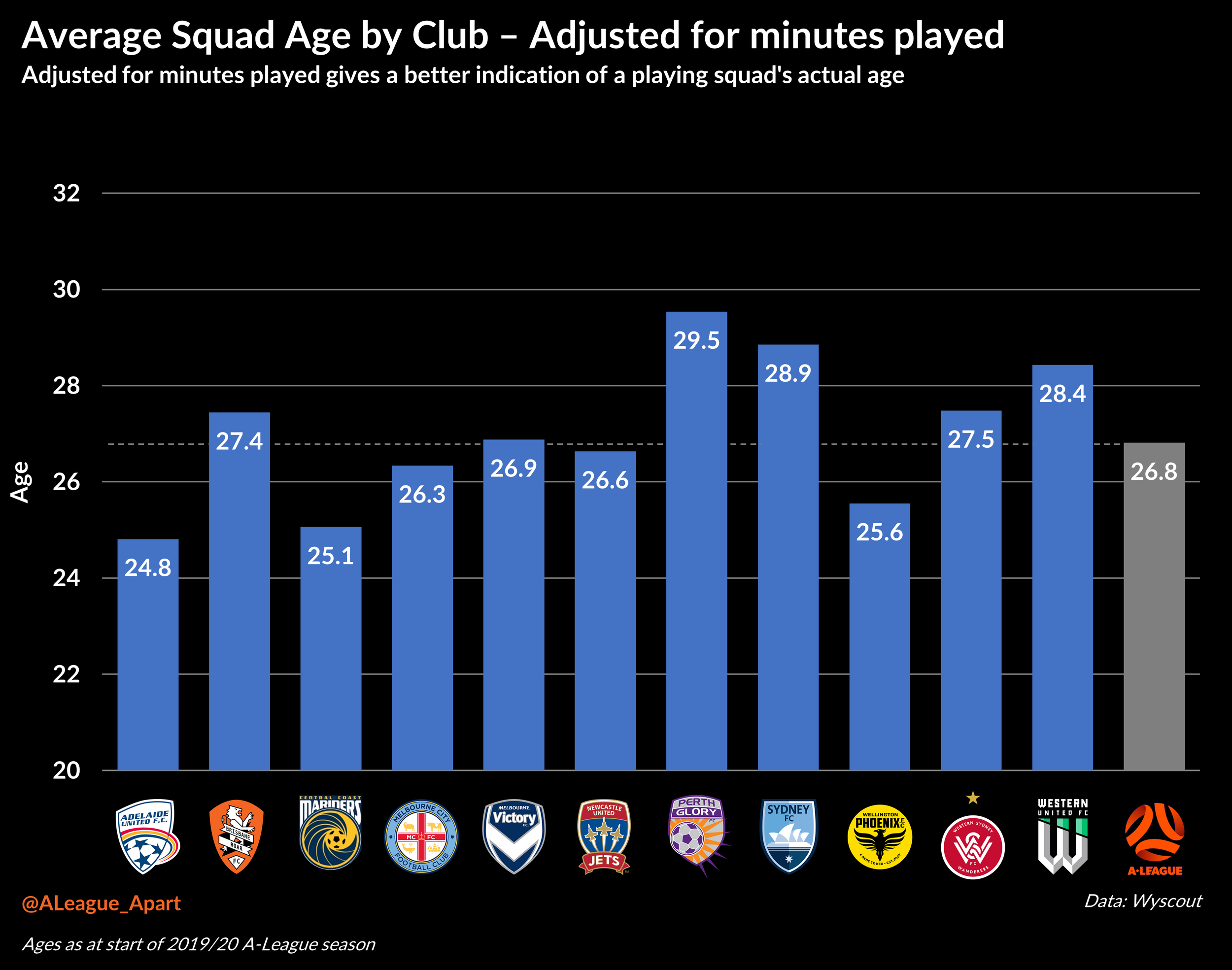
Once actual minutes played is taken into consideration, all of the clubs’ average ages increase.
And when compared with the data provided by the PFA, we can see how much the average age shifts at each club, with some having larger shifts than others.
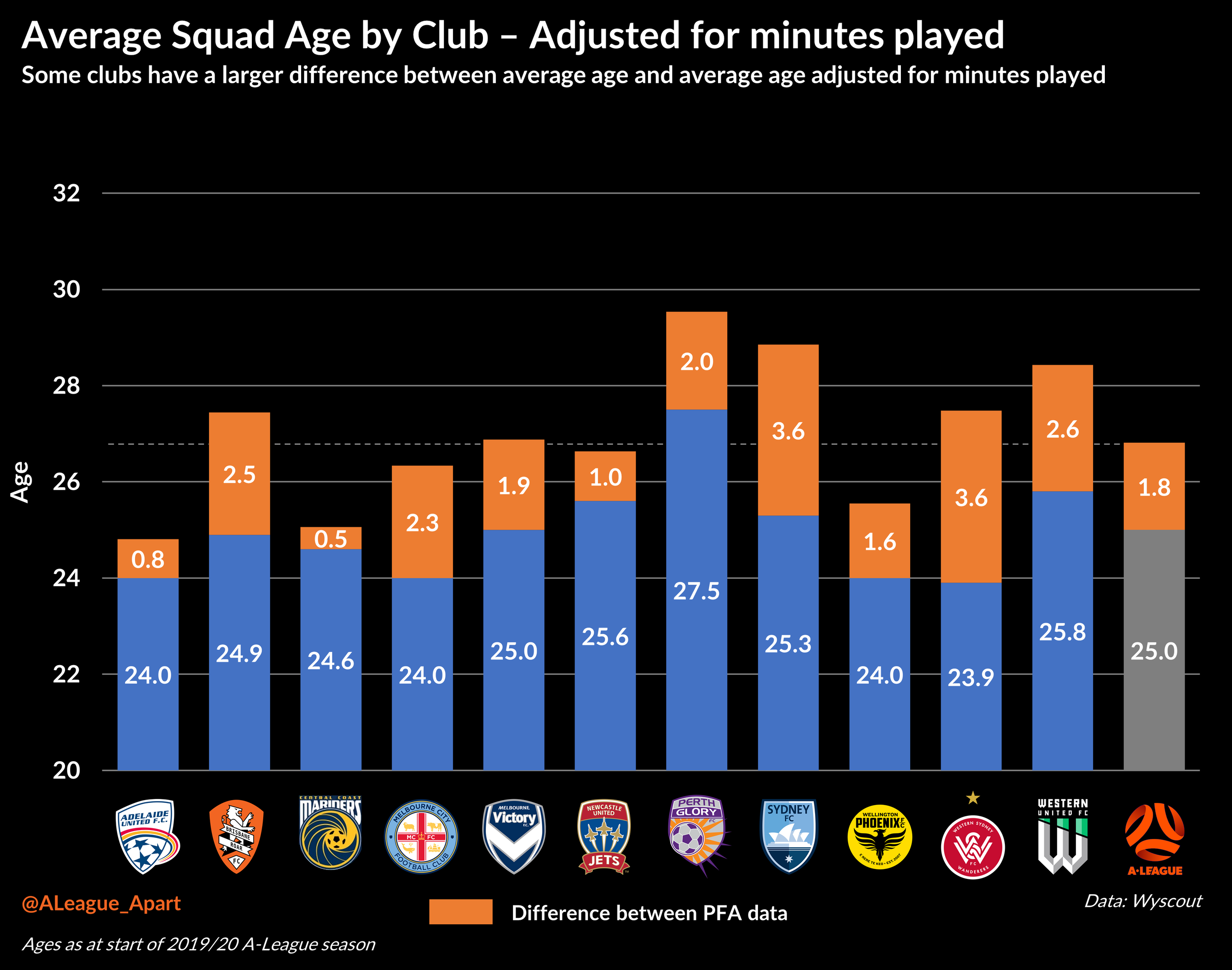
Taking Sydney as an example, they had an average age of 25.3 in the PFA data, but after taking playing minutes into consideration, the average age shoots up to 28.9.
Upon closer inspection of the squad profile we can see why:
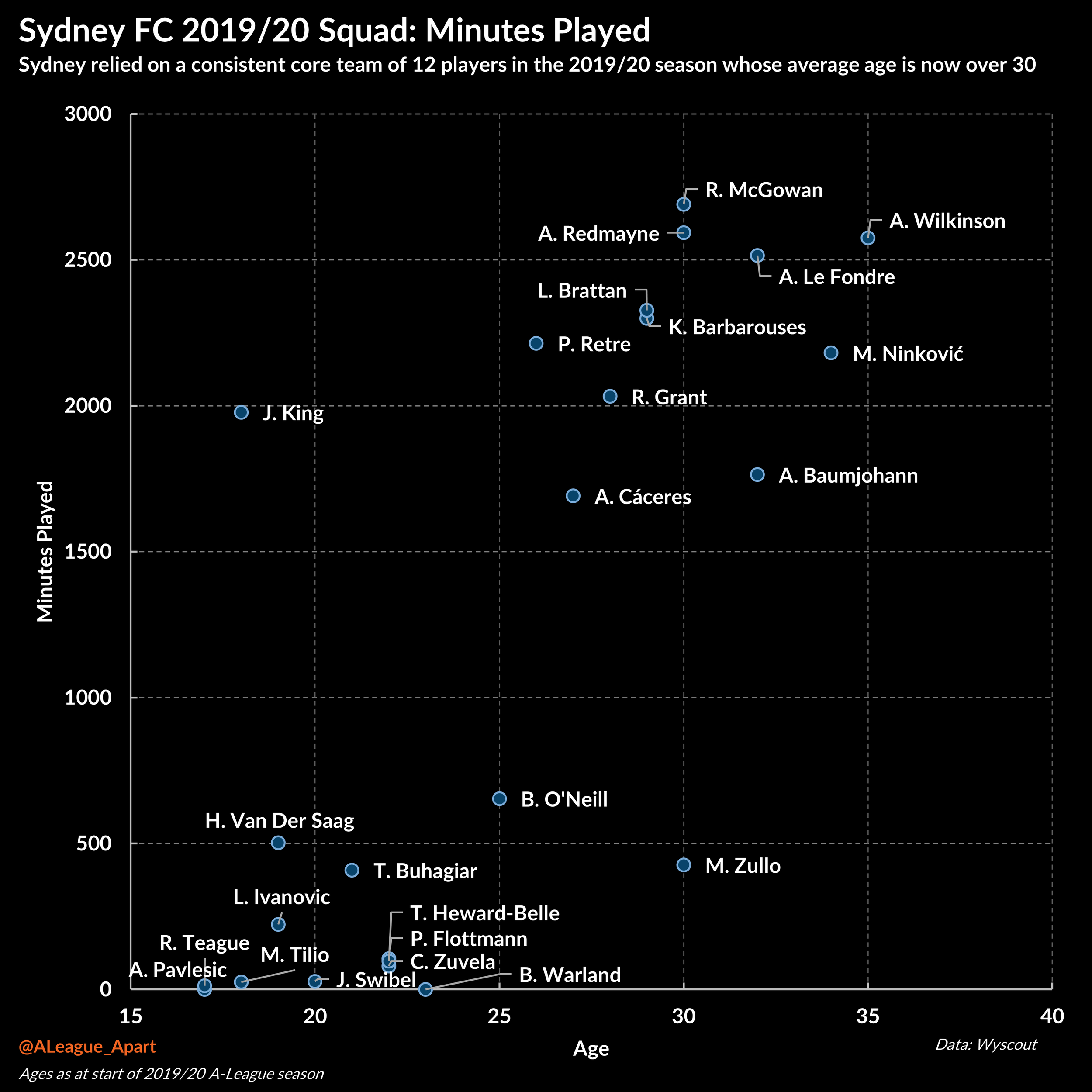
The main group of players who saw playing time had an average age of 29, while nine players aged 22 or below made appearances totalling less than 500 minutes. By adjusting for minutes played, it removes the distortion of these appearances by the younger players, and brings the average closer to the older players who played most of the minutes.
Adelaide United, on the other hand, are much more balanced in the distribution of their minutes, with most of the minutes going to a set of nine players with an average age of 24.
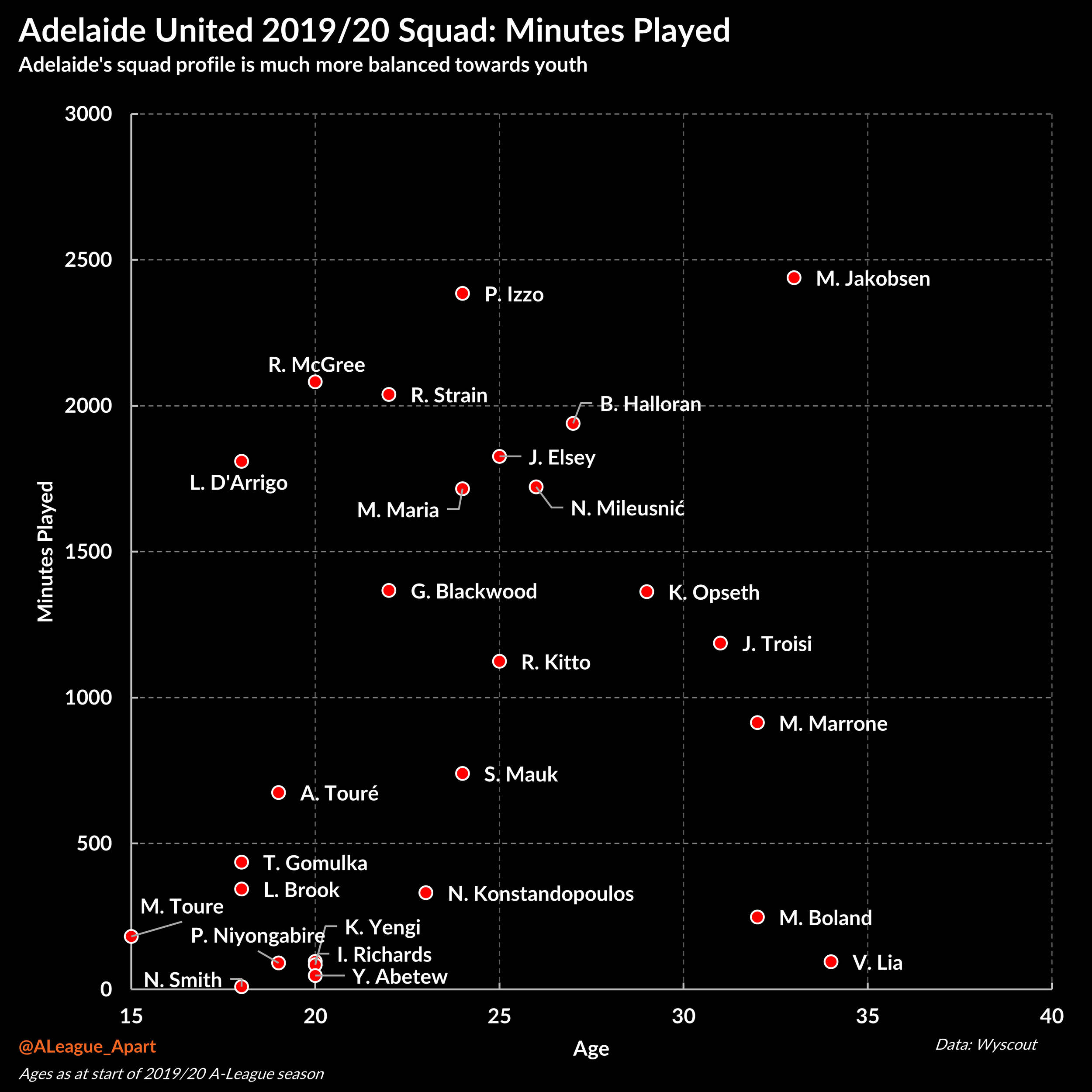
Adjusting for minutes played then means that there isn’t as large a correction as with Sydney.
Is anybody getting 2250 minutes?
Back to the FFA’s Report, which mentioned the 2250 minute benchmark that was a significant indicator of positive career progression.
The median number of minutes played by an A-League player with at least one appearance was 988 minutes – well short of the 2250 minute benchmark.
So is anybody in the A-League actually getting 2250+ minutes?
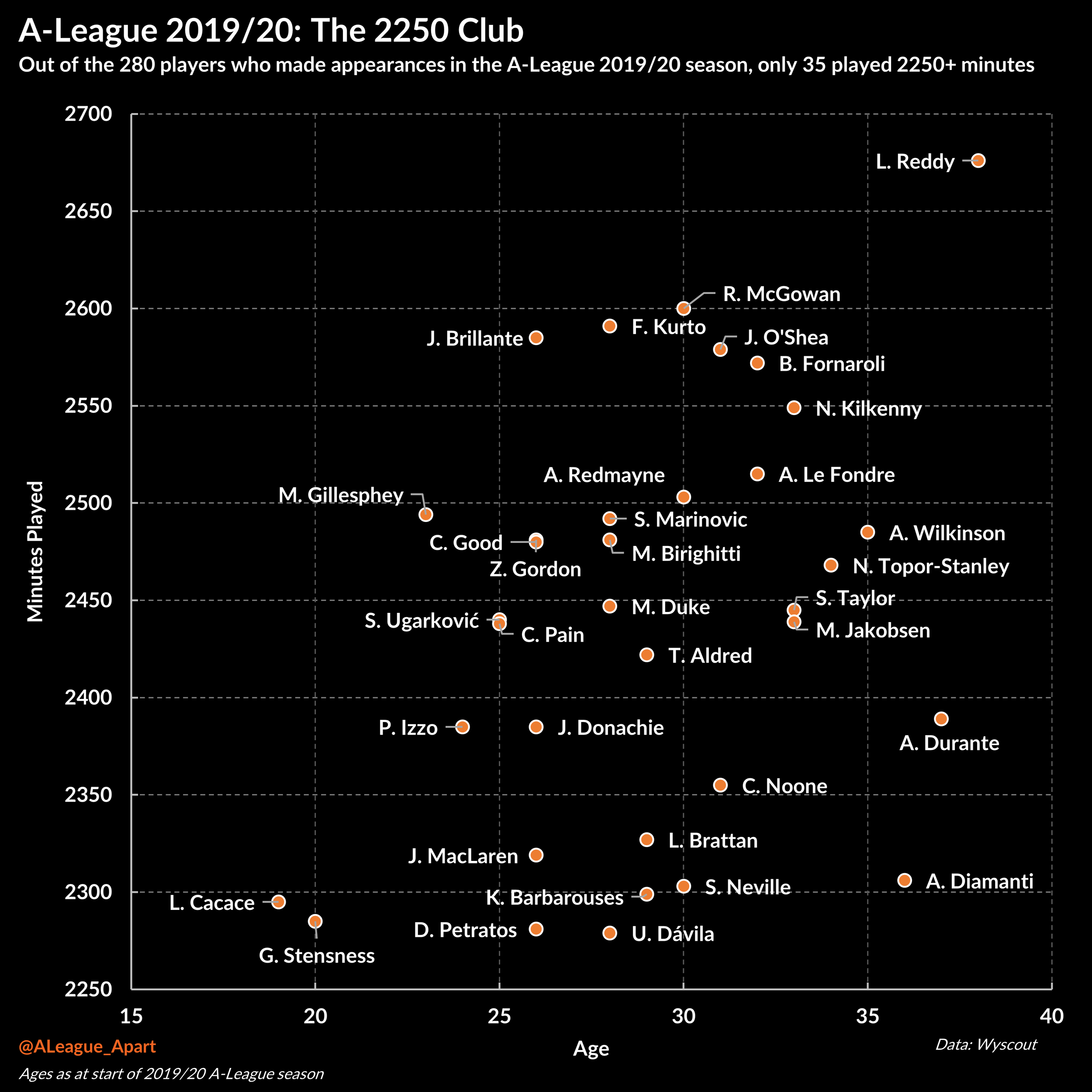
Out of the 280 players who made appearances in the 2019-20 season, only 35 players (or 12.5% of players) managed 2250 or more minutes, with the average age of these players being 29.
Of this, only three players (Libby Cacace, Gianni Stensness & Macaulay Gillesphey) were aged 23 or under, which is the development age Arnold refers to a few times in the piece, with only one of the three eligible to play for Australia (Stensness – although he’s been capped by New Zealand at U20 level).
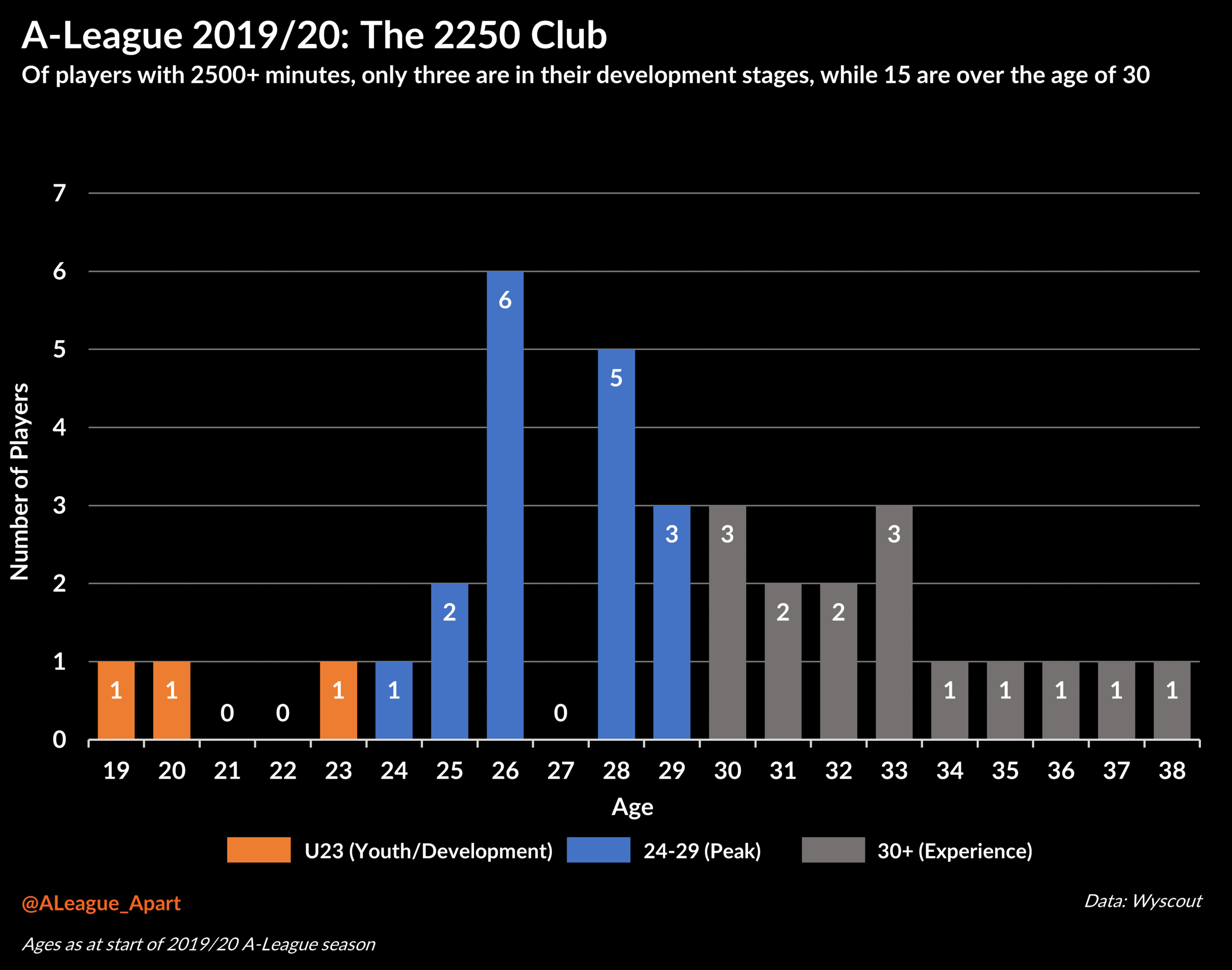
When moving up to 25 years of age, which is when players should be starting to enter their peak, there are only three more (all Aussies) – Paul Izzo, Connor Pain and Steven Ugarkovic. In the meantime, 15 of the 35 players are over the age of 30.
Represented in age distributions, we can see why the FFA might describe the A-League as an “Experienced Player” competition.
Well, it’s not all bad – when we reduce the number of minutes required to 1500, the number of U23s becomes 15, with all but three of them eligible to play for Australia.
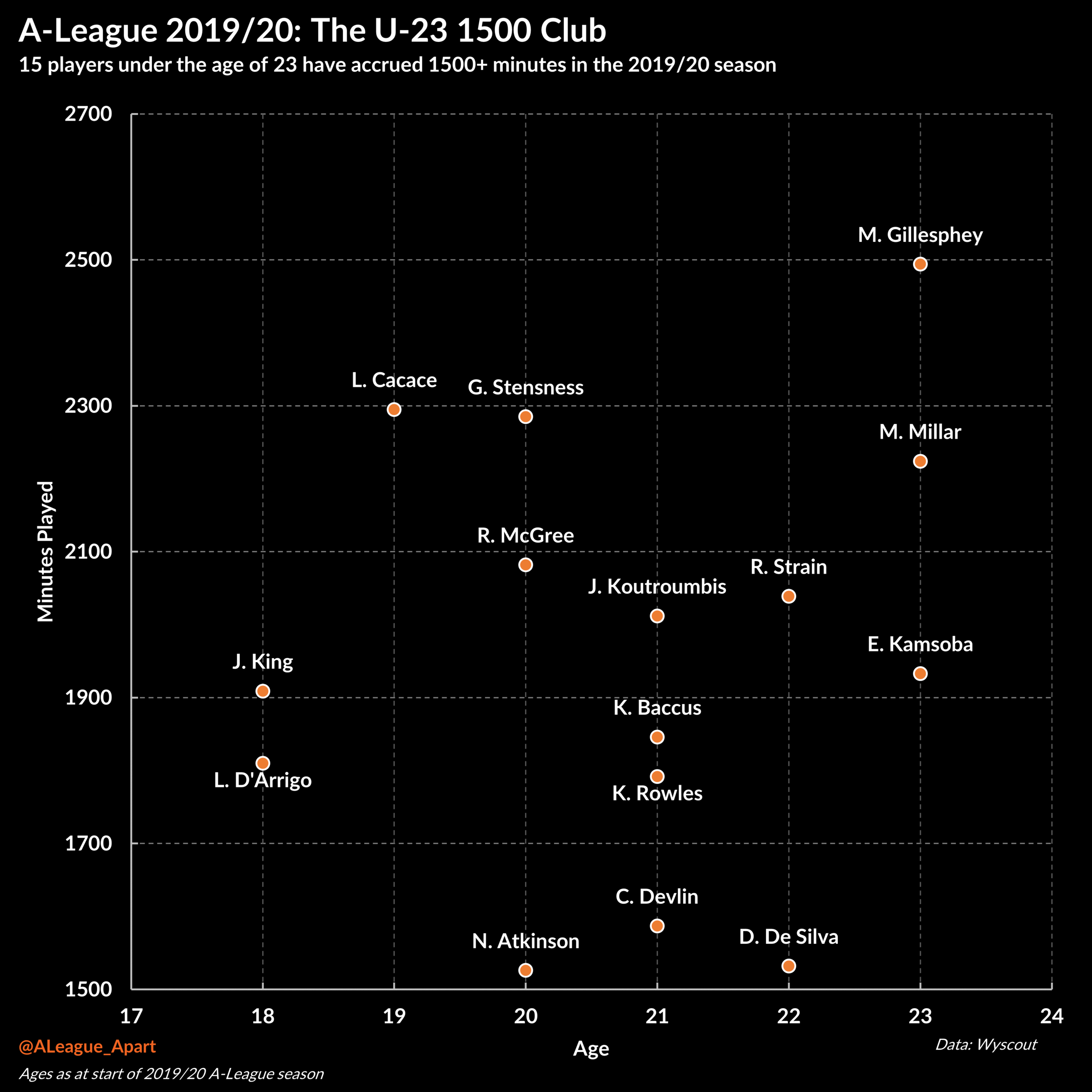
Hopefully the upcoming season will continue (and increase) this trend.
What conclusions can we draw from this?
Certain teams’ playing squads are not as young as their club’s average age. Plenty of teams appear to have a young average age, but this is partly due to the number of youth players who either don’t make an appearance, or don’t play significant minutes. Older players are the ones who are getting most of the game time.
While the youth/development players are in squads, they’re not getting much game time in the A-League, with hardly any development players getting more than the 2250 minutes benchmark. With only three players under the age of 23 getting 2250 minutes, it’s a sobering view of how much football is available to promising Australian development players.
As both the PFA and the FFA reports suggest, let’s hope that we can come together to make changes to create opportunities for Australia’s youth to flourish, be that in the A-League or in the NPL.
This article was originally published on The Reserve Team.