Grand Final Preview: Sydney FC vs Melbourne City
The longest A-League season will finally come to a close with Sunday's Grand Final, where Steve Corica’s first placed Sydney FC will take on Erick Mombaert’s second placed Melbourne City. Conveniently, it’s a rematch of the game that the two battled out at the beginning of the month. As a refresher, Melbourne City managed to defeat Sydney FC in their previous game, with two mistakes from the Sydney defence gifting City the two goals in a tight game.
Since then, both teams' form has been mixed. Sydney proceeded to draw games against Adelaide United and Brisbane Roar before losing to Western United, followed by their semi-final win against Perth Glory. Melbourne City drew against Adelaide United (collapsing after a 2-0 lead after Craig Noone got sent off to draw 2-2 in stoppage time) and then winning twice against Western United (one being the semi-final).
I don’t think we’ll see any big surprises in the starting lineups - both managers have spent their time tuning the lineups and it seems like their best lineups played in their respective semi-finals.
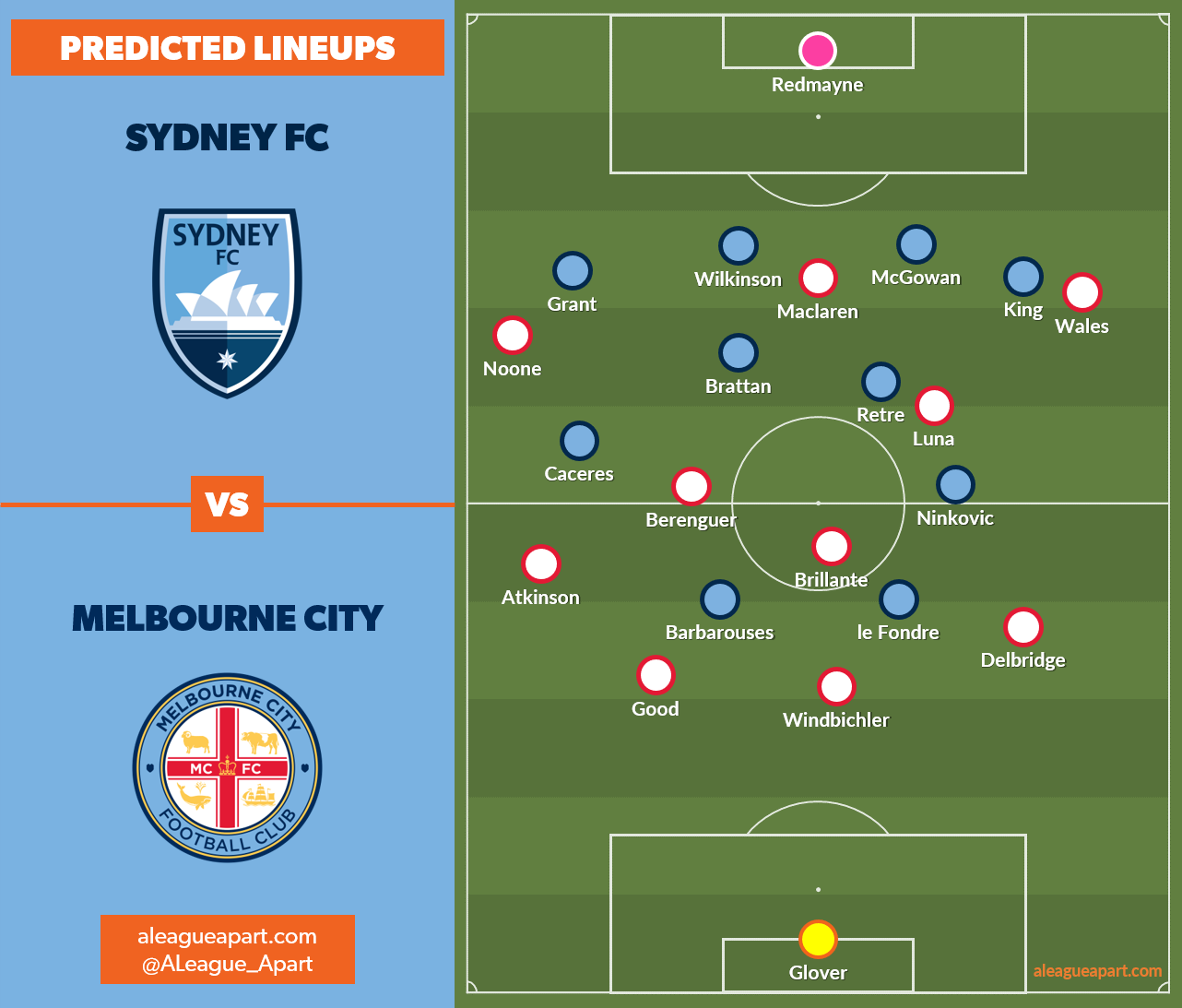
Sydney’s selection notes
Sydney’s lineup should be pretty straightforward. The spine of the team is made up of great partnerships - Adam Le Fondre and Kosta Barabarouses up front, Paulo Retre and Luke Brattan in midfield, and Alex Wilkinson, Ryan McGowan and Andrew Redmayne at the back. Also nailed on would be Milos Ninkovic on the left side of the midfield and Rhyan Grant at rightback. The two remaining places are the only other ones with a real likelihood of changing.
Even with Michael Zullo likely returning from injury, leftback is likely to be Joel King, who on the balance of this season is likely inching closer to becoming the undisputed first-choice leftback. The drawback is that he’s not as technically skilled and composed in the final third, but it seems that Sydney’s players have adapted to this.
The more interesting selection choice is on the right side of midfield. Anthony Caceres definitely put his case forward against Perth, combining very well with Brattan, Grant and Barbarouses on the right, while also industriously tracking back in defence.
Alexander Baumjohann has recently played more of the games at right midfield than Caceres, but this is partly due to players being shuffled around with Grant's injury. He's slightly less defensively switched on, but he provides a much more direct option in attack, skipping past defenders to progress the ball forwards and has a very handy ability to win fouls this way.
Melbourne City’s selection notes
Melbourne City's lineup should also be pretty straightforward - the lineup used against Western United in the semi-final seems to be their preferred options. Jamie Maclaren will likely start up front with Craig Noone and Lachlan Wales, while the three in midfield seem to be locked in as Florin Berenguer, Adrian Luna and Josh Brillante. Finally at the back, we're likely to see the (now) standard Nathaniel Atkinson at leftback (with Scott Jamieson now at home), Harrison Delbridge at rightback, and Curtis Good and Richard Windbichler at centreback in front of Tom Glover.
The only changes I can see happening are replacing Berenguer with Connor Metcalfe. Berenguer had a very quiet game against Western United, and was unable to really get on the ball effectively. Metcalfe replaced him, and he took up good positions, moved the ball quickly and was willing and energetic runner in midfield.
Scott Jamieson’s out
Scott Jamieson elected to return home following the birth of his first child, and his absence has meant that Nathaniel Atkinson has filled in at leftback instead.
Jamieson’s leftback role is an interesting one, as he has the skillset to stay wide and play as a traditional fullback, but also the skillset to come inside into the midfield and play as a central midfielder. In addition to keeping the opponents guessing, it does a few things:
Provides more passing options at the back - Brillante & Jamieson in midfield means they have options when building up from the back,
Vacating the flank means that the passing lane is left open for balls into Noone or Berenguer when he drifts wide
Creates passing triangles around/in between a 4-4-2 defensive shape
Able to help progress the ball, ping long diagonals into Wales
Atkinson is a good player, but he doesn’t have the same versatility. Specifically, he’s not as adventurous with his passing, and not as composed in possession. Against Western United, he didn’t have too much joy and when he received the ball he wasn’t too adventurous.
He is quite good at defending though, so it’s not like his selection at leftback is a bad choice. Besides, he’ll have his hands full...
Rhyan Grant’s in
Rhyan Grant’s return from injury has meant that they have more thrust and attack on the right hand side than their last encounter. In their previous matchup they struggled, with Paulo Retre (the rightback on the day) getting into decent positions, but not confidently able to cross the ball or drive with the ball into dangerous situations when he received the ball on the right. Grant’s played two games since then and already the right flank looks so much more dangerous, with the pass and move combinations providing a direct attacking option down the right. He combined well with Baumjohann against Western United, and Wednesday’s semi-final against Perth saw him link up well with Caceres.
It was notable how willing he was to provide that direct attacking thrust towards the end of the game against Perth. With Sydney leading 2-0 in the 92nd and 94th minutes the chance opened up twice for a counter and on both occasions Grant immediately started sprinting up out of defence to expose the undermanned Perth defence. He didn’t end up getting the ball on either occasion, but it really highlights the kind of attacking industry that Grant provides from rightback.
Sydney’s approach
From Sydney, I think we’re likely to see an approach similar to how they played in the second half of their previous game against Melbourne City. In the first half of that game, they struggled to deal with City’s press and build up play effectively, but in the second half they managed to turn it around.
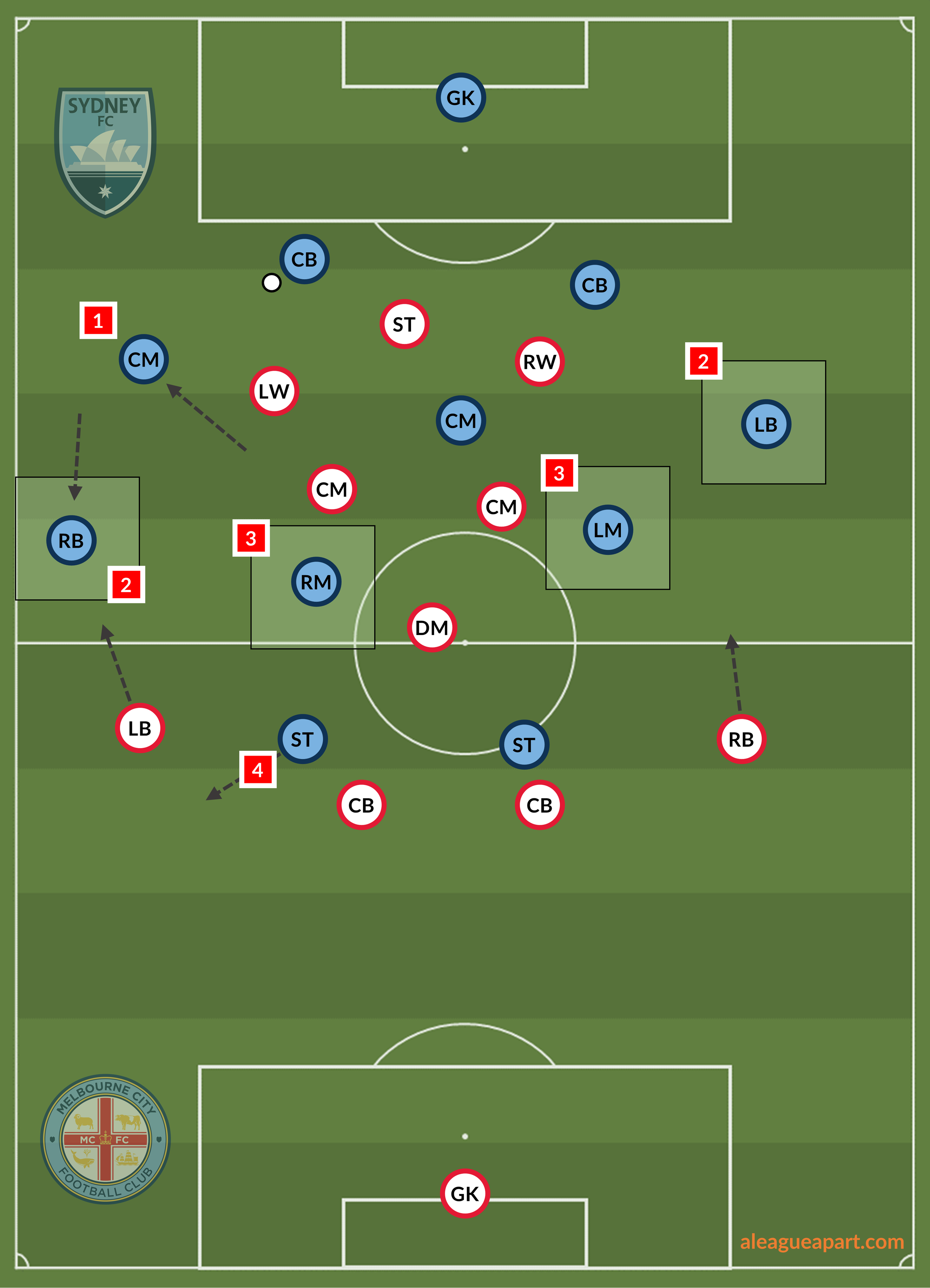
Their structure involved four main points:
The central midfielders dropped into the defensive line to help retain possession by providing a passing option when building out from the back
The fullbacks pushed up higher, providing an easy out ball to evade the press. The City fullbacks would have to come out of defence to close them down.
The attacking midfielders positioned themselves narrower to open space up for the fullbacks. Their positioning meant that they could be found by their teammates easily once they bypassed the press, and by being in closer proximity to each other, they could combine with each other easier.
These movements opened up space for the strikers to use, with the fullbacks being drawn forward.
Sydney always prefer focusing down the right hand side, with the combination of Brattan, Grant, Baumjohann/Caceres and Barbarouses being a very deadly combination. Here’s an example of a great piece of play down the right from the semi-final vs Perth.
This makes the flank a very interesting battle - Noone will have to track back to help prevent the overload, while Atkinson will need support from both the left-centreback and someone from the midfield.
Melbourne City’s approach: Midfield
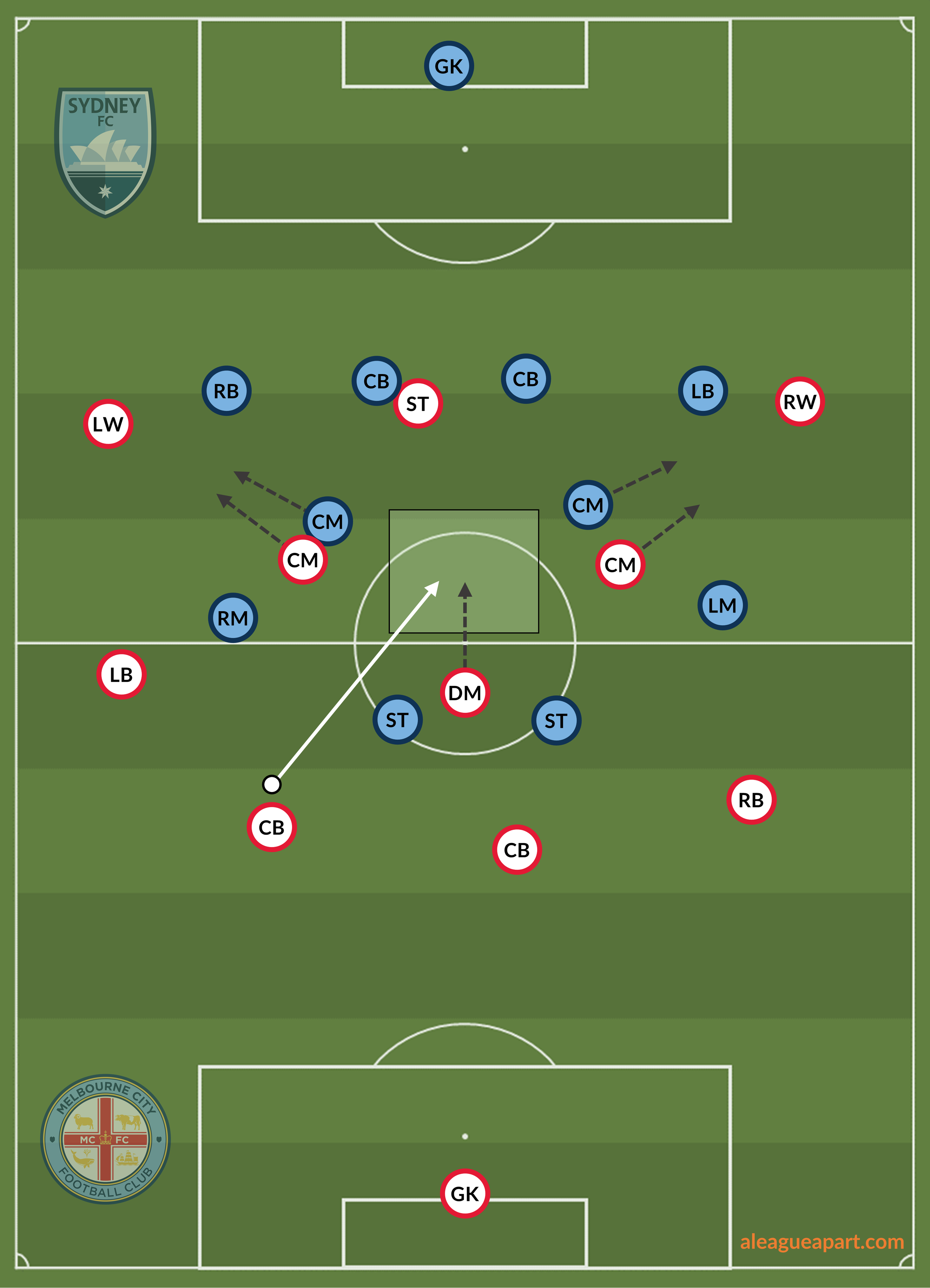
One of the biggest keys for Melbourne City in their buildup is the two central midfielders.
In buildup, while they start centrally and help to bring the ball out of defence, their primary danger is the movements that they make, away from the centre of the pitch into wider positions. When their movements don’t allow them to shift the defense around, they will also start to introduce rotations, alternating as one will drop and the other will push forward, with Brillante offsetting these movements and hoping to free up their teammates. Their movements take them to areas not usually expected from a central midfielder, which often can cause chaos for a defensive marking scheme - especially when it’s more zonally oriented.
These movements also open the door for rotations between positions. As the midfielder drifts wide and the winger comes in side, which player should cover which?
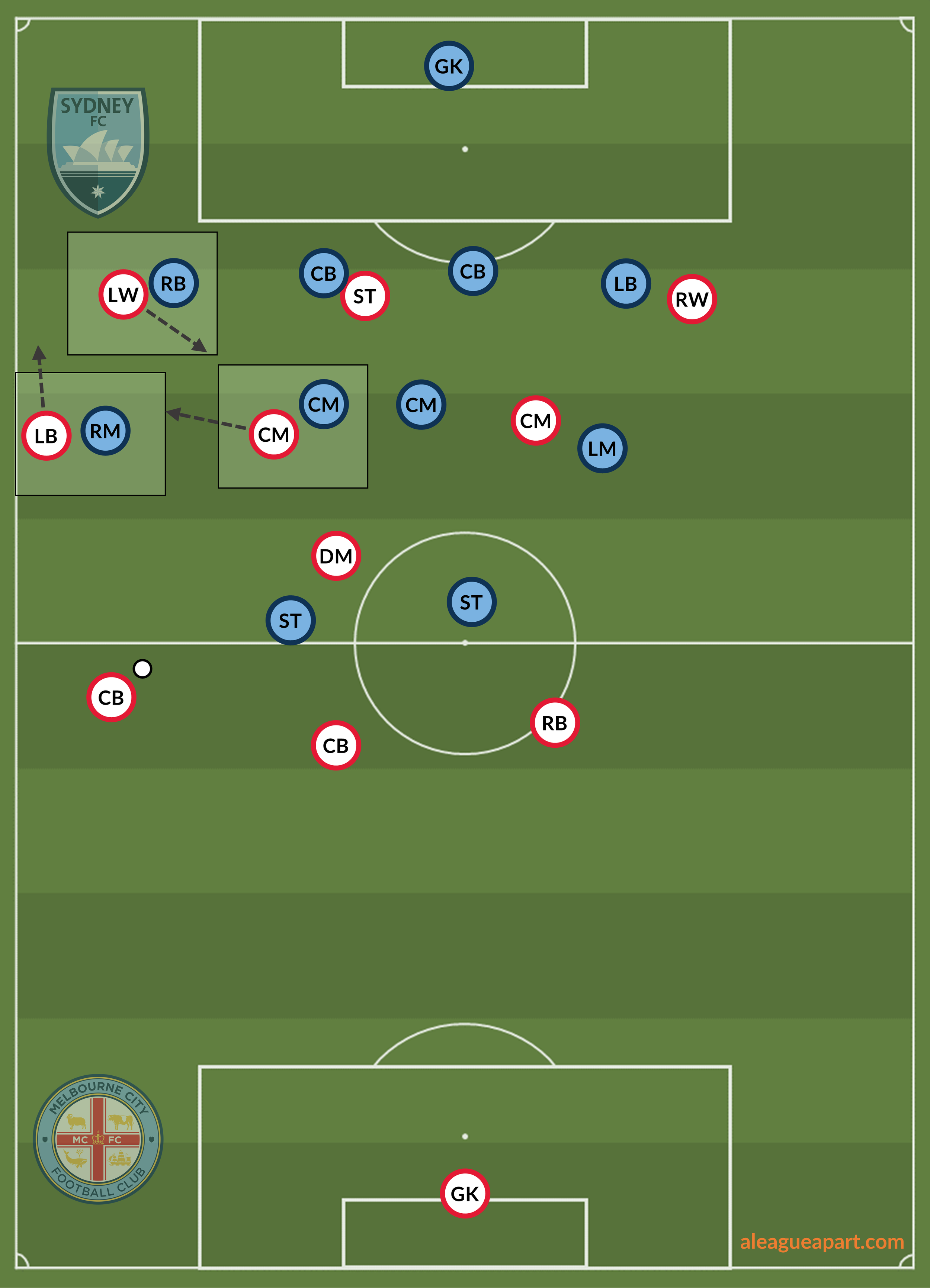
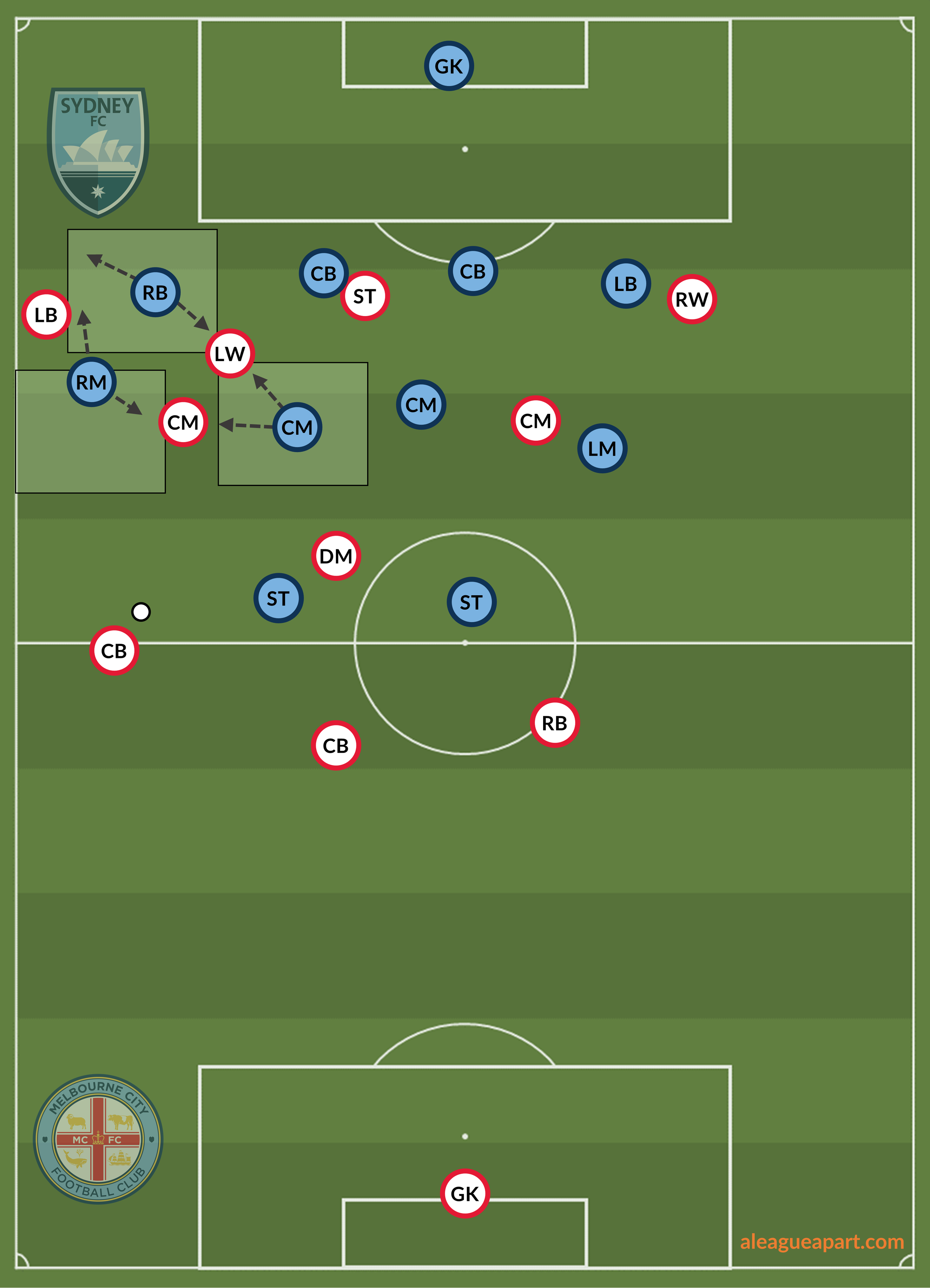
Western United actually coped extremely well with this. They were man-oriented with Luna marked by Pasquali and Berenguer marked by Lustica, following them across the pitch when they went wide or forward, but also passing them off well between them when they swapped zones. For example, as Berenguer drops into the ‘6’ position, rotating with Brillante, Lustica hands Berenguer to Berisha and picks up Brillante. Further forward, Luna pushes forward to counterbalance. Pasquali tracks him and then passes him off to the centrebacks when he gets too far forward, and then positions himself in the midfield zone, ready to deal with the second ball.
Because of their tight marshalling of the midfielders, City found it tough to play through the middle for the entire game, and ended up building up using the wide players or playing the ball long. It actually took until the 63rd minute for them to fashion a shot out of a build-up that came from the centre, and that was from a situation that both midfielders had pushed up, allowing Brillante to step into a now-vacant midfield.
While this ultimately didn’t work for Western United (they lost 2-0 from goal from a penalty and a corner), it showed what can happen when the midfielders are not given the opportunity to roam freely. I’m not sure if Sydney are particularly equipped to mirror this though - their preference still remains to defend with two banks of four behind the front two, which means that there’s ample opportunity for City’s midfielders to find spaces in between the lines through rotations and movements.
The alternative is direct play into Wales, who will be looking to stretch the play wide, and also in behind. He won’t contribute as much to the buildup, and instead will always be ready for a switch of play from left to right or a direct ball over the top, and it will be interesting to see his contest against the leftback. While he lacks support from a rightback with Delbridge usually sitting further back, support will generally come from the energetic Luna, who loves to get forward centrally and out wide on the right, almost as a supplementary winger. Dealing with these bursts forward will likely form the responsibility of either Ninkovic or Retre - but if it’s the latter, there’s the opportunity for overloads in the centre.
Barbarouses and Le Fondre partnership
I see a lot about how Barbarouses should be dropped, but I think a lot of the criticism misses the point. While he may not score as much as people would like, the reason for his continual selection is his ability to play his role in the setup perfectly.
Fantastic partnership and great chemistry with Adam Le Fondre. Throughout the pitch their movements are in sync: if one drops deep, the other will push forward; if one attacks the near post, the other will drop off to the penalty spot or hit the far post. As one opens up space, the other will be looking to take advantage.
Technical quality in tight spaces. Countless times Barbarouses and Le Fondre will manage to engineer shooting opportunities from nothing by simply passing the ball between themselves with 1-2s.
Running the channels quite selflessly to help his side progress the ball. His experience playing as a winger comes in hand here and he can get himself free well to combine and cross the ball.
Links play with the midfield well, able to quickly dart into space in between the lines to layoff the ball, helping his team progress the ball forwards.
Pressing well. While Le Fondre is usually the one who triggers the press, Barbarouses is always a willing runner whose pace allows him to quickly complement Le Fondre’s press. Taking the goal that Le Fondre scored by pressing Liam Reddy as an example, Barbarouses helps to create the opportunity by sprinting forwards to help Le Fondre. He sees Reddy looking to pass to Osama Malik and quickly cuts out the option forcing him to take a touch instead and allowing Le Fondre to close the gap to score.
He has a good defensive workrate, frequently coming back to help defend central positions
High acceleration, allowing him to stretch the play by threatening runs in behind and into the channels
It’s also worth noting that he’s got 6 assists (only one less than a certain Alessandro Diamanti) and 7 goals (again one less than Diamanti!), while his total expected assists and expected goals lands him at 5th in the A-League.
The alternate options are not as well-rounded as Barbarouses - Buhagiar’s main strength remains his pace on the counter, while Ivanovic is better playing in the midfielder slot as he has technical quality but doesn’t stretch the play as well as Barbarouses.
Summary
We’re poised for another cracker of a grand final, with the season's two best teams in the league battling it out. Two contrasting styles of play will battle it out, with Sydney's style of play focused on keeping it tight at the back and then penetrating with rapid, coordinated patterns, while City's style of play is more expansive, aggressive and attacking Neither side should spring any tactical surprises on Sunday; instead it'll be whoever can impose their style of play on the opposition more. Can both sides learn from the game they played at the beginning of the month? Both teams have a goal in them, and we'll see a fantastic game of football on Sunday.
PS. I played around with a few bits of data the last time the two sides met!