Western Sydney Wanderers’ Tactics under Jean-Paul de Marigny
Western Sydney Wanderers and Markus Babbel struggled in the 2019-20 season, and by the close of Round 15 Babbel was sacked, with his assistant Jean-Paul de Marigny taking charge. Since then, their form has improved, with 3 wins, 3 draws and 1 loss. This article takes a closer look at the playing style of Western Sydney Wanderers under Jean-Paul de Marigny.
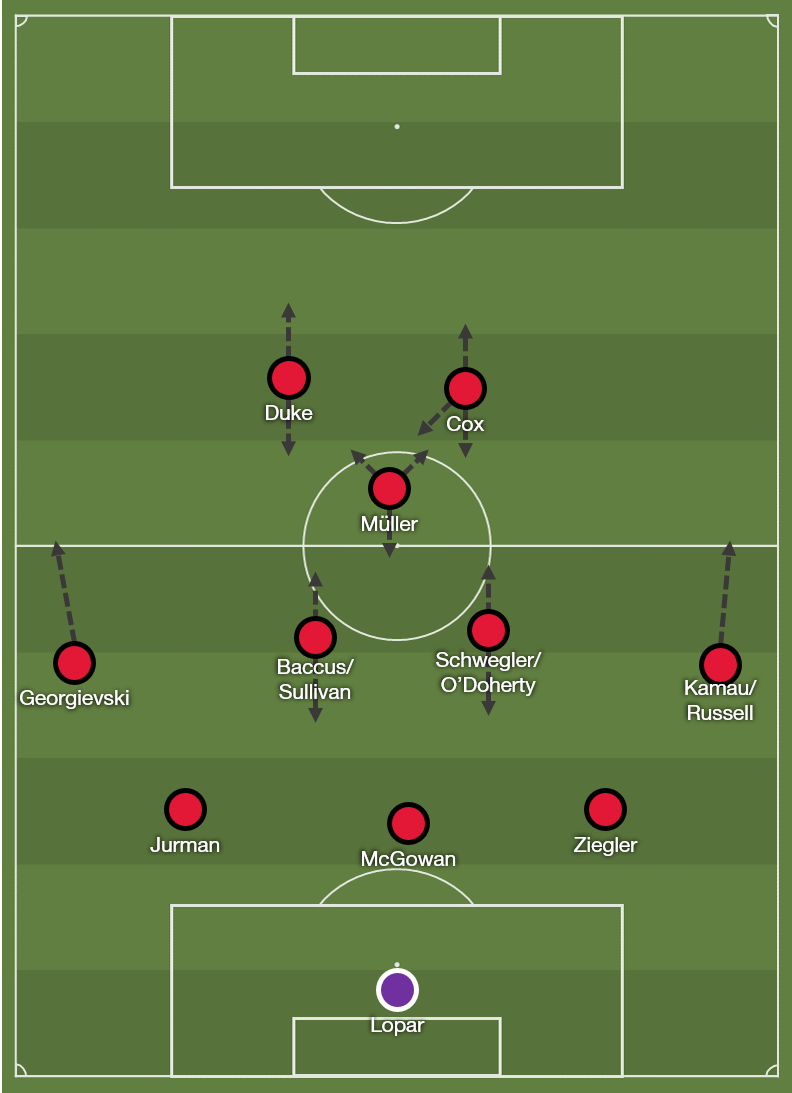
New manager, same ideas?
The most obvious change that JP has implemented is a switch in formation from a 4-2-3-1 to a defensive and counterattacking 3-4-1-2. Where possible, he's been quite consistent with his lineups, with a few rotations (some which were forced) in midfield and with his wingbacks.
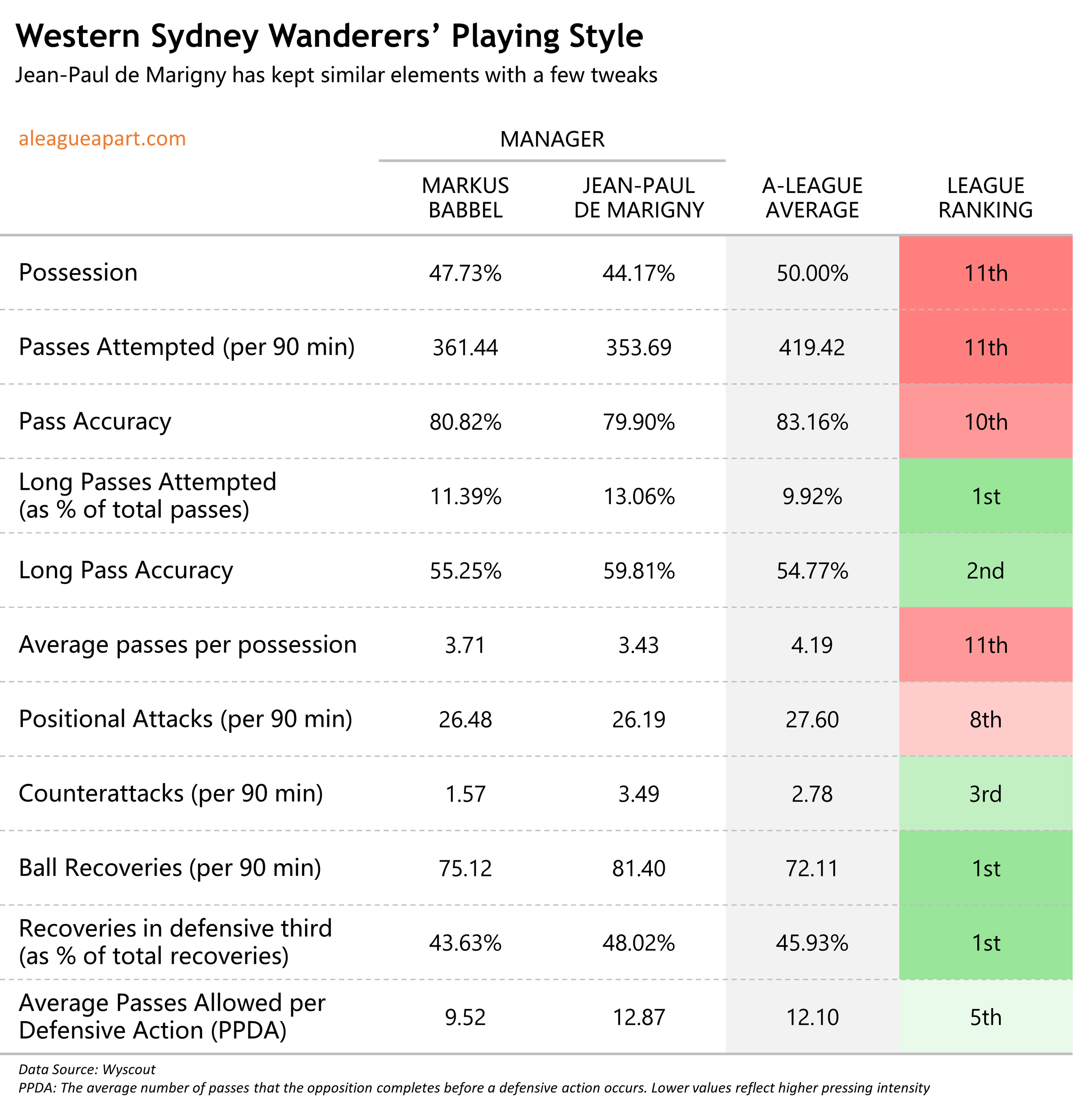
That's not to say that there's been a huge change in playing style - actually, they've been pretty consistent with their previous ideas, and in some cases taken them further, while changing other aspects of their game. Under de Marigny, they’ve conceded more possession and relied on more on a passive defence, and slightly tweaked, their short vs long passing mix. They’ve also increased the directness of their attacks and started using more counterattacks.
Defence
Because of their tendency to cede possession to their opponents (44% average possession over the past 7 matches), it makes sense to start with the Wanderers’ defence.
Defending from the front - blocking passing lanes
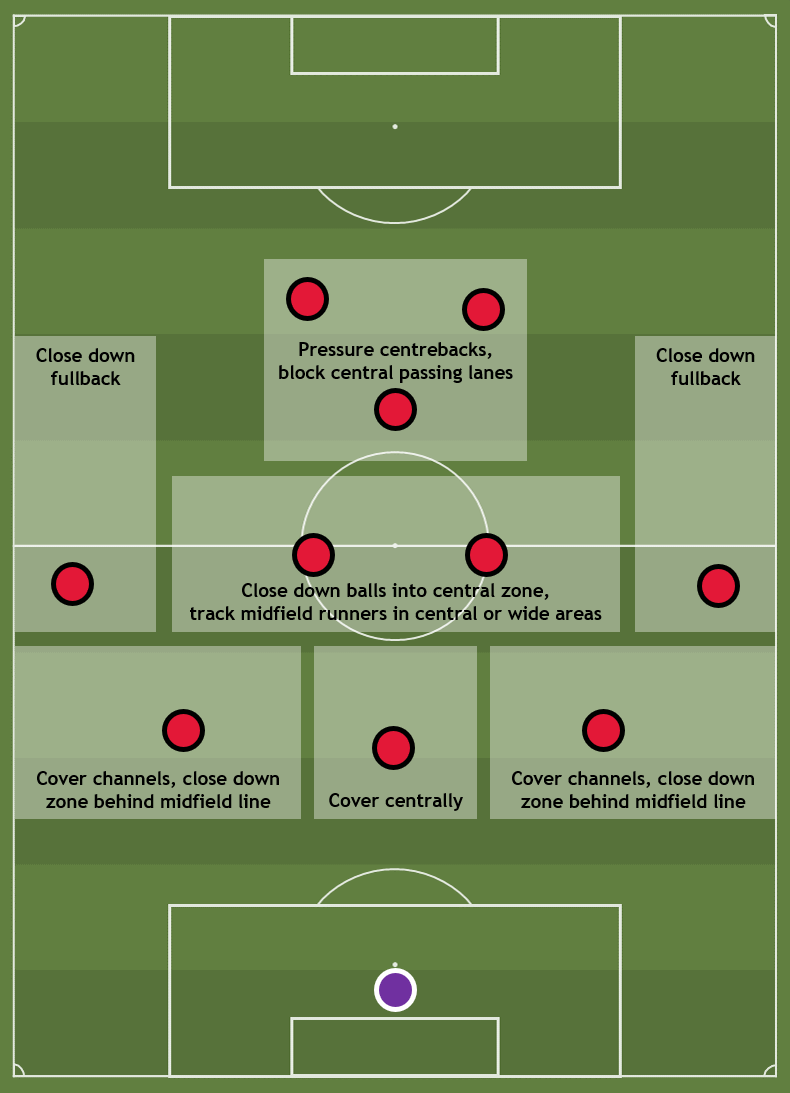
The three forwards don’t necessarily press high, but keep a tight block in the centre of the pitch, aiming to direct play wide rather than through the middle. The player who finds themselves in the attacking midfielder position will usually cover the deepest midfielder to make it difficult to progress the ball through the centre, while the two forwards will close down the centrebacks - not necessarily to win the ball back directly, but rather to pressure them and force them to move the ball quicker and potentially causing errors.
In certain games, they may flip the first defensive shape to a 2-1, with only one player pressing the back line, and two slotting into the midfield. They did this against Sydney in Round 19, which made it difficult to find Sydney's midfielders and attacking midfielders in the centre of the pitch.
Because the front three are fairly narrow, when the ball gets shifted over wide the responsibility falls to the wingbacks. The wingbacks generally have a lower starting position, but will come forward as the ball is being shifted over to their side. They don’t press aggressively, but will close down quickly, and when the ball is played away from their flank, they will drop back into the defensive line.
Midfield zones - covering and tracking runners
The two central midfielders generally do not follow the press initiated by the forwards. They cover the zones in the middle of the pitch, tracking players as they enter these zones and protecting space in front of the back line. Here they close down opponents aggressively, and prevent players from receiving in space and turning on the ball.
They also track midfield runners into wider areas, helping their wingbacks deal with wide overlaps. The midfielders are mobile, but Schwegler prefers to play positionally/zonally, and can struggle with tracking runs from midfielders. When one midfielder is dragged wide, the other midfield will come over accordingly, covering the centre of the pitch. However, with only two players tasked with covering the whole midfield across the entire width of the pitch, the areas in front of the defensive line can be overloaded by their opponents, especially by dragging them wide, and then attacking the space created centrally.
Centrebacks - Closing down aggressively
With space able to be created in front of the defensive line, the centrebacks are proactive and aggressive with their positioning. When the ball is played beyond the midfield, the centrebacks are ready to jump out to challenge, either winning the ball, making it difficult for the player receiving the ball to turn, or closing down if the player manages to turn and drive. The outside centrebacks also have a more active role in the defence, as they also have a role of covering runs into the channels, especially when the wingbacks have pushed high up the pitch.
All three centrebacks are good at pushing forward to defend, although Jurman is the standout. He's often the most aggressive with his positioning and his challenges, which reflects on the stats. Often he’s the furthest forward of the three centrebacks, acting as a stopper in front of the other two, who shift over slightly in response to his positioning. McGowan mainly acts as a covering centreback, staying central and in the defensive line where possible, covering based on the defenders’ positions and sweeping up behind them.
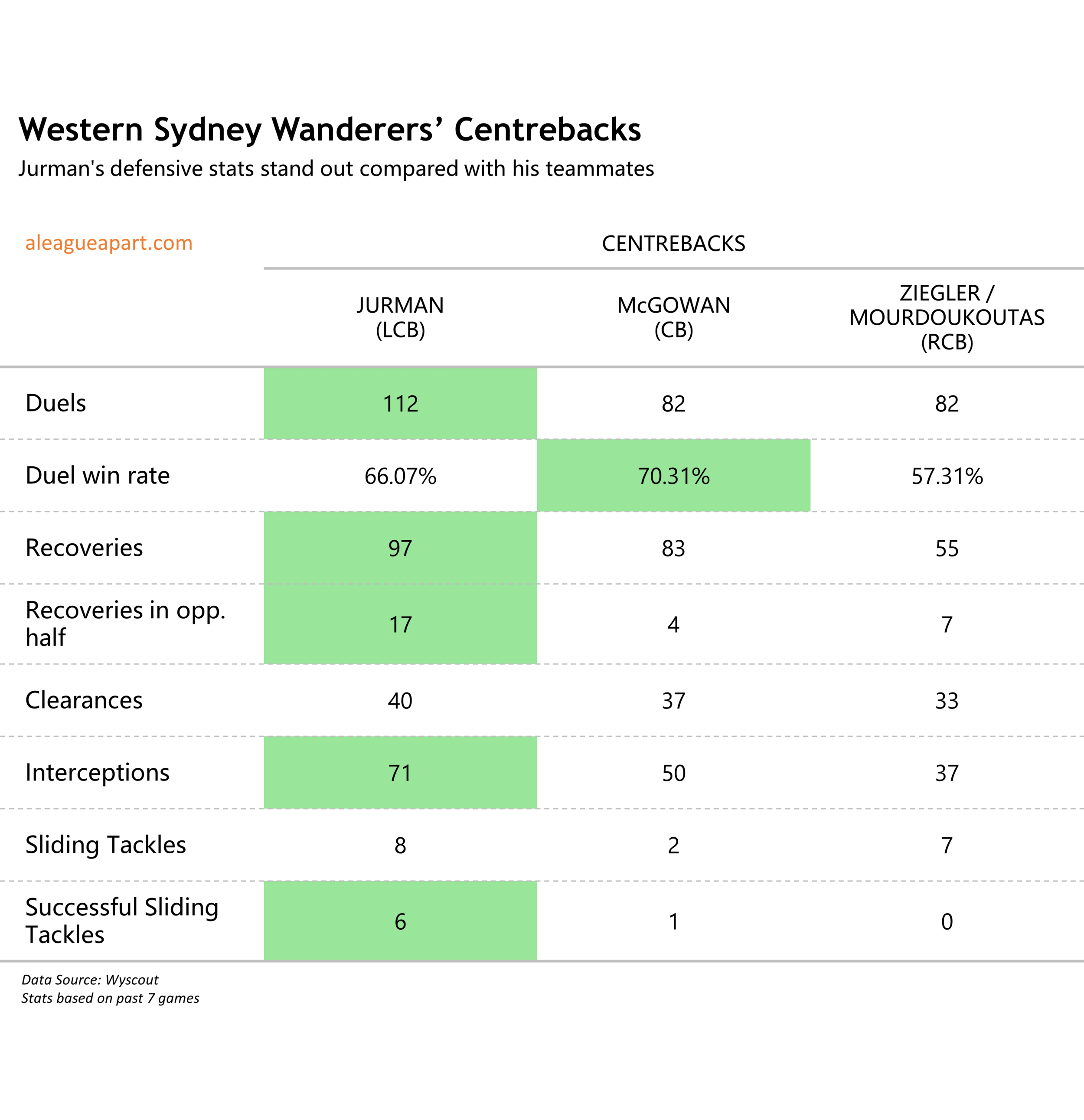
The centrebacks can be exploited by opponents by isolating them 1v1 - if the centreback who comes out of the defence is beaten, then the opposition is able to run directly into space or at the defensive line. Jurman with his aggressive positioning can be pulled out of the backline, leaving the other centrebacks to have to deal with the direct threat.
Driving directly at the defensive line can also be dangerous, especially when a striker pins the centrebacks by making a run, making it difficult for them to jump forward to close the player without opening up space for a run from the striker. This happened against Melbourne City, where Atkinson was able to shoot unopposed, which eventually resulted in a penalty being conceded:
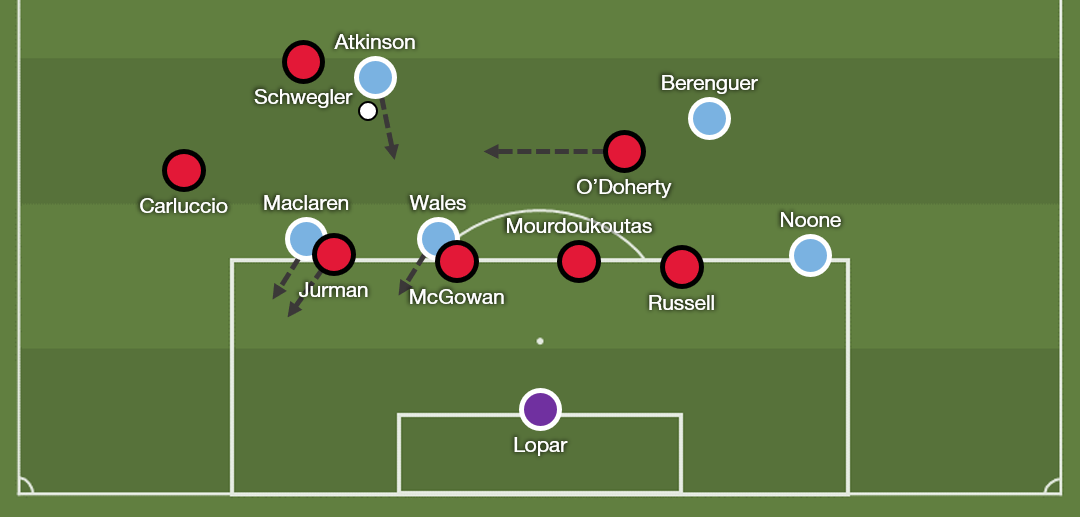
Towards the final stages of opposition attacks, the Wanderers structure is very compact with the three tall central defenders packing the box and the midfielders tracking opposing players’ runs into the box. Lopar is good in crossing situations, able to come off his line quickly to claim crosses.
In order to reduce the amount of space the opposition has on the edge of the box, it’s important that the forwards come back to support the defence, covering space both centrally (in front of the penalty area) and slightly wider (helping with wide overloads from fullbacks coming up). The forwards all generally have good defensive workrates and generally at least two will come back to help, but they can be slow to get back, especially after they’ve committed themselves forwards.
Defensive transitions
In defensive transitions, most of the time the Wanderers find themselves still in a decent shape, as they usually have their defensive midifielders in good spaces to counterpress, as well as having three centrebacks behind the ball. With the defensive line lacking somewhat in pace, they can still struggle against direct balls in behind or through direct dribbling. As such, one of the keys to their play in the defensive transition is the aggression again - either winning the ball to quickly stamp out any threat, or committing tactical fouls. Indeed, they have the highest fouls per 90 min stat in the league.
The wingbacks generally find themselves high up the pitch on offence, and as a result, can be slow in returning back into defence, and again, the forwards can be slow to get back to help.
Attacking Transition
Because of their tendency to be defending, and also because their forwards track back quite a lot, the attacking transition becomes a key for the Wanderers’ attacking gameplan. Either through being instructed not to track back or just being slow to return to defence, often at least one forward is lurking slightly higher up the pitch and so upon winning the ball, the goal is to play the ball forwards quickly, with the other forwards and wingbacks rushing up the pitch in support. The kind of ball that is played into the forward depends on who is the receiver - Duke is like a battering ram in the air while Cox is also good in the air so an aerial ball can be played directly to them, while Muller is better receiving the ball to feet.
Since the rest of the team is usually further back defending, the three forwards can often find themselves isolated from the rest of the team, and at times, it can look like two separate units - seven players defending and three players attacking. In order to keep possession from direct balls, the forwards must be able to find each other in support, and they generally have a good understanding with each other, combining well with interplay - receiving the ball, laying it off, and making supporting runs.
Attacking in Possession
At goal kicks, the Wanderers have three options
Play short to the centrebacks. The centrebacks will circulate the ball between them, hoping to create passing angles centrally or distributing to the wingbacks. If the opposition sets up a high press, they will not play goal kicks short.
Medium length to the wingbacks. If the opposition presses high, the wingbacks will push up to midfield, often unmarked at goal kicks. Georgievski is better in the air, but Russell can also challenge - if he is able to bring the ball down, he provides a quick and direct attacking option.
Long balls to the forwards. Duke is the main target here, but Cox is also good in the air. Aerial balls will be played slightly wider than central, allowing the wingbacks, midfielders and other forwards to challenge for second balls.
The preference is to play the ball shorter. The three centrebacks will look to play simple passes, finding the midfielders or forwards if the passing lanes are free in the centre, and if not, they will cycle the ball to the wingbacks on the flanks. From here, the defensive coverage must shift over, and often the angles are left open for the wingbacks to play the ball into the centre, or play one-twos to advance. If the midfielders are able to get on the ball in space, they can play good penetrating passes direct, it cycle the ball out wide. They can also pop up on the flanks to help release the wingbacks in behind through overloads and one-two combinations.
The aim is to find one of the forwards dropping into space in between the lines, with all three comfortable dropping in to receive. From here, the ball is either switched to the opposite flank, or the forwards will combine quickly to break through the defence. Muller is the most dangerous on the ball and when receiving the ball in space, dribbles directly from deep and plays penetrating passes through the defence.
While they can sometimes manage to work the ball forwards quickly to attack, their attacks will often make use of the wingbacks. One of Duke’s signature moves is to receive the ball, take a touch backwards into space, before switching the play using a long ball out to the opposite flank into the wingback, and then turning to head into the box for the cross. The wingbacks then drive into spaces on the flanks and look to cross the ball.
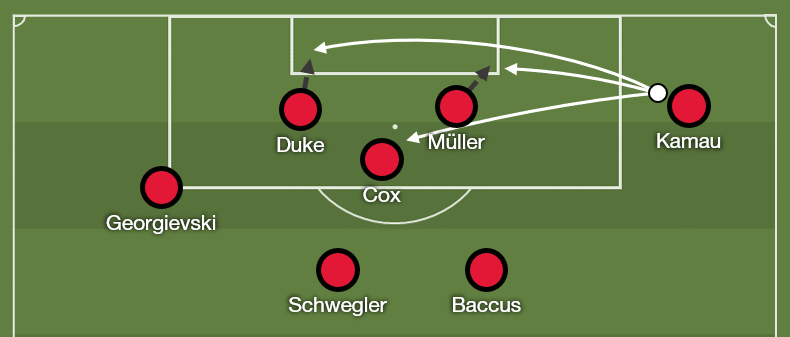
Wanderers attack the box with the three forwards, with the wingbacks supplementing from wide. While they attack with five players, it’s a different set up to Brisbane Roar’s, mainly due to the rapid and more direct nature of their attacks - they get forward from deep, rather than contributing to attacks from the front line. The wingbacks will generally perch on the opposite edge of the box, ready for missed crosses or clearances. The midfielders are prepared around the edge of the box, ready for deflections or clearances, and also providing an option to circulate the ball to the opposite flank. With strong aerial options and targets in the box, partly due to the shift in formation to have 3 attackers, the Wanderers have options for crossing, and they make use of it. Their crossing accuracy is the highest in the A-League this season (37.89% under JP vs 33.03% A-League average).
Western Sydney Wanderers’ Key Principles
Defence
Protect the centre - block passing lanes and do not allow players to receive and turn with the ball in the middle
Aggression through closing down and defensive challenges
Defend deep with numbers - forwards come back to help
Pack the penalty area and dominate the box
Attack
Transition quickly to forwards who attack in a group of 3
Combination play in the centre to retain possession/penetrate
Switch the play to allow wingbacks to attack space wide
Attack the box with crosses