Scouting Report: Robbie Fowler's Tactics in Brisbane Roar's Revival
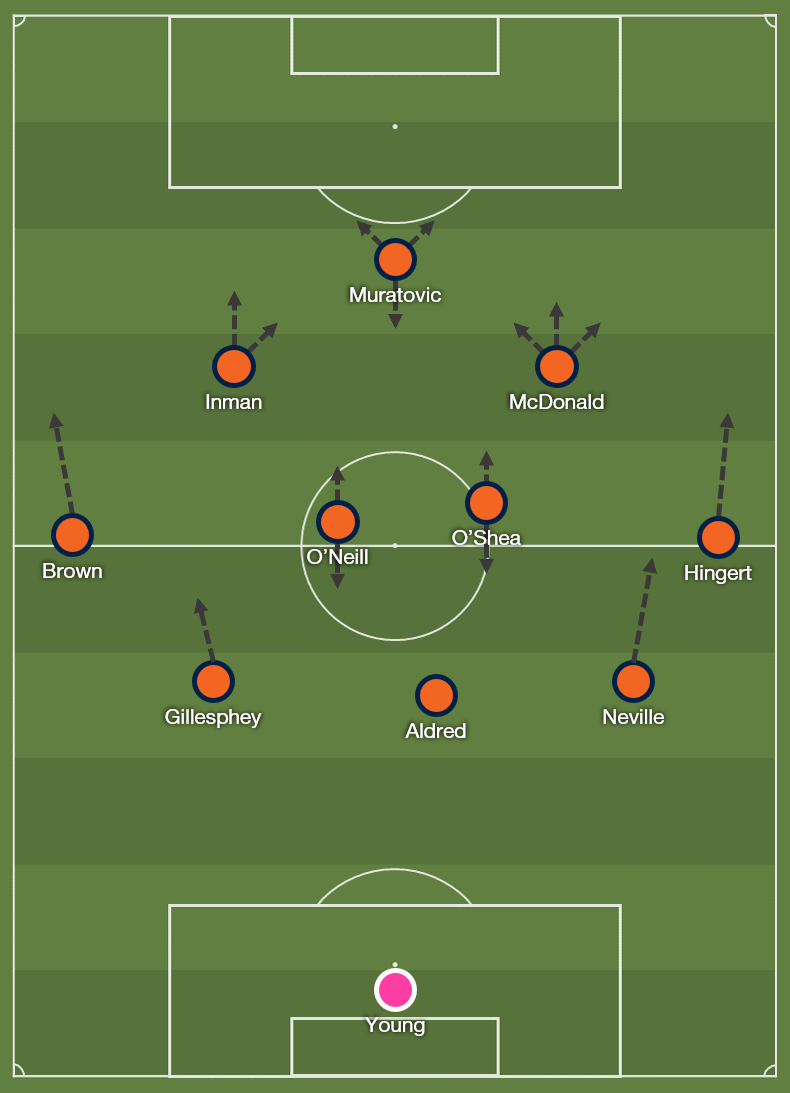
Brisbane Roar have had a season of two halves in the A-League, having started slowly with a poor run of results, but turning around their results to find themselves in finals contention in 4th place. This article looks at Brisbane’s tactics and style of play since mid-January.
Brisbane’s attacking style
Robbie Fowler has Brisbane Roar playing with a patient, possession focused style, looking to work the ball methodically into dangerous situations, but notably not playing risky passes. Instead, when an opportunity does not present itself, Brisbane will patiently circulate the ball back around to the other side, or wait for an opportunity to develop through overlaps or clever movement. This reflects itself in the stats:
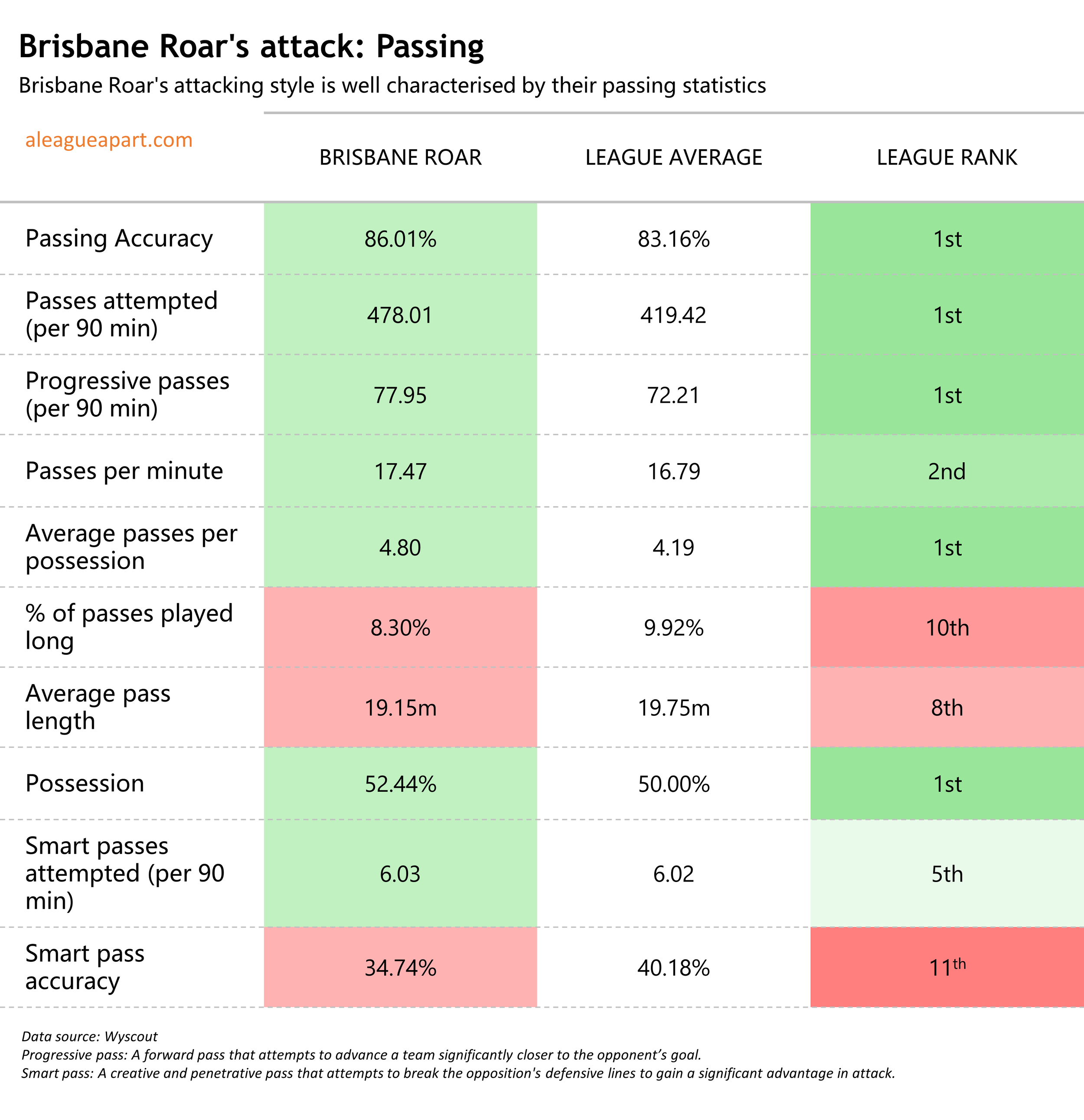
Brisbane dominate all the passing related stats in the league, except average pass length and % of passes played long (meaning they like to play short passes), and smart passes (meaning they don’t like to play risky, clever balls).
Five attacking players across the front
In recent games, Brisbane have lined up in a formation that is notated as a variant of 3-4-2-1 or 5-4-1, which can at first glance seem very defensive with only one striker in the formation. This hasn’t been the case though - in attack Brisbane brings plenty of players forward to join the attack, with the two attacking midfielders (Brad Inman and Scott McDonald) joining the attack in the half-spaces, and the wingbacks (Corey Brown and Jack Hingert). With the four players joining the striker, Brisbane essentially attack with five players across the front in a 3-2-5 structure.
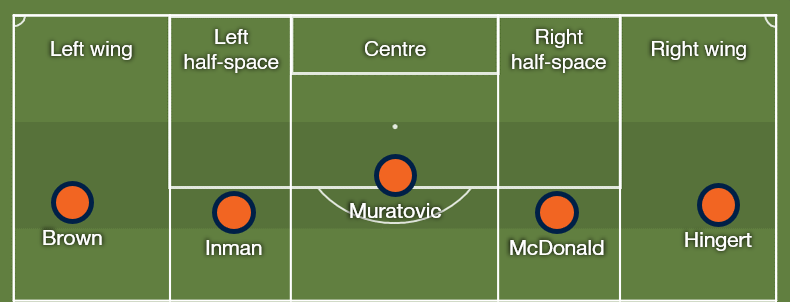
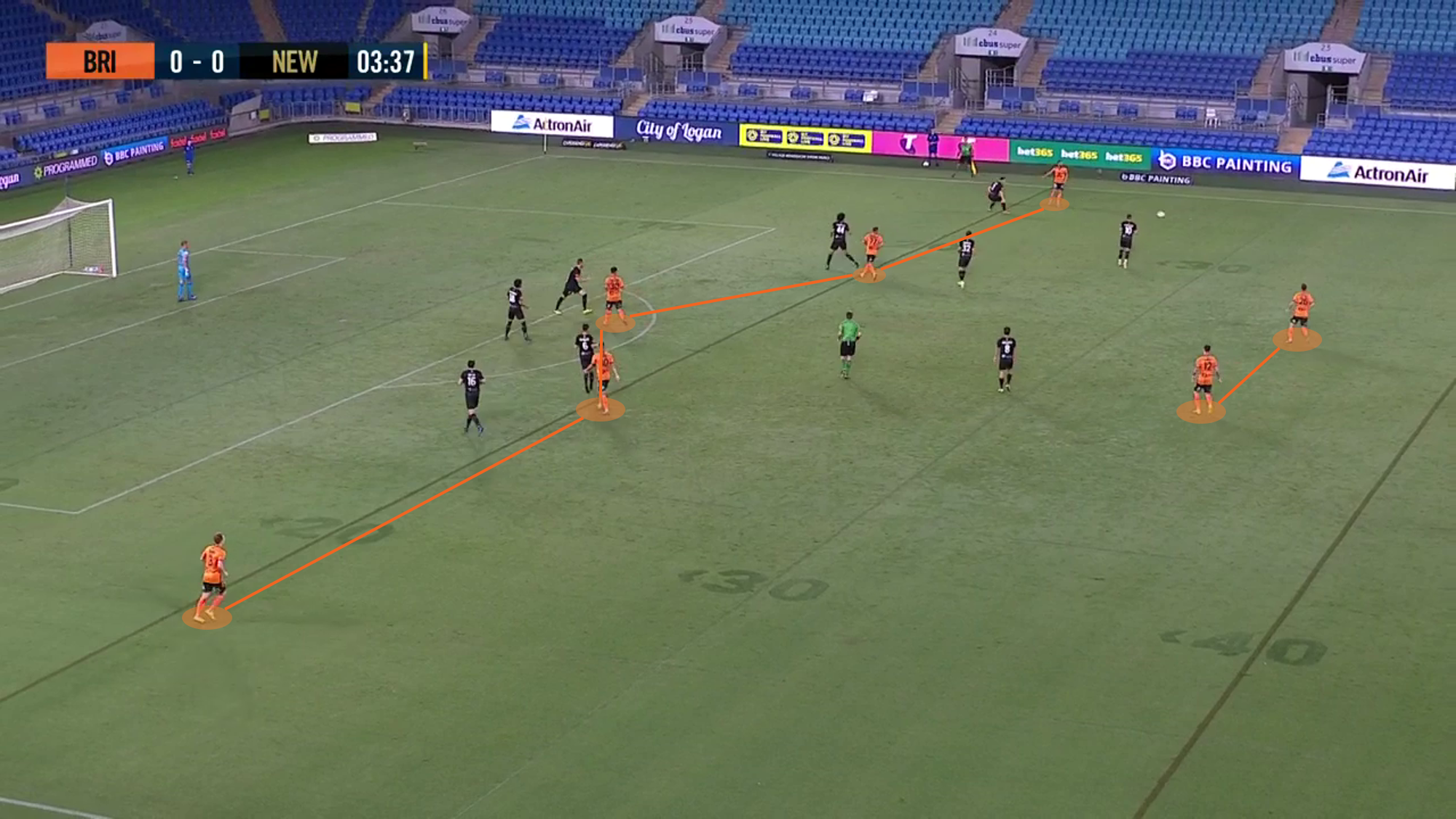
The wingbacks push all the way up, playing as wingers while in attack. They position themselves very wide, often close to the touchline. This helps to stretch the defence and provides an option for the switch of play - if the ball is able to be switched quickly, the wingbacks will be able to push forwards quickly into space.
The wingbacks are vital in this setup - it’s no coincidence that Brisbane’s form started to change since they were able to sign Corey Brown in January. His acquisition meant that Hingert could return to the right, and that Scott Neville could play further back as a centreback. Since his arrival, both Brown and Hingert have played every Brisbane game since in their preferred wingback slots.
Three strikers, three attacking options
With the departure of Roy O’Donovan in the summer, Robbie Fowler has rotated his strikers, with one of Mirza Muratovic, Aaron Amadi-Holloway or Dylan Wenzel-Halls leading the line. Each one has a different skillset, and results in a different attacking style of play. Robbie Fowler rarely plays the strikers together, and if he does, one will be replacing the role of an attacking midfielder.
Muratovic likes to start high up, and is good at dropping short to receive passes in between the lines and also comes wide to link play and pull defenders out of position. He’s surprisingly good when the ball is played into feet with his back to goal to bring others into the attack. He will also run into the channels to act as an outlet for long balls.
Amadi-Holloway is a more physical option, able to play as a target man. His style of play doesn’t necessarily fit with the possession-focused style that Brisbane like to play, but is a great option for a ‘plan B’.
Wenzel-Halls is a pacey player, who is best when he has space to run into. He runs the channels very effectively, and is a threat on the counter. He’ll often come on as a substitute later in the game when the defence is tired, or will start when Brisbane expect to have less of the ball.
Their most important role, however, is to pin the defensive line back, to allow the attacking midfielders to find space in between the lines.
Attacking midfielders - finding space and combining intelligently
The attacking midfielders Inman and McDonald have the most attacking freedom and responsibility in the team. Both players make good off-the-ball movements and find space well. Inman is a more dynamic attacking threat, driving into space with the ball and making penetrating runs in behind the defence, while McDonald plays more intelligently, with a quick turn of pace to increase tempo.
They have four main roles:
Help create overloads wide - pull slightly wider into their respective flanks to help create overloads and progress the ball up the pitch wide.
Drop into space to circulate the ball - receiving the ball slightly deeper, acting as a reset, or looking to switch the ball.
Attack space by running from deep - run from deep through the back line to receive penetrating passes centrally, often using combination play with each other and the striker.
Finish attacking moves - when the ball is played in behind, the attacking midfielders make their way into the box to attack the ball.
Overlapping centrebacks contribute to the overload
To add further chaos, Brisbane also use overlapping centrebacks. The concept of an overlapping centreback has been popularised by Sheffield United and is an unusual but simple innovation: the centrebacks will step forward out of the defensive line to provide an additional attacking option wide on the overlap. Their positioning provides an additional option when the ball is in the final third, and will help to further overload the flank.
Scott Neville and Macaulay Gillesphey are perfect candidates for these roles, as they both played as fullbacks earlier in their careers (Neville used to play primarily as a rightback, Gillesphey played both as a leftback and as a centreback), and as a result, they are comfortable playing high and wide up the pitch. They often come up to help bring the ball up the field, and when the opportunity arises and the attack continues, they can pop up on the overlap. They never both step forward at the same time, to keep the balance by ensuring there’s always at least two defenders staying back.
The heatmaps below show the positioning differences of each of the centrebacks (data: Wyscout):
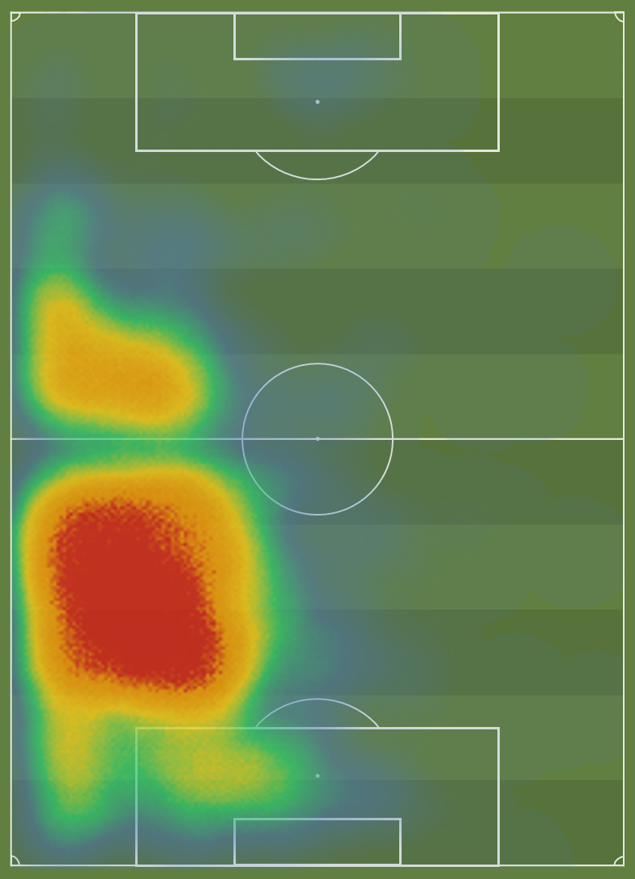
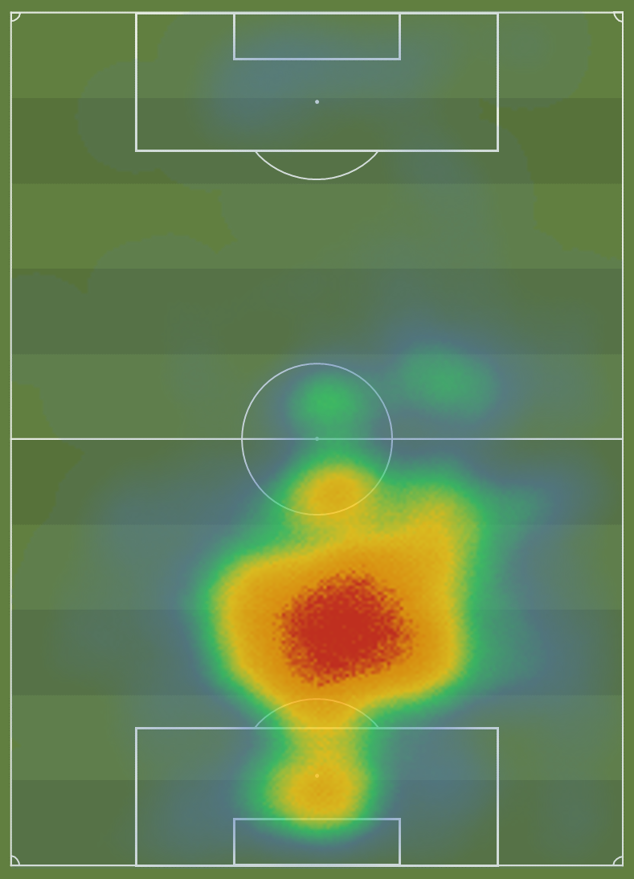
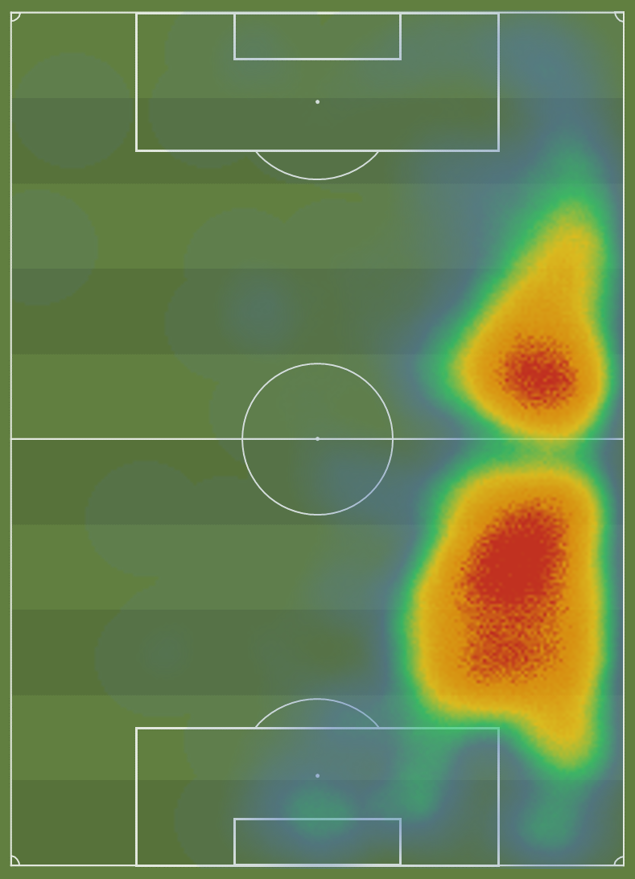
The overloads caused by the strikers/attacking midfielders and the onrushing centrebacks forces the defence to adapt - if they don’t respond, then Brisbane will be able to create unpressured crossing opportunities in time and space. Strikers and attacking midfielders can cause the centrebacks and/or central midfielders to follow them wide (potentially creating gaps centrally), while the overlapping centrebacks can make their way forward unmarked, unless one of the attacking midfielders or strikers drops back accordingly. These complexity of dealing with these overload situations results in four common situations:
An unmarked player wide - easy crossing opportunity
Space opened up in the centre - creating gaps for runs in between defenders or additional space for crossing targets
Time and space on the edge of the box - opportunities to shoot, play killer balls
Defence shifted over to the overload side - opportunity to switch the play for a quick attack on the opposite flank, where the wingback has space, or is 1v1 against their defender
Brisbane in Defence
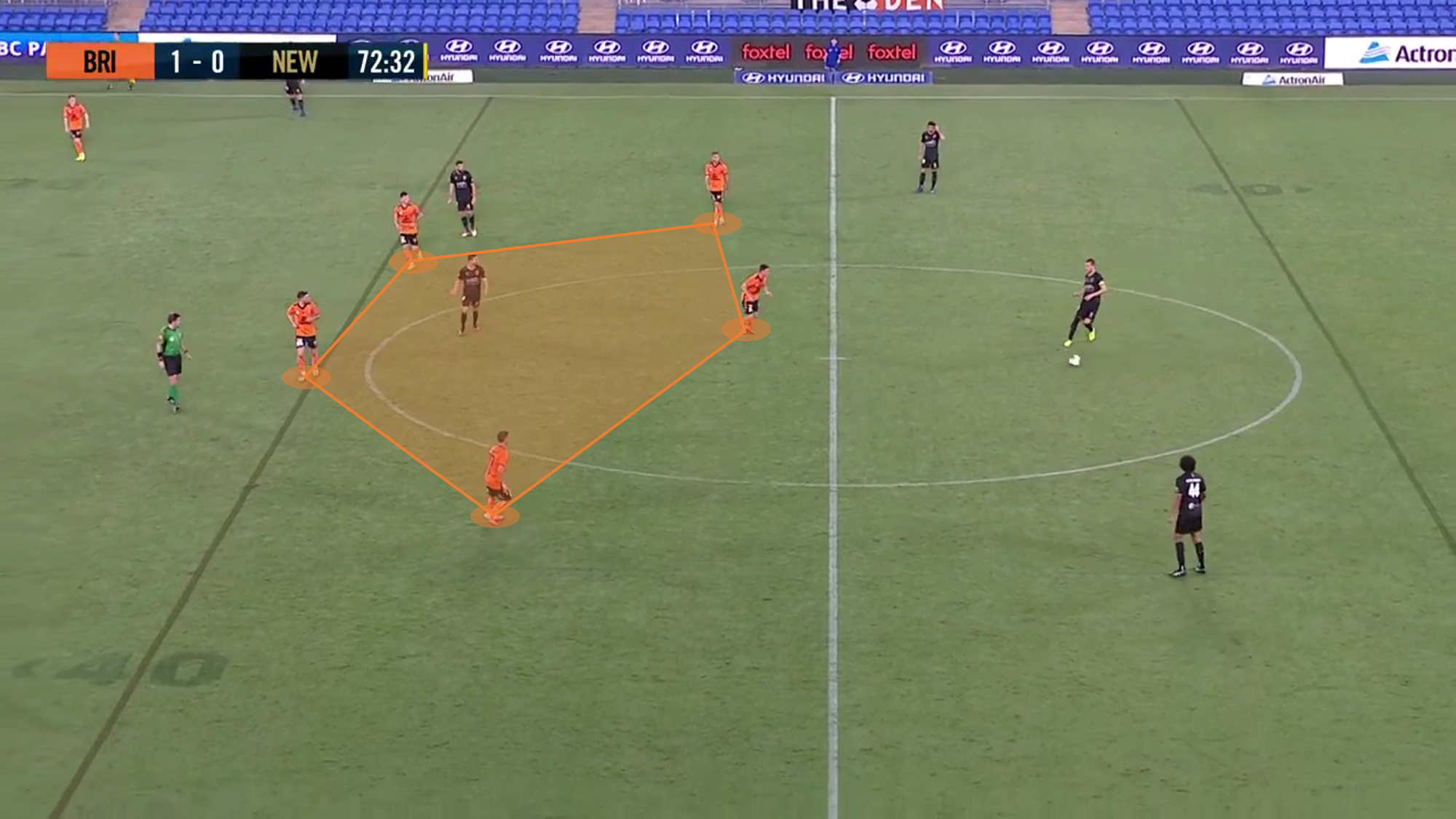
Brisbane play in a fairly passive medium block, in a 5-2-3 (or 5-3-2) shape. Higher up the pitch, the strikers and midfielders stay compact, cutting off passing lanes into the centre. Generally, this will be in a 2-3 shape, but against stronger side who having strong passing capabilities, or against teams who have 2 wide players on each flank they form a 3-2 shape. The intent of both shapes is simple - to crowd the centre of the pitch to make it difficult to play the ball through the centre. The pressing is not particularly intense - the intention is not necessarily to win the ball back immediately through challenges, but rather to force balls long or wide.
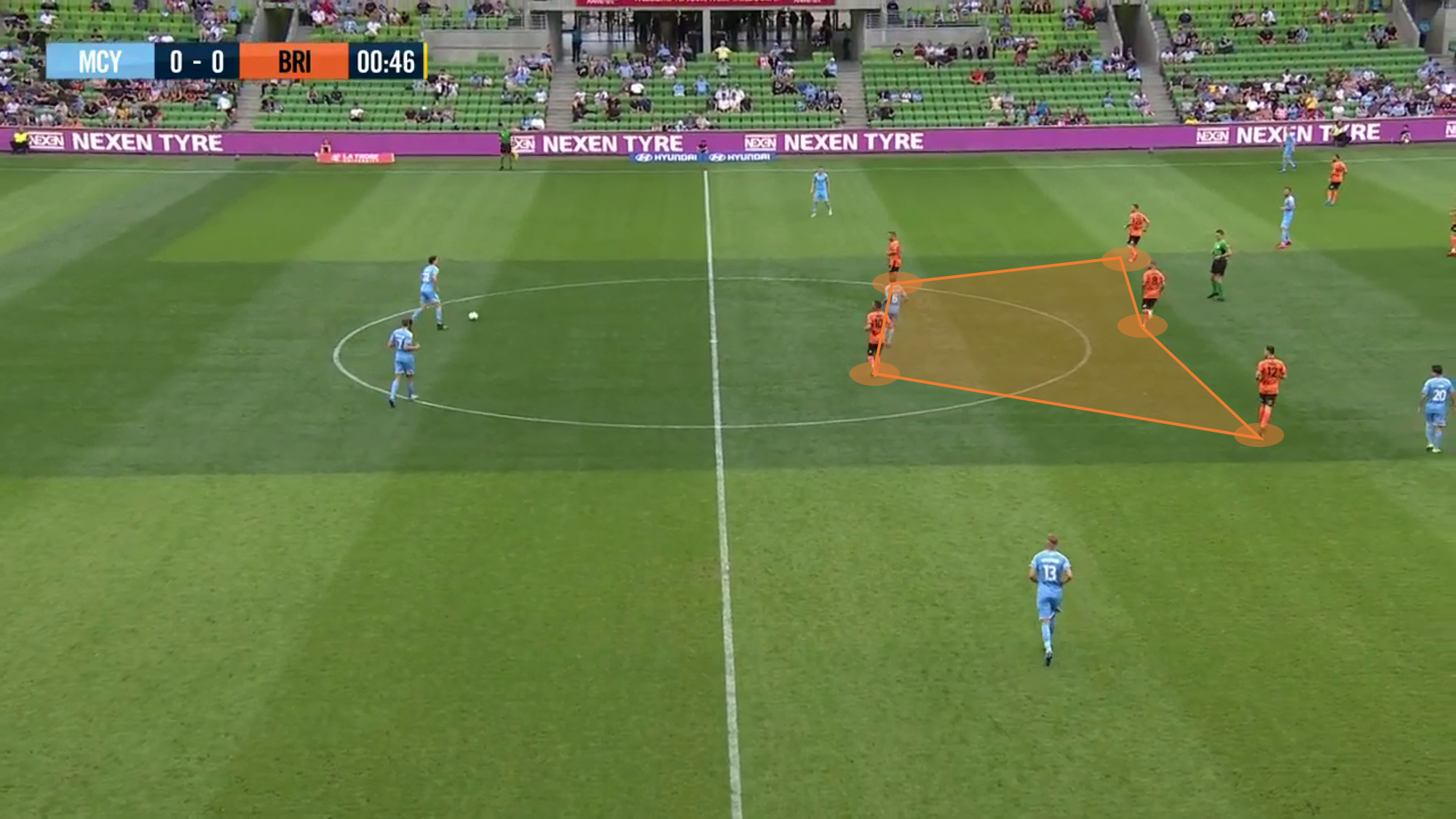
In wider spaces, the spine of the team does not shift over to the corresponding side, and instead, the responsibility falls to the wingback. The wingbacks start fairly deep and cover long balls, giving space to wide players if they come short to receive the ball. This illusion of space is actually a pressing trap, as once the ball is in motion towards the wide player, the wingback will immediately sprint forward to apply pressure, with the near-sided attacking midfielder and central midfielder also collapsing towards the ball.
The combination of a crowded centre and strong pressure on the flanks make it difficult to penetrate Brisbane, so teams may attempt to play long balls. Brisbane is well set up for this, with three tall centrebacks able to contest aerially and cover a wide area of the pitch. With three centrebacks, they often have a spare man, who will come up out of the back line in case the central block is played through.
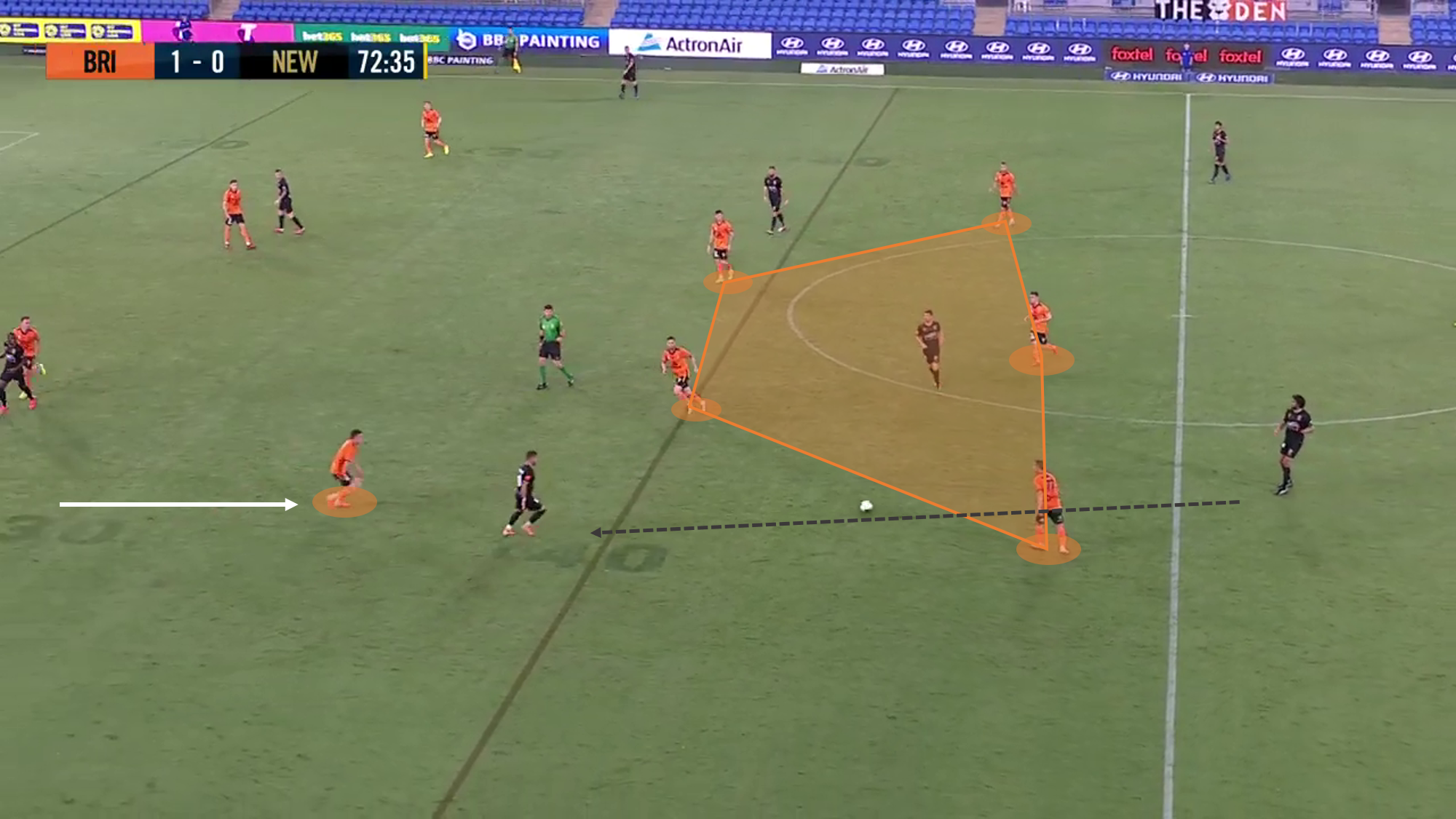
When the press is broken through, or when Brisbane find themselves in winning situations late in the game, Brisbane will drops into a deeper low block, in a 5-4-1 shape. This will also happen if the opposition sends two players wide in an attempt to outnumber the wingback on the flank - the attacking midfielder will shift over to support to prevent them from being overloaded.
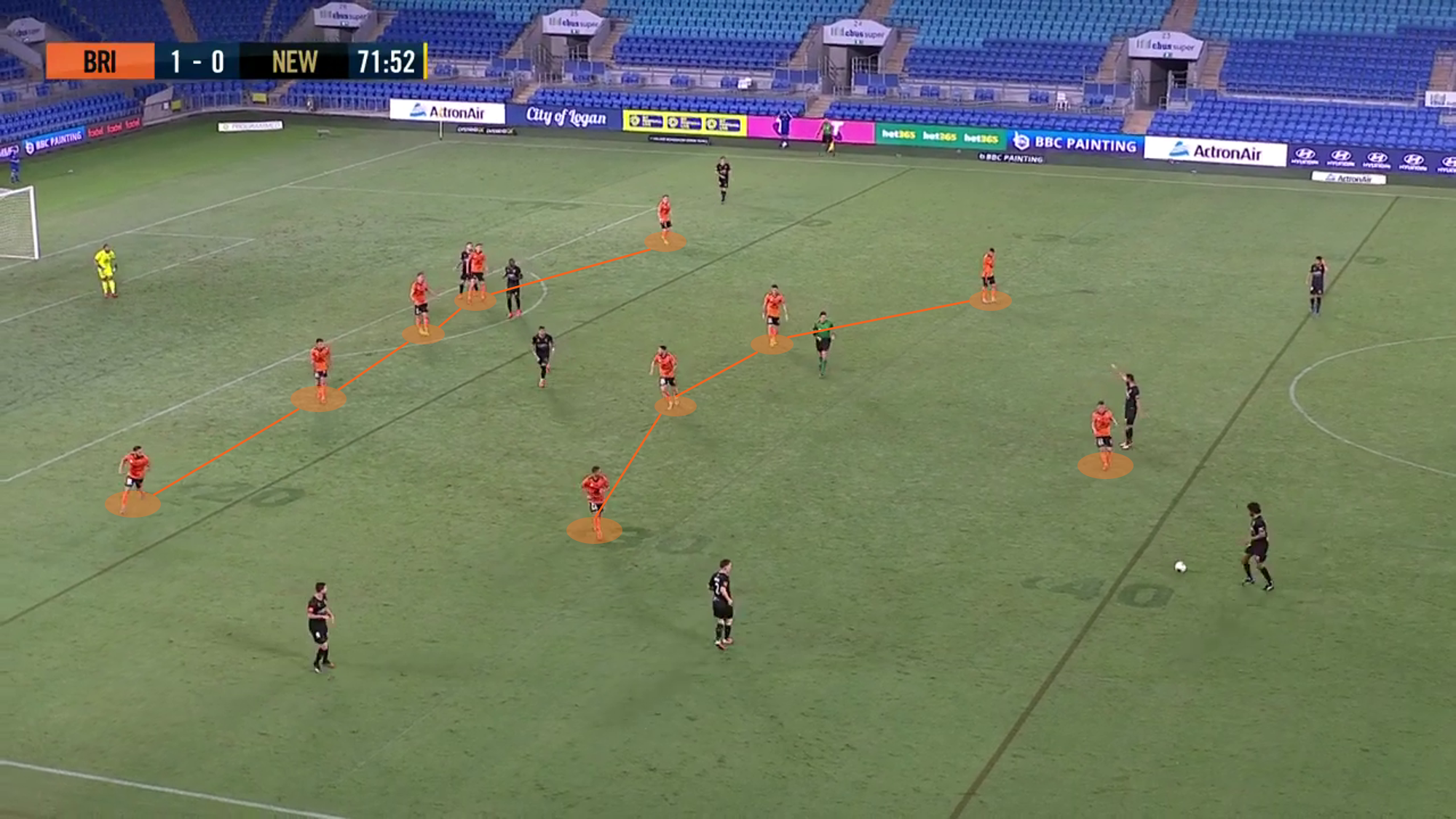
The biggest weakness that Brisbane have is on defensive transitions. In attack, they get players up the pitch, which can result in gaps at the back. The wingbacks being high up the pitch mean that wide areas are exposed for long balls, which is amplified when they lose the ball with one of the centrebacks up the pitch.
The goal Western Sydney Wanderers scored against them shows an example of this. The right centreback Neville comes up on the overlap, and is not tracked by anyone, meaning that WSW have a spare man ready for the counter. Instead of using the spare man, Hingert overcomplicates things and ends up losing the ball, and WSW score from the counter, having had a man advantage (4v3) and resulting in a 2v2 up the pitch.
Brisbane’s key principles
Brisbane Roar’s play can be summarised by a set of attacking and defensive principles:
Defence
Congest the centre - cut off passing lanes into the middle of the pitch
Press hard on the flanks - make it difficult to play the ball up through the flanks
Force the opposition to play through the central block or attempt long balls
Attack
Patience in possession - work the ball forward with simple, short passing
Overload the defence on the wings, cause the opposition to react in a way that opens up their defensive structure
Penetrate through crossing/gaps in the defence, or switch the play to the weak side