Central Coast Mariners 2 - 4 Melbourne City
Central Coast Mariners and Melbourne City played out an entertaining game of football that started out hectic, but settled and later petered out in hot conditions.
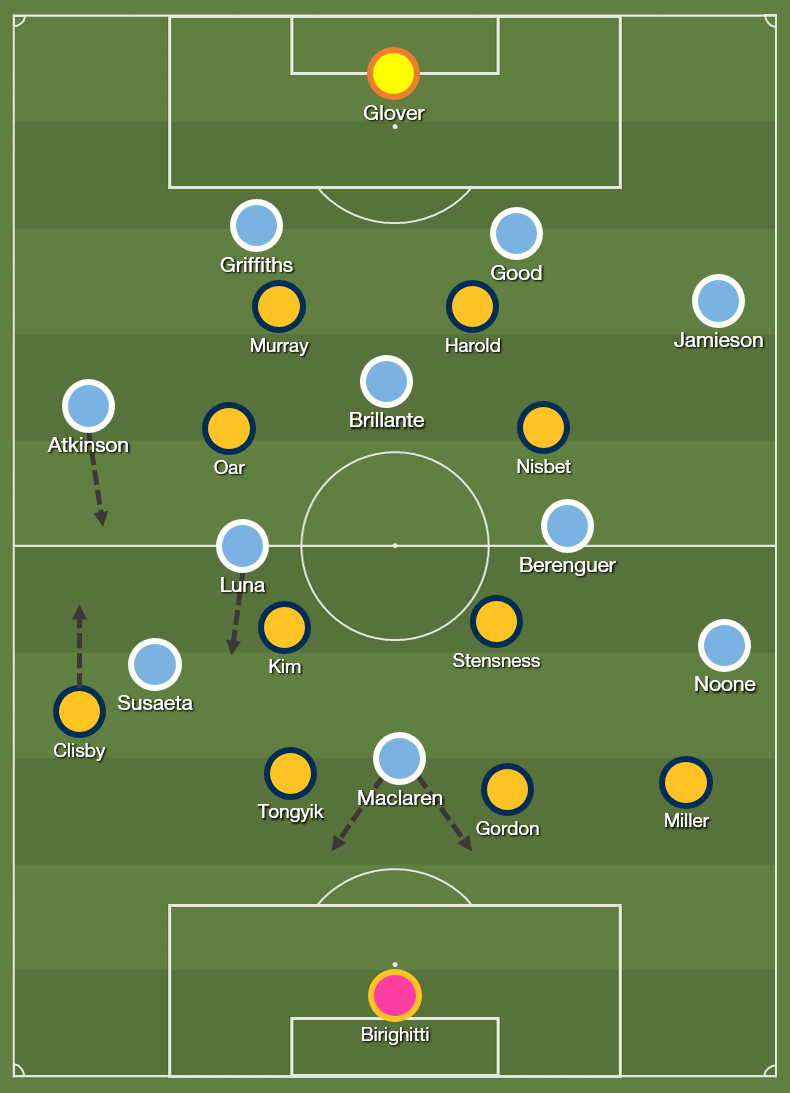
Central Coast played in a 4-2-2-2 (narrow). Clisby and Miller were up forward to provide the width, while Kim and Stensness sat further back to provide cover. Oar and Nisbet mainly stayed central, while up front, Murray and Harold were full of running, and play into them was aerial (into Murray) or into the channels (into Harold).
Melbourne City played in a 4-3-3, Maclaren leading the line, running the channels and providing a focal point, Susaeta and Noone playing wide, and Luna and Berengeur played centrally, popping up wide when they could. Brillante screened in front of the defence, and the full backs came up to support, underlapping and overlapping the wide players.
Central Coast Mariners’ Attack
The Mariners built up play with the defensive midfielders largely staying central and looking to play balls into the (fairly static) attacking midfielders Nisbet and Oar. City’s pressing structure resembled a 4-4-2, with Luna coming forward to help cut the passing lanes into Kim and Stensness, and Brillante and Berenguer picking up the two attacking midfielders. This made it difficult for any play to come through the centre of the pitch. The fullbacks came high up the pitch to provide the width for the Mariners to compensate, and upon receiving the ball, would play the ball inside to bypass the press, and then move forwards again into crossing positions (video).
They scored very early with a straightforward approach instead - a long ball behind the defence after winning the ball in transition. This highlighted the Mariners’ strength: numbers up front upon winning the ball high. Their early pressing was very promising, and they were threatening on the counterattack. Their tight central press made it difficult for City to play out through the middle, and forced them wide, where they recovered possession. They looked best when the front four had the ball and had space to run into in between the lines, and almost punished City’s early passing (14 min (video), 15 min (video), 27 min (video). Unfortunately for the Mariners, they couldn’t work these situations into their normal build up play, and after the early spell, they were few and far between.
Another approach they used was long balls towards Jamieson, who had difficulty dealing with these balls all game and stuggled under pressure (11 min, 34 min, 37 min). Their 2nd goal came from another instance of this.
Melbourne City in Attack
The Mariners’ press was narrow and tight, meaning that City had difficulties playing through the middle. Long balls to Noone were an option, as he stayed high up by the touchline on the left. He managed to receive the ball due to the narrow press in midfield, with Griffiths playing some excellent long balls out to find him.
The most threatening play, however, came from when they lost the ball, and then proceeded to win the ball back and catch out the Mariners in transition. The Mariners being poor in transition is said quite a lot, but lets have a look more closely at what it means.
Central Coast Mariners in Transition
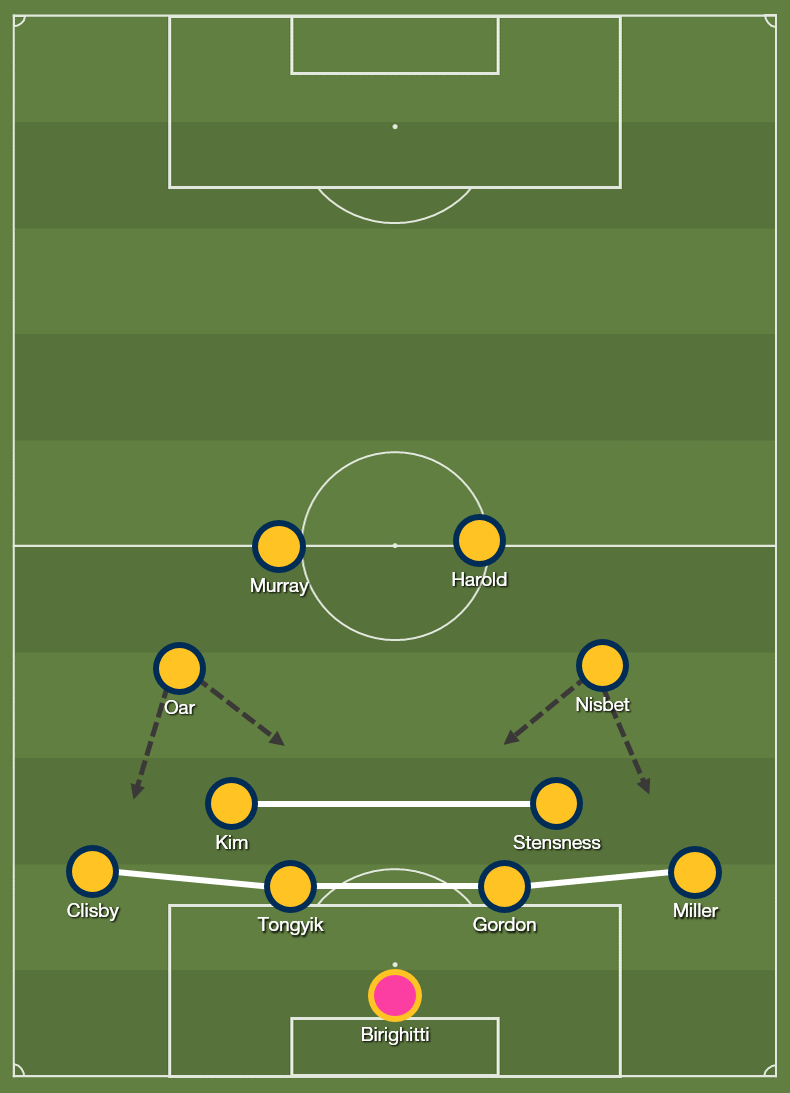
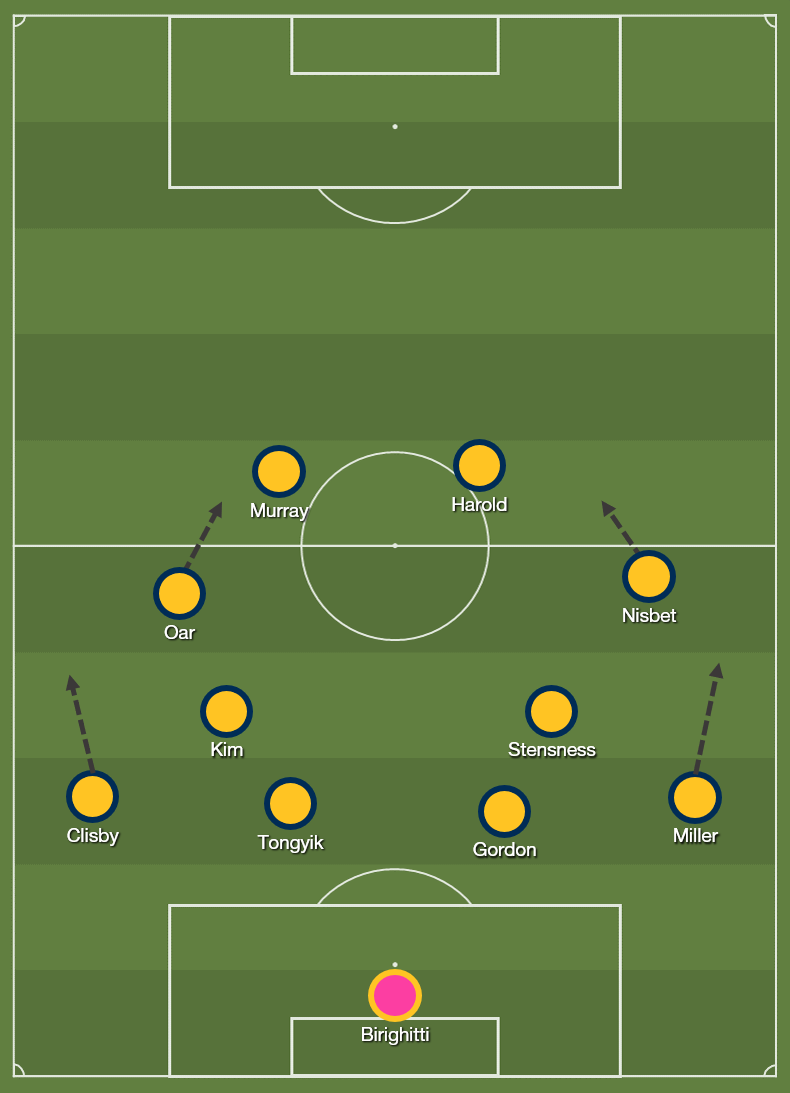
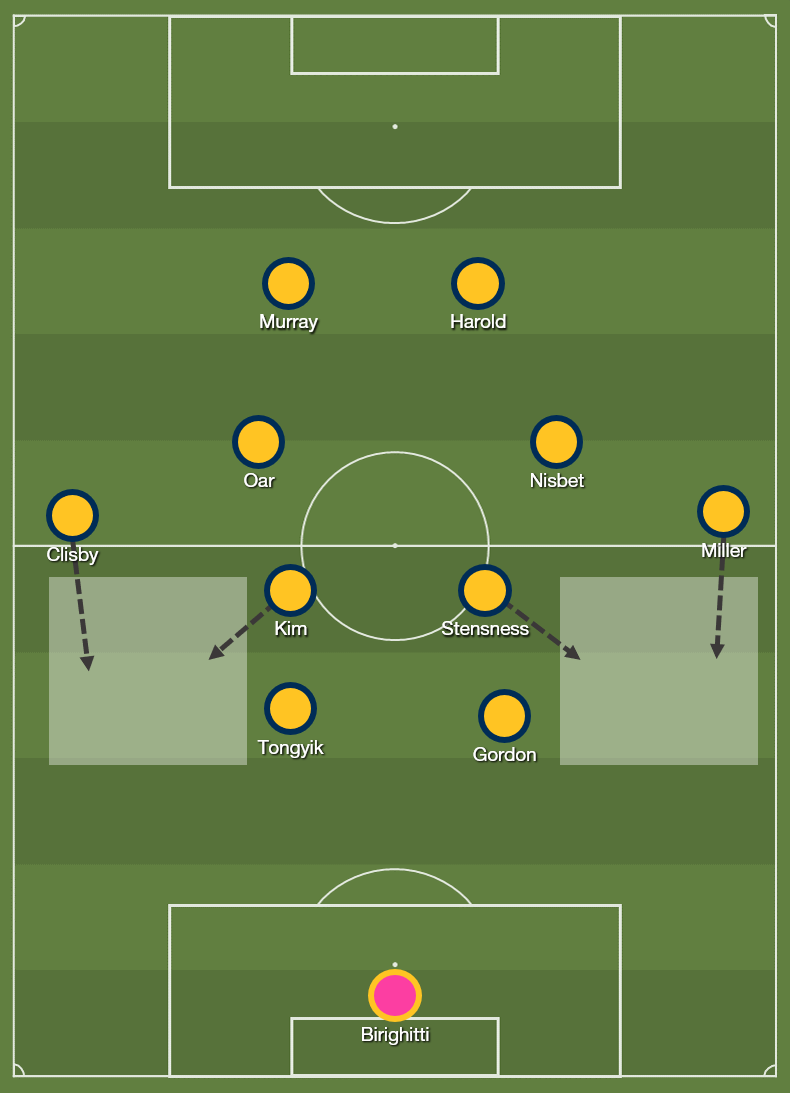
The transition is about getting six players into attack/defence as quickly as possible, and when they are interrupted in the attacking transition phase, everyone is in motion - forwards. The fullbacks are caught high up the pitch, and the defensive midfielders have to slot back into the channels to cover, while the centrebacks have to stay central to cover the striker. They need to get back to the positions they have in the first image - a 4-2, with the two attacking midfielders coming back to cover. If the attacking midfielders don’t come back quickly and with discipline, space is easily exploitable through overlaps in both the channels and on the outside.
Normally, this might be recoverable, but this has been an issue that they have had notably poor at (as I covered in their game against Western United), and today, this was on the other side in the inside right channel (between Tongyik and Clisby). A gap was present and was so wide due to three reasons:
Centrebacks stayed quite central
The centrebacks were focused mainly on Maclaren, who pinned them both centrally and also threatened to run into the channels on both sides. Tongyik in particular was hesitant to shift out of his position.
Overloads being created by City helped by attacking midfielders not tracking back
A common scenario during this game was a 2v3 situation caused by Luna, Susaeta and Atkinson, who would all occupy the right wing area. They would be tracked by Clisby and Kim, but often the marking from Oar was lacking, either due to him not tracking back, or just general slack marking
Clisby often being caught high up the pitch, and slow to recover.
As mentioned above, Clisby had a duty of bombing up the left flank to help stretch play and provide an overlap, so he was often in advance of the defensive midfielders - including when they lost the ball. He was also somewhat slow to recover from these situations, meaning that both Luna and Susaeta could run in the space that he left behind
City exploited this to score all four of their goals in this game:
Once the fourth goal went in, the game was not as much of a contest. Jair added a bit of running and Duric provided a few deliveries, but Delbridge on for Atkinson was a move to close out the game. The game petered out as the heat made it difficult for both sides to keep up the intensity.