Melbourne City 2-2 Wellington Phoenix
Patrick Kisnorbo’s Melbourne City entered this gameweek as top of the A-League table, hoping to extend their 3-win streak. Looking to dampen their spirits was Ufuk Talay’s Wellington Phoenix, who started the campaign with two draws and a loss. This was an entertaining contest, with Wellington coming in with a clear gameplan, against the organised and intense City system.

The Melbourne City setup was straightforward, with Kisnorbo having a good idea of his best lineup for now. Thomas Glover started in goal, with Thomas Lam and Curtis Good resuming their centre-back partnership, Jordan Bos and Callum Talbot starting at full-back. Taras Gomulka came back from suspension to partner Aiden O’Neill with Valon Berisha in front of them. Marco Tilio continued his run, starting ahead of Andrew Nabbout, with Mathew Leckie and Jamie Maclaren rounding out the side.
Talay made a few changes in his starting eleven. Tim Payne shifted to centre-back, with Callan Elliott at right-back, Sam Sutton and Scott Wooton rounding out the defence in front of Oli Sail. In midfield were Clayton Lewis and Nicholas Pennington, and the front four were Benjamin Old, David Ball, Yan Sasse and Ben Waine. Stefan Ugarkovic, Oskar Zawada, Bozhidar Kraev, Joshua Laws and Kosta Barbarouses, who had all been starters in their last three matches, started on the bench.
These changes came with a slightly different Wellington setup than their previous matches. Rather than having two strikers in a target man (Zawada) and pace (Waine/Barbarouses) partnership, we saw Waine up front on his own, with Sasse sitting deeper in a ‘10’ role.
Wellington helped us out in understanding how it worked right from the kick-off. While most teams have a kick-off routine that results in the ball being pumped forward to one of the wings, Waine passed the ball directly to the centre-backs, who sat in a deep position just in front of their 18-yard box. The centre-backs passed the ball between themselves, inviting City to push their structure forwards, and only once City engaged in the press did Wellington start to play.
City’s press formed its usual 4-1-3-2 shape, with Berisha pushing up to join Maclaren in pressing the centre-backs on the first line, with one of the two midfielders (usually O’Neill) pushing up to join the second line, with the other (usually Gomulka) covering the spaces behind the structure in midfield.
Wellington’s gameplan
Wellington had prepared for this, and had a clear plan to counter the press:
Trigger City’s first line to press by playing the ball at the back between centre-backs
Draw out City’s second line by threatening to break first line with midfielders holding their position and moving into pockets of space behind the first line
Provide an option for wide outlets by advancing the full-backs
Pin the centre-backs with Waine staying high and threatening runs in behind, meaning that centre-backs can’t step up to close down spaces in midfield
Overload the now under-manned centre by having wide ‘10’s come narrow
Work ball into an unmarked ‘10’ in space by using quick combination passes
Turn and play penetrative through passes centrally (Waine running in behind) or wide (full-backs up in support).
While they had nothing to show for it on either the scoreboard (no goals) or on the statsboard (no shots on target), the first 15 minutes saw them create (or almost create) a flurry of chances from this series of movements:
4th minute: an unmarked Sasse receives, turns and plays in Waine, who gets a shot off, the deflection falls to an unmarked Sutton whose volley misses the target
9th minute: an unmarked Sasse receives, turns and plays in Waine, who gets a shot off which is deflected by Good and collected by Glover
10th minute: Lewis receives and dribbles through the first and second City lines, plays in Waine for a 1v1 against Glover (he’s offside and misses)
13th minute: an unmarked Ball receives and flicks a pass for Waine to run onto, who is a bit slow to react
Of course, attempting to work the ball through the most organised pressing team in the A-League is risky business, with City threatening to regain possession in dangerous positions. Maclaren’s pressing in the 14th minute caused Payne to slightly misplay a pass, with Tilio picking the ball up, dribbling towards goal and shooting. The shot hit Payne in the arm and resulted in a penalty that was converted by Maclaren.
The second goal came from another error in buildup - this time a heavy touch from an unmarked Sasse that allowed O’Neill to nip in to dispossess him. With Wellington’s full-backs high, City were able to convert from the resulting counterattack, outnumbering the defence 3v2.
City start to control
The first goal seemed to settle the nerves for City, and they took control of proceedings for the remainder of the first half. In attack this season, City have set up in a 3-2-5 shape, with five attacking players at the front, with Berisha and Bos pushing up to join the front three. Going left to right, the attack looked like this: Bos-Leckie-Maclaren-Berisha-Tilio.
This is reflected in the data, with the differences in received passes in Wellington’s half during the first half based on their position across the front:
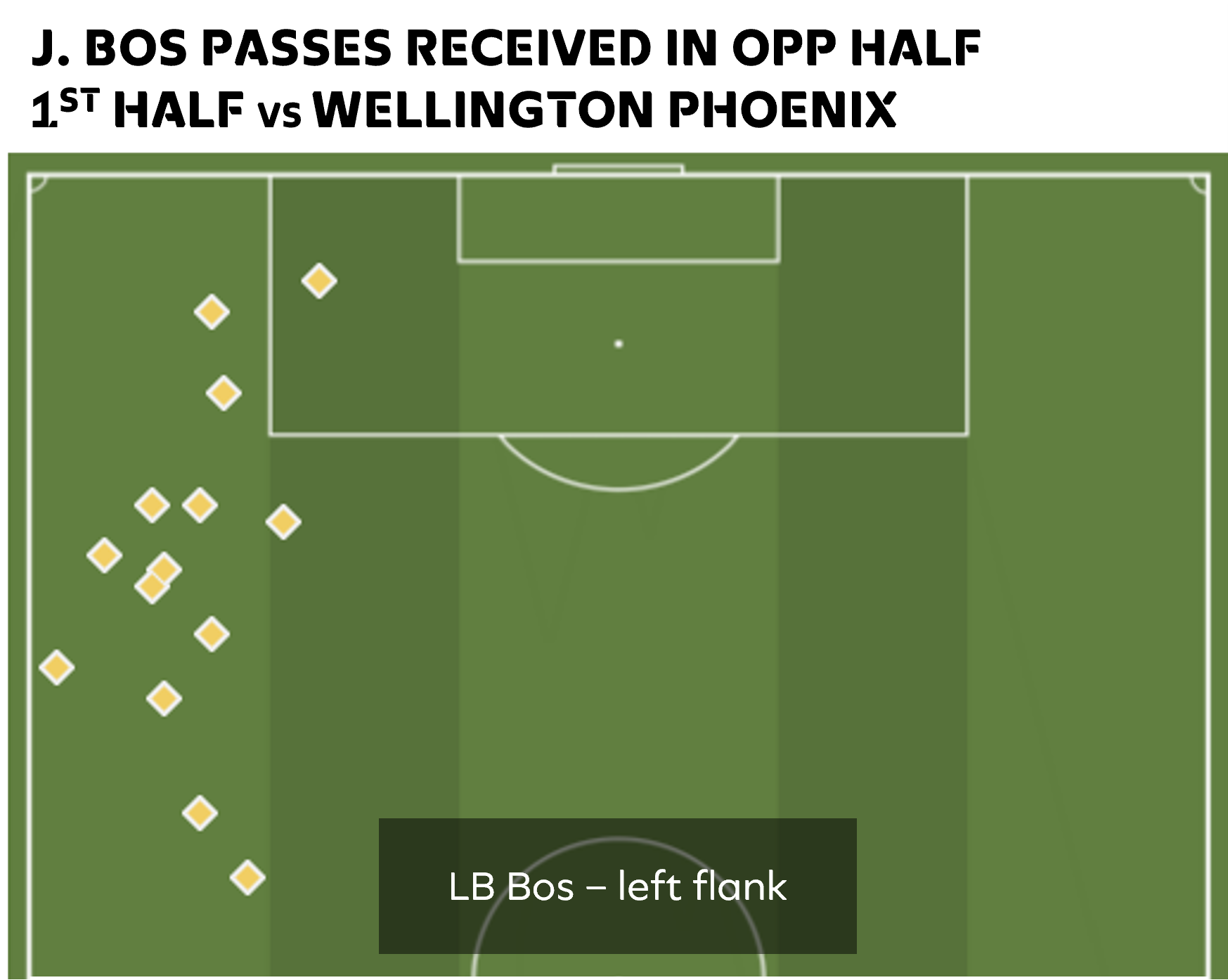
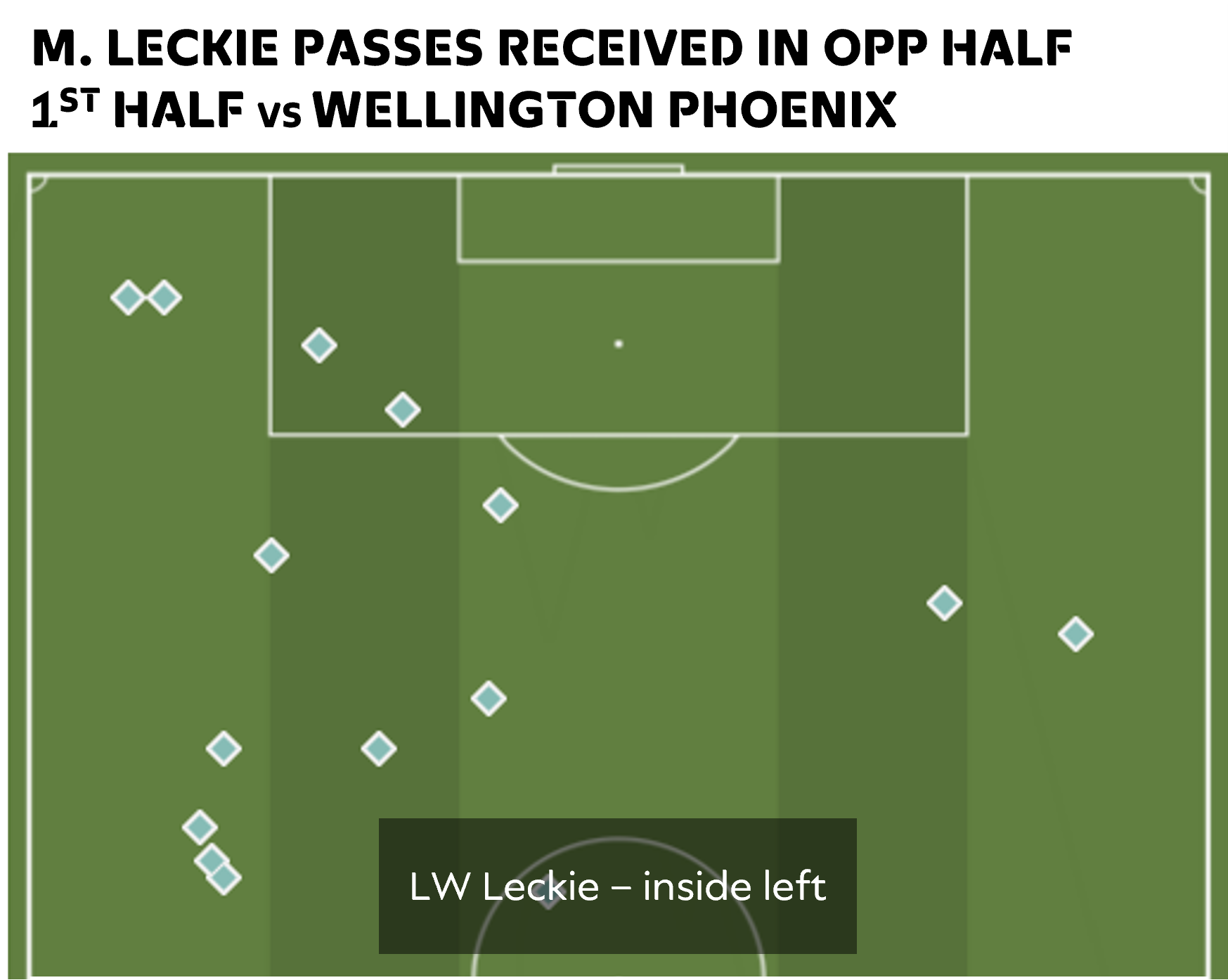
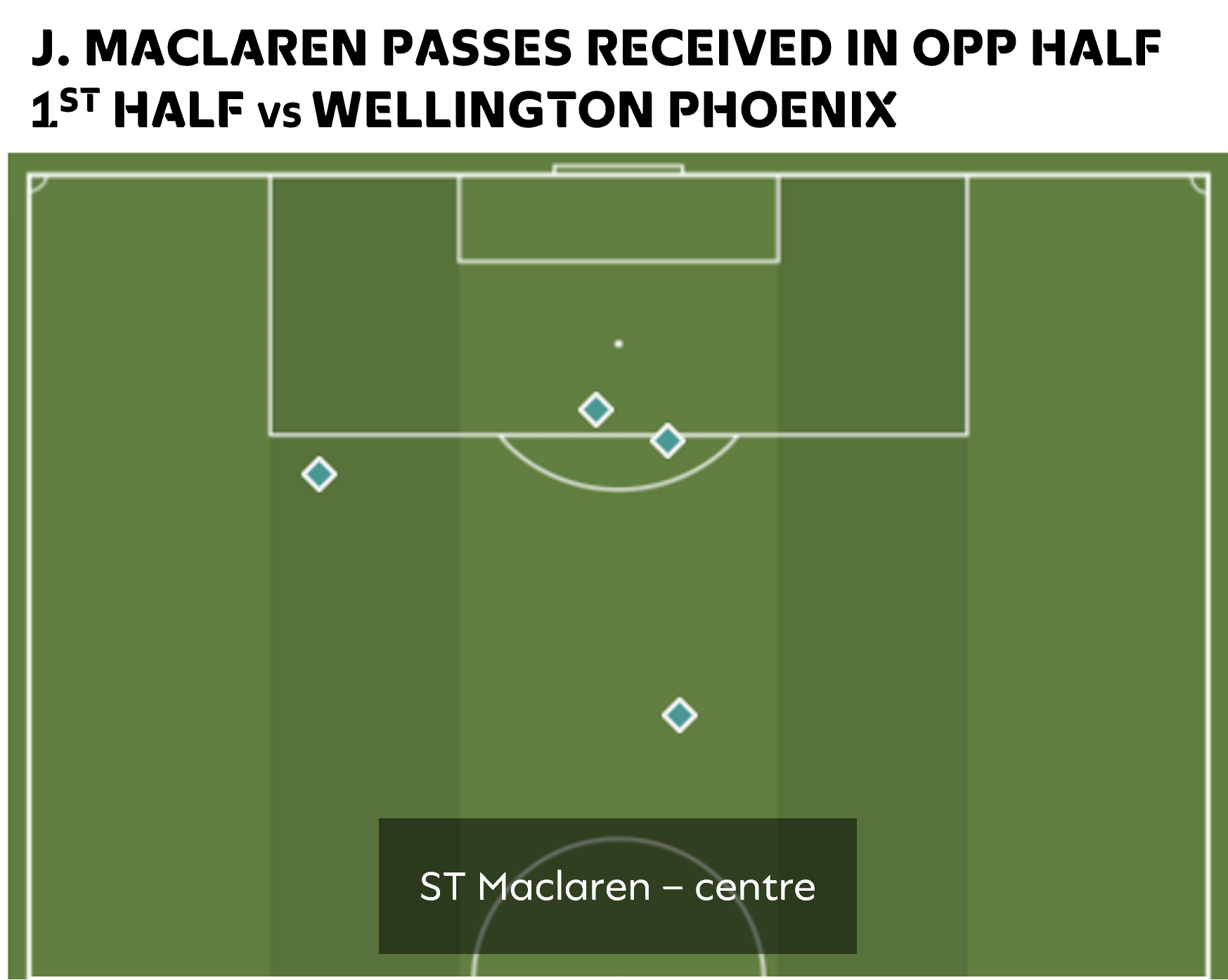
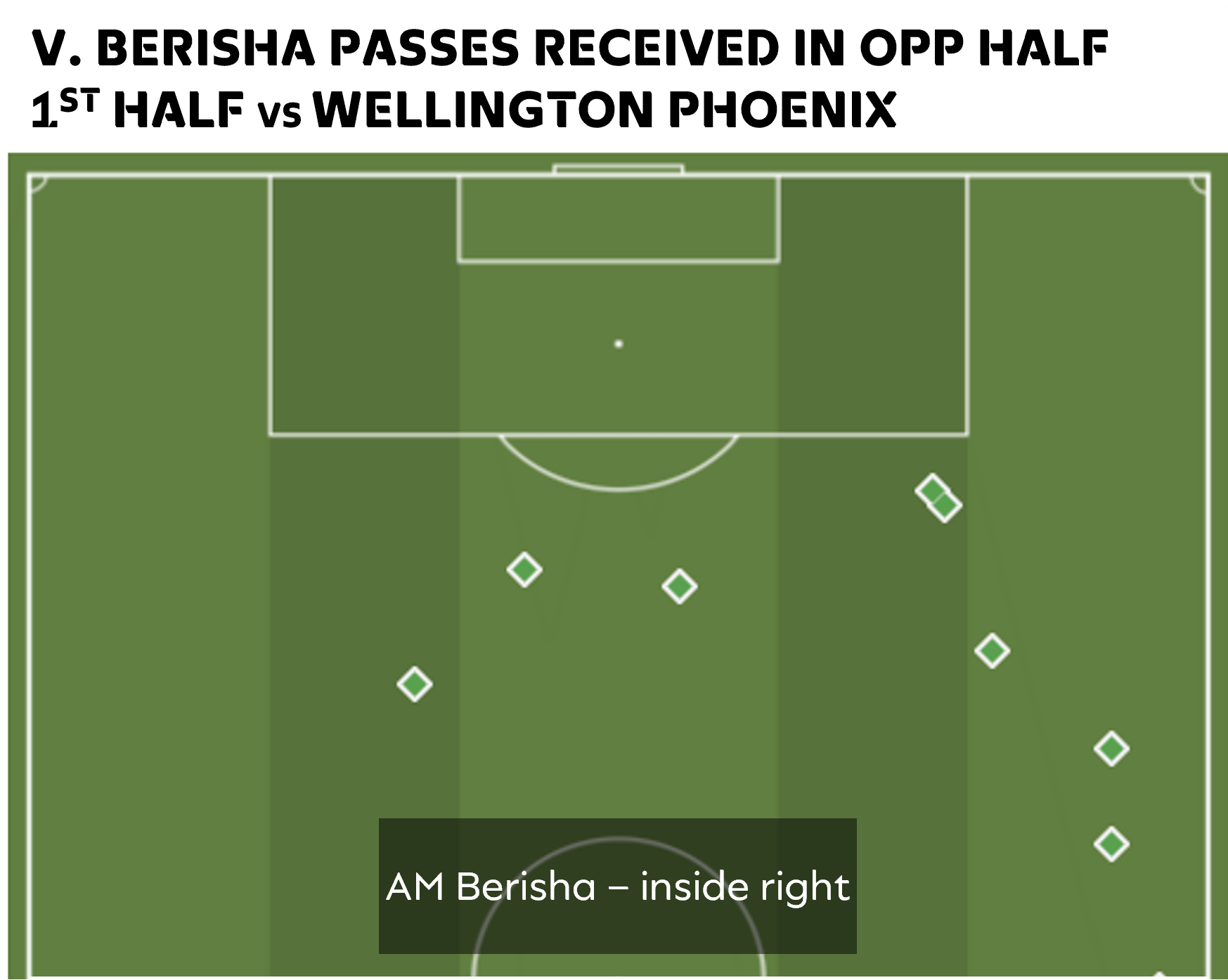
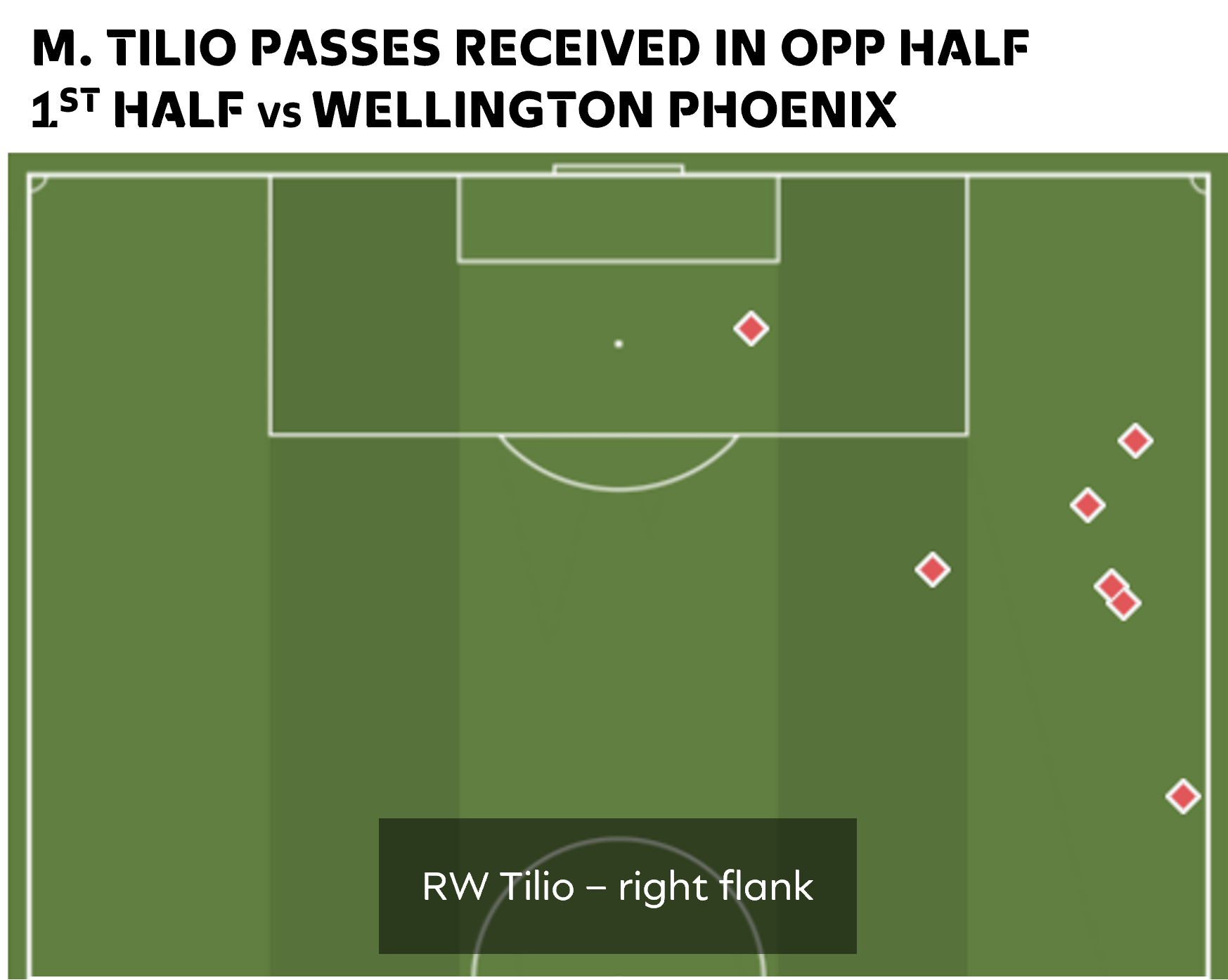
Bos in particular got into the game well, being active in defence and then pushing forwards the moment his team won the ball. He was a key outlet for City, with his wide overlapping runs catching Wellington’s defenders out on a few occasions.
It looked like City had also reduced the impact of Wellington’s build-up by modifying the press - rather than pushing up high to the centre-backs, Berisha appeared to be orienting himself more towards Pennington and Lewis while Leckie was more targeting Old, meaning their defensive structure looked more like a lopsided 4-3-3 shape. This, along with a series of smart fouls, protected the centre and reduced the impact of Wellington’s possession, to the extent that they only had 3 possessions that entered the attacking third in the last 15 minutes of the first half. It looked like it would be a straightforward victory for City.
Second Half
Wellington needed to make changes to get back into the game, and it looked like they made a slight tweak coming out of the half-time interval. Instead of aiming to find the ‘10’s in between the lines, after the first passes into midfield, the focus seemed to be to use combinations to get the ball out wide to the full-backs, who positioned themselves more aggressively.
A particularly common pattern was worked down the left. Lewis would drop into the space just outside and in front of his left centre-back Wootton, forcing Tilio to come from the flank to pressure him. This freed up space for Sutton, and Wellington would play the ball into the centre and then bounce the pass back out to the unmarked Sutton. The defending full-back Talbot had to quickly come out and close down Sutton, opening space for the left winger Ball (and later Kraev) to sprint into.
They managed to get on the ball in more advanced positions, and a cross in the 54th minute from an unmarked Sutton found Sasse, who headed over - in Wellington’s first shot since the 10th minute.
Talay was first to the bench, making a triple attacking substitution, with Waine, Sasse and Ball coming off. Kraev provided a more direct threat on left the wing, adding power and pace in his runs in behind, Zawada provided a focal point by way of being a target man in the box, while Barbarouses meant a reversion to two strikers up top and swapped the playmaking style of Sasse for more mobility and clever runs.
Perhaps a bit surprisingly, the changes did not directly change how Wellington built up or intended to attack, rather, their game plan seemed to be to do Plan A better - passing their way through City. Their unwavering commitment to playing through the lines became more effective, with O’Neill and Gomulka increasingly becoming passersby to the penetrative passing of Wellington. Gomulka was taken off in a like-for-like substitution in Richard van der Venne, with Kisnorbo trying to shore up the midfield protection. Kisnorbo also sent Nabbout on for Tilio in an attempt to restore some attacking thrust and defensive industry to the right flank.
However, without a change in defensive structure protecting the centre, Wellington kept going back to the well. Lewis was composed in building up from the back and pulled the strings, the attacking midfielders and strikers kept finding spaces between the lines, and the full-backs kept getting the ball in attacking positions. The momentum was shifting.
Wellington leave it late
The breakthrough came from a Sutton volley following a corner. It was just desserts for Sutton, who had been a vital part of Wellington’s build-up play, and it was a nice combination between him and Kraev that led to a free-kick, which then led to the corner.
With about 10 minutes to play, Ugarkovic came on to replace Pennington. By this time, the City press had become slightly more disjointed, possibly due to the amount of ground they had to cover in defence over the course of the game. Ugarkovic provided the ability to receive in the widening gaps between the lines, turn and drive forwards with the ball at the overloaded midfield.
He did this twice in the possession that led to the goal - once receiving between the lines and distributing to the full-back, and on the return pass, driving into midfield and splitting them open with an excellent pass to Old outside the box. Old then found Barbarouses, who took two nice touches to place the ball perfectly in the bottom corner.
City got the stuffing knocked out of them with Lam’s second yellow card, and the last action of the game saw Lewis test Glover following a neat combination with Kraev.
Summary
City will be disappointed with their all-round performance, not managing to create too much of their own accord with their most dangerous attacking situations arising from transitions. Kisnorbo spent much of the game instructing both Tilio and Gomulka in their defensive responsibilities, but it certainly looked like their system was just unable to cope with Wellington’s gameplan. In the end, they were fairly lucky to have been granted the two clear cut chances that led to their goals, and reflecting on their performance on the day I think they’d be content with a point.
While Wellington’s first-half was characterised by two errors leading to goals and an inability to convert their early promise, they did grow into the game as it went on, doubling down on their system and gameplan. The gameplan was well-prepared for this matchup, and they had been drilled well
which looked well-prepared for this matchup and well-drilled. They looked better than their results so far this season and their team has good depth. Sasse kept popping up in nice spaces between the lines, Kraev has some very good touches on him, Barbarouses showed that he’s back following his injury and Lewis put in a good performance as the deep-lying playmaker.