Melbourne Victory 0-1 Western Sydney Wanderers
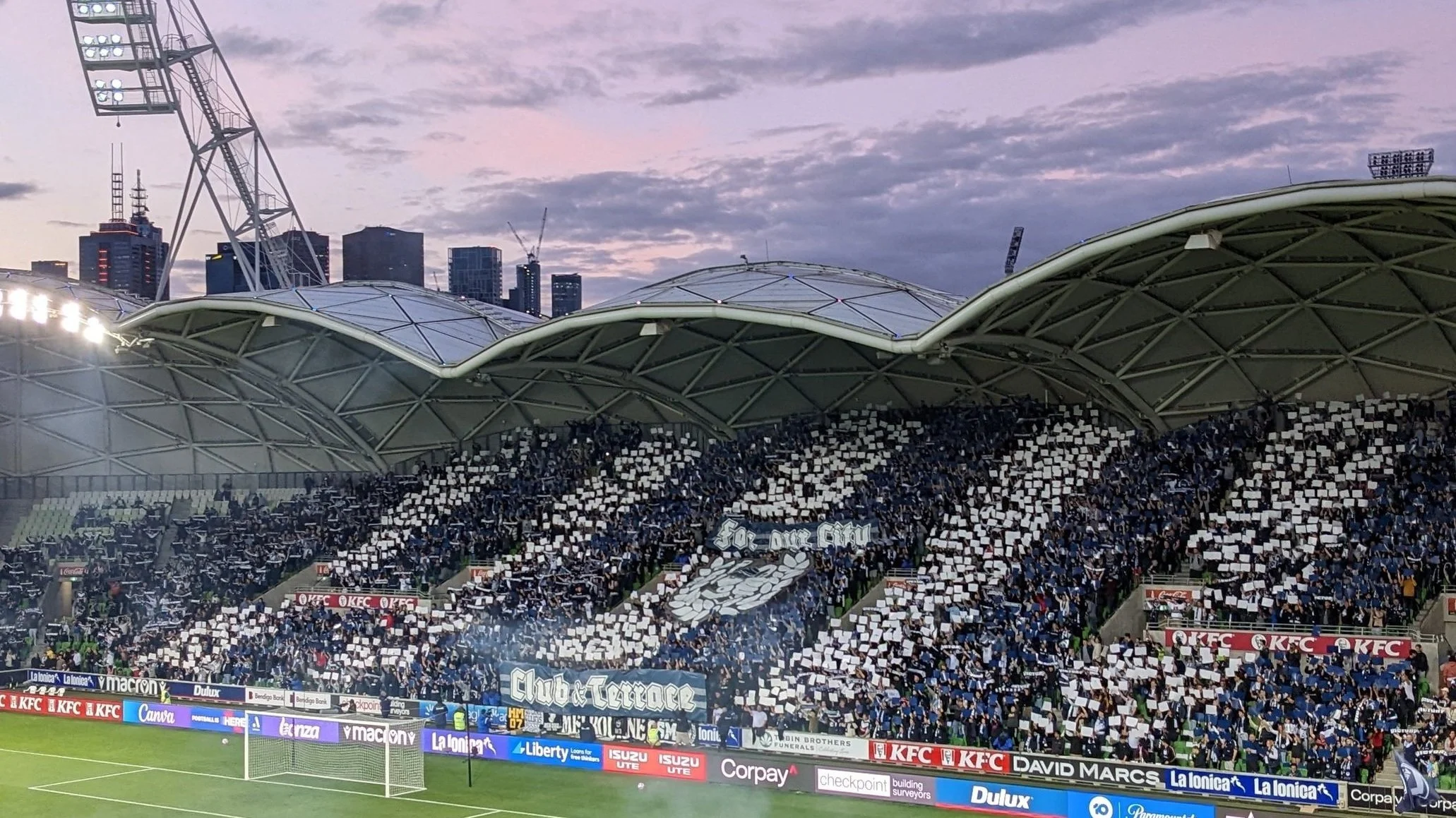
Melbourne Victory kicked off their home campaign against Western Sydney Wanderers at AAMI Park. It was a fantastic day for a game, with two packed sets of active support providing an electric atmosphere that I haven’t seen at an A-League game for a decent while.
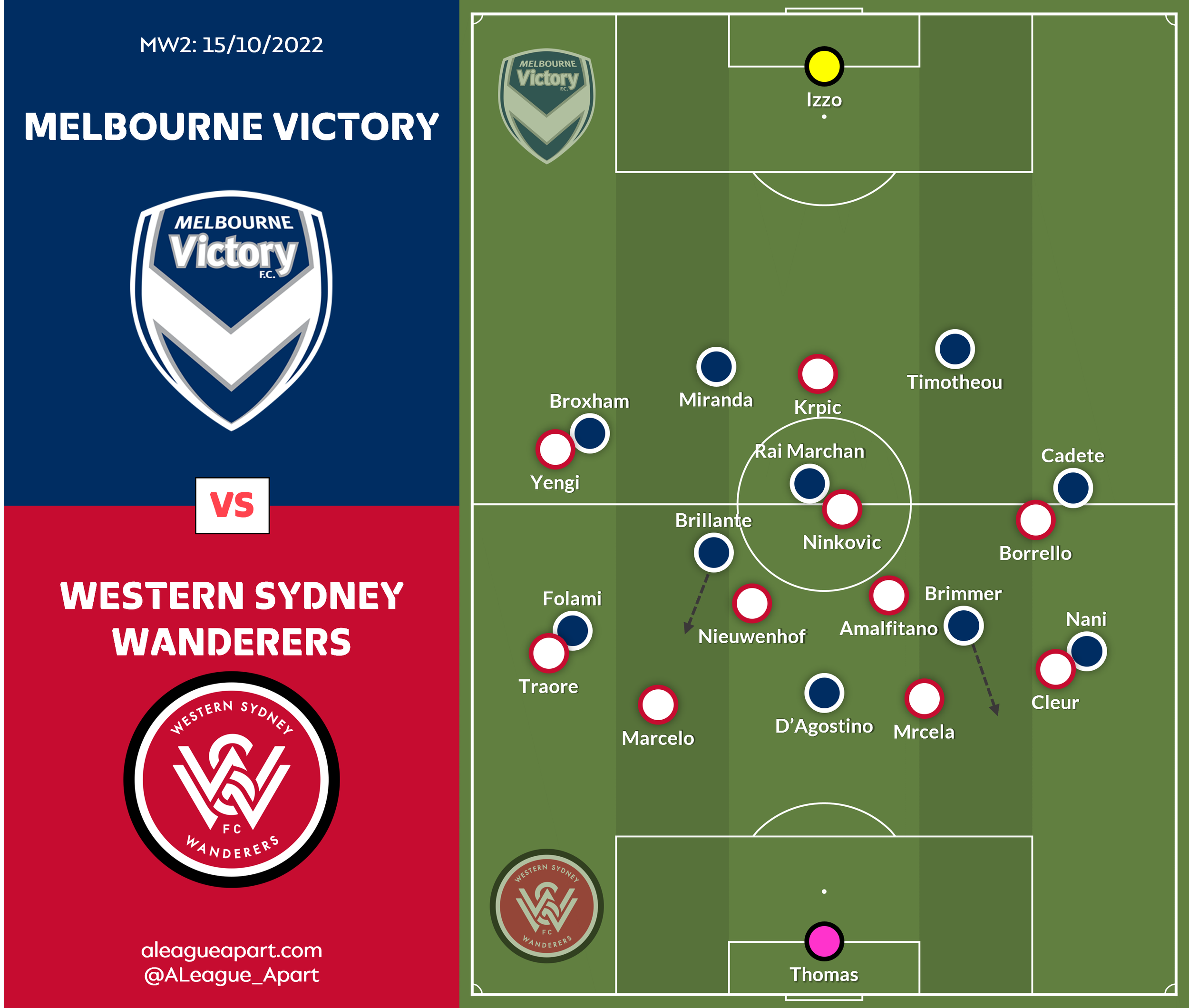
Both sides continued with similar systems from last week - Victory played in their 4-3-3 with Rai Marchan sitting in a holding midfield role behind Josh Brillante and Jake Brimmer, while in defence George Timotheou came in at centre-back with Leigh Broxham moving out to right-back. The rest of the squad was unchanged - Luis Nani, Nick D’Agostino and Ben Folami up front, with Kike Cadete, Roderick Miranda and Paul Izzo rounding up the squad in defence.
Western Sydney Wanderers were unchanged - the solid back line of Gabriel Cleur, Tomi Mrcela, Marcelo and Adama Traore protecting Lawrence Thomas, midfield trio of Calem Nieuwenhof, Romain Amalfitano and Milos Ninkovic, and front three of Brandon Borrello, Kusini Yengi and Sulejman Krpic.
The shapes of each team’s setup meant that aside from the centre-backs, each player had a direct opponent. Because of this, the game was not as much a tactical chess game, and often resembled a series of individual battles across the pitch.
The midfield structures
Both teams had three in midfield, although there was a difference in how they were deployed. Specifically, Victory’s three had one holding midfielder (Rai Marchan), one more box-to-box midfielder on the right (Brillante) and one more attacking midfielder on the left (Brimmer), while Wanderers had one attacking midfielder (Ninkovic) and two deeper central midfielders (Nieuwenhof and Amalfitano). Their relative positions meant that each of them had a direct opponent - Rai Marchan against Ninkovic, Nieuwenhof against Brillante, and Amalfitano against Brimmer.
The Rai Marchan vs Ninkovic battle was fairly straightforward, with Ninkovic tightly marked and unable to really impose his game going forwards, although he was energetic in defence, contributing a few ball recoveries and interceptions.
While Victory were in attack, their two midfielders had similar goals - overload the Wanderers full-backs by making runs into the channels. Wanderers’ midfielders couldn’t always follow the runs without vacating the centre of the pitch, and they’d have to pass the run onto their defenders. The main beneficiaries of this were the wingers.
Nani attacks Cleur
The contest between Nani and Cleur was the most important of this game, with Victory’s gameplan being clear - get the ball to Nani. Out of all players in the game, he received the 4th most passes, and when including attackers only, he received the most passes (47), while 20 of Victory’s attacks came down Nani’s left flank, compared with 9 attacks down the right. All-in-all, it was a busy night for Cleur.

From the left side of central midfield, Brimmer would drift over to the flank to help create space for Nani. Sometimes they would swap positions, with Brimmer temporarily sitting by the touchline with Nani drifting inside, while other times Brimmer would wait for Nani to receive the ball wide before running in behind Cleur. The two’s movements and positioning worked well to create penetration early in the game.
This also worked when Victory moved the ball down the right flank and drew the defence over. The 11th minute chance where Nani hit the post arose from this, with D’Agostino’s movement taking Marcelo out of the play and causing Mrcela and Cleur to shift over. The cross was deflected just out of Brimmer’s reach, but Nani was free at the back post.
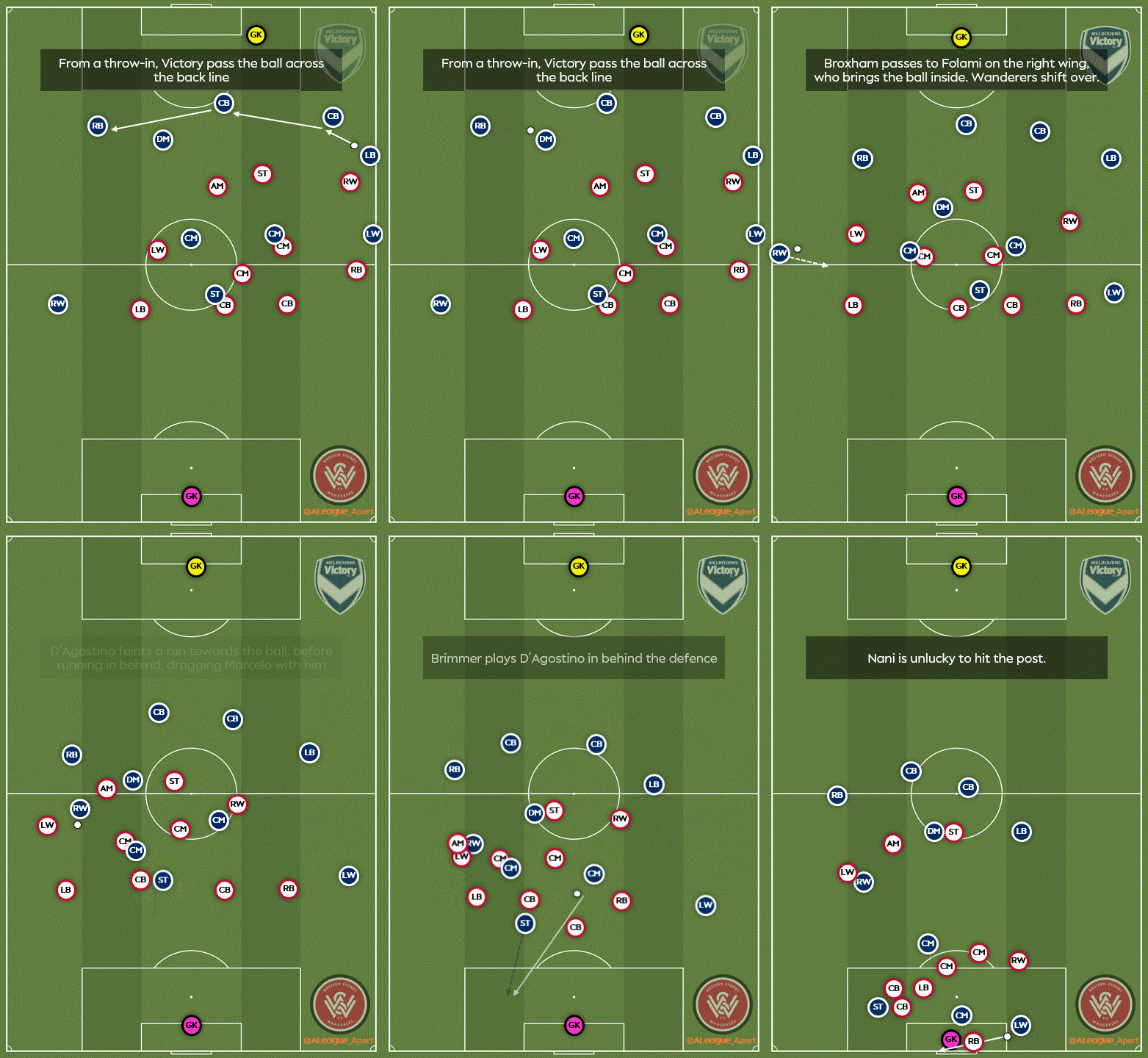
Nani was also good when one-on-one with Cleur. He showed that he’s still got a turn of pace, standing up Cleur before driving towards the touchline. His delivery was into a good zone, but in somewhat of a theme of Victory’s attack, no-one was able to attack the delivery. A minute later, probably with the earlier one-on-one in mind, Cleur impeded a Nani run by almost wrestling him to the ground. He was perhaps lucky to escape getting booked, which would have made it difficult to defend against Nani for over an hour .
Victory’s attack drew blanks
While Nani had a few good opportunities in the final third, the other two Victory attackers didn’t have as much luck. Folami would receive the ball in the final third, dribble past an opponent skilfully, only to get tackled or lose the ball when trying to find a teammate. He’s got the technique with the ball at his feet, but his final product is definitely still a work in progress.
Up front, D’Agostino was completely swallowed up in attack. One of the main aspects of D’Agostino’s game is his tenacity and running, always making darting runs to attempt to link up play or receive between the lines, before sprinting in behind. His direct opponent was the veteran Marcelo, who was up to the task and then some.
Aside from the previous passage of play that resulted in Nani hitting the post, Marcelo was flawless at the back, tracking and winning duels against D’Agostino as he dropped deep, before coming back and stamping out crosses that came into the box. It was a bit strange that Victory would go on to insist on hopefully crossing the ball, considering the mismatch between D’Agostino and the centre-back pairing of Marcelo and Mrcela.
Wanderers get in the game
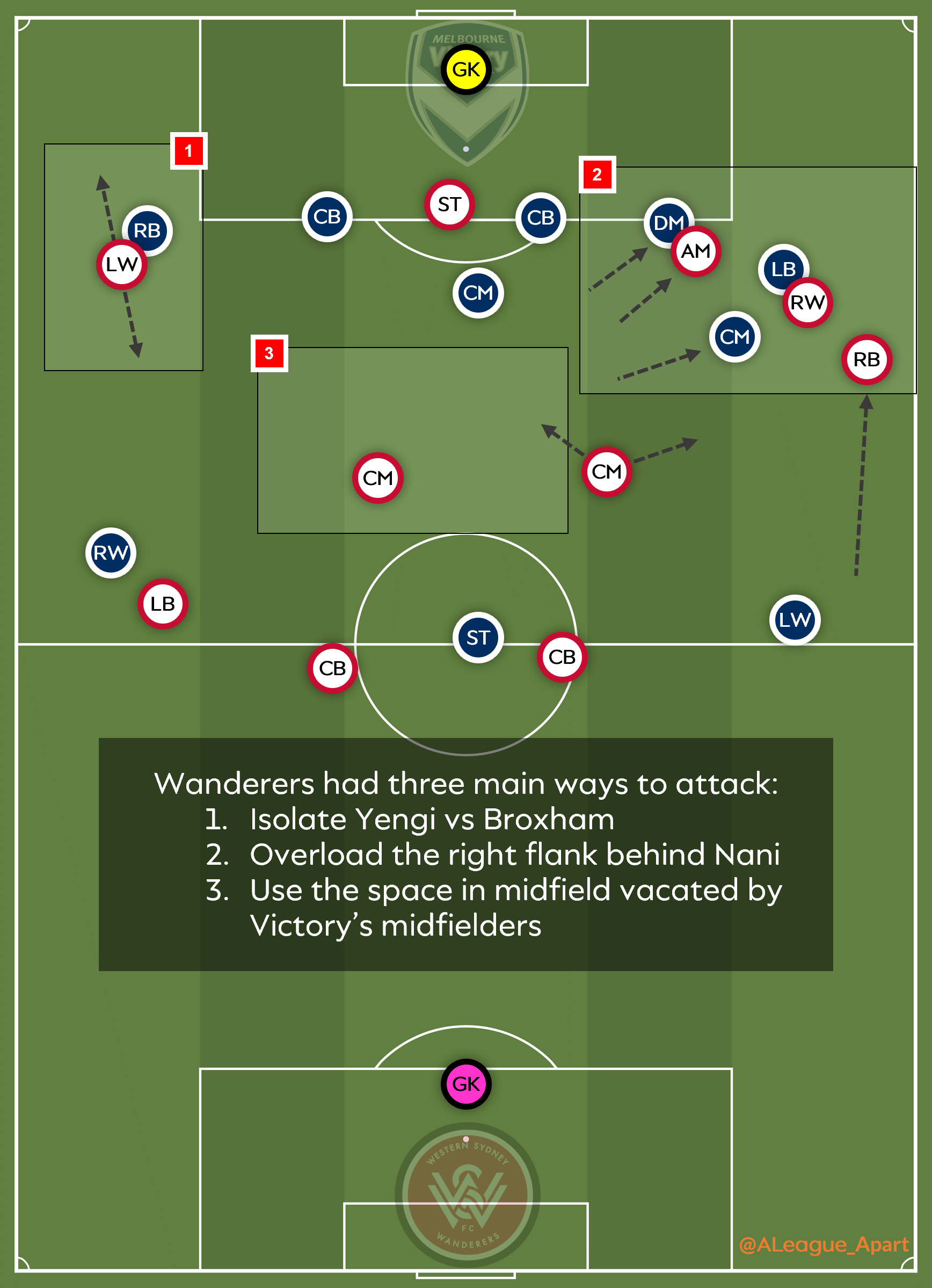
After the 20 minute mark, Wanderers managed to get into the game. There were three things that helped:
Kusini Yengi vs Leigh Broxham
Yengi was up against Victory’s makeshift right-back Broxham, and he proved to be a tough opponent for Broxham with his pace, power and his ability to convert possession in midfield to final third attacks. To make matters worse, Broxham picked up an early yellow card after being beaten to a 50/50 by Yengi, meaning he had to be cautious for the rest of the game.
This effectively empowered Yengi and allowed him to act as an outlet for Wanderers. They could give him the ball and be sure that he would be able to receive it, hold onto it, and turn it into attacking play. Broxham was powerless against him, as Yengi would easily hold off his challenges, turn or lay the ball off to his teammates. Yengi was at the centre of three of the best first-half opportunities; receiving the ball in transition and driving forwards before releasing Krpic for a one-on-one; dribbling at and beating Broxham on the edge of the box before delivering a dangerous cutback; and arriving at a pulled back cross only to fail to make contact.
Space behind Nani
That pulled back cross arrived from their right flank - a zone where Wanderers found some joy in the first half. While Nani would track back, he wasn’t able to keep up with runners in behind. Wanderers attacked this space with Borrello and Cleur starting out wide, with Amalfitano and sometimes Ninkovic coming over to work overloads. They used these overloads to create a series of 7 crosses from the right over a 15 minute period, but crossing quality was poor overall.
Space on the edge of the box
Victory’s solution to this had been to use the midfielders to help cover the spaces wide. Rai Marchan would shift over and slot into the defence, with Brimmer dropping deeper to cover spaces on the left. This meant that Victory’s midfielders were pulled away from central areas, and left plenty of space on the edge of the box. From this position on the edge, Nieuwenhof was unpressured and he used this to exert control, acting as a quarterback and pulling the strings on the edge of the box.
Nieuwenhof’s passing from this zone was dangerous (most notably for the pass which resulted in Ninkovic’s injury) and accurate, with all of his passes in the final third finding their targets, aside from a couple of crosses.
The breakthrough came from a transition moment - surprisingly not coming from the wingers, but through centre-back Mrcela. This arose from both sides losing the ball in transition - first a sloppy loss of possession from Broxham and Folami, from which Cadete managed to recover before attempting to dribble through the centre of the pitch. Mrcela picked him off and carried the ball forwards with the now-depleted Victory defence backtracking. He found Borrello, continued his run and managed to get the goal following a goal-line clearance that fortuitously found its way back to him to score.
Second half and substitutions
The second half picked up where the first half left off. It was more of the same, with Victory attempting to find Nani. Wanderers made more efforts to double-team him, with Borrello helping Cleur out as the ball went out wide.
This meant that when Nani did get the ball, it was more difficult to combine with his teammates. Brimmer would always be hovering slightly inside to attack the space, but he had a poor game by his standards, with his first touch completely deserting him all game. He constantly had issues with controlling the ball dead with his first touch, which made his subsequent touches more difficult, pressured, and ultimately inaccurate.
Behind him was Cadete, who you might expect to be providing overlapping runs from left-back, but he doesn’t seem to be that kind of player. Last week against Sydney he sat fairly deep, and while he got forwards more this week, he doesn’t seem to have a particularly attacking skillset.
Popovic made a triple substitution to address a few of these problems; Chris Ikonomidis came on for Folami and added a dynamic attacking option on the left (with Nani swapping over to the right), Stefan Nigro came on to help deal with Yengi (replacing the booked Broxham) and Noah Smith provided a more attacking option at left-back than Cadete. The substitution almost immediately bore fruit, with Ikonomidis and Smith combining to deliver a cross for Brimmer, who saw his diving header flash wide.
From here there were a few more substitutions, with Brimmer being replaced by Nishan Velupillay, which saw Nani play as an attacking midfielder momentarily before being replaced himself by Lleyton Brooks. Rudan also went to the bench, with Ramy Najjarine replacing Ninkovic and Jarrod Carluccio replacing Cleur, who was suffering from cramp.
It didn’t really matter though; by this point, the game had lost most of its structure. Wanderers looked to shut up shop, which involved a few tactical fouls that bore yellow cards, including an impressive foul by Nieuwenhof where he dragged down D’Agostino to shut down a dangerous attack on transition. These challenges sparked two moments which caused tempers to almost boil over, but they proved to be the last noteworthy incidents of the match.
Summary
As Popovic said in the post-match press conference, Victory didn’t deserve to win the game. Brimmer had an uncharacteristically poor game, D’Agostino was well-marshalled by the Wanderers defence, while aside from Ikonomidis, the substitutes from the bench never looked like difference makers. Victory will be desperate for some of their other players to return to full fitness - even a superstar like Nani won’t be able to do it all on his own.
Rudan got a bit of criticism for declaring his side one of the best looking teams last week, but it must be said that his side does look quite strong. It’s a new defensive line this season, and while Mrcela will get most of the plaudits coming out of this game, Marcelo already looks like one of the best centre-backs in the league. Their attack over the two games has been a bit of a snooze at times, but there are bright spots - Ninkovic is still crafty as ever, Yengi will be a tough task for defences, and Nieuwenhof will be controlling his fair share of games this season.