Melbourne Victory 2 - 1 Adelaide United
Adelaide United's build up play
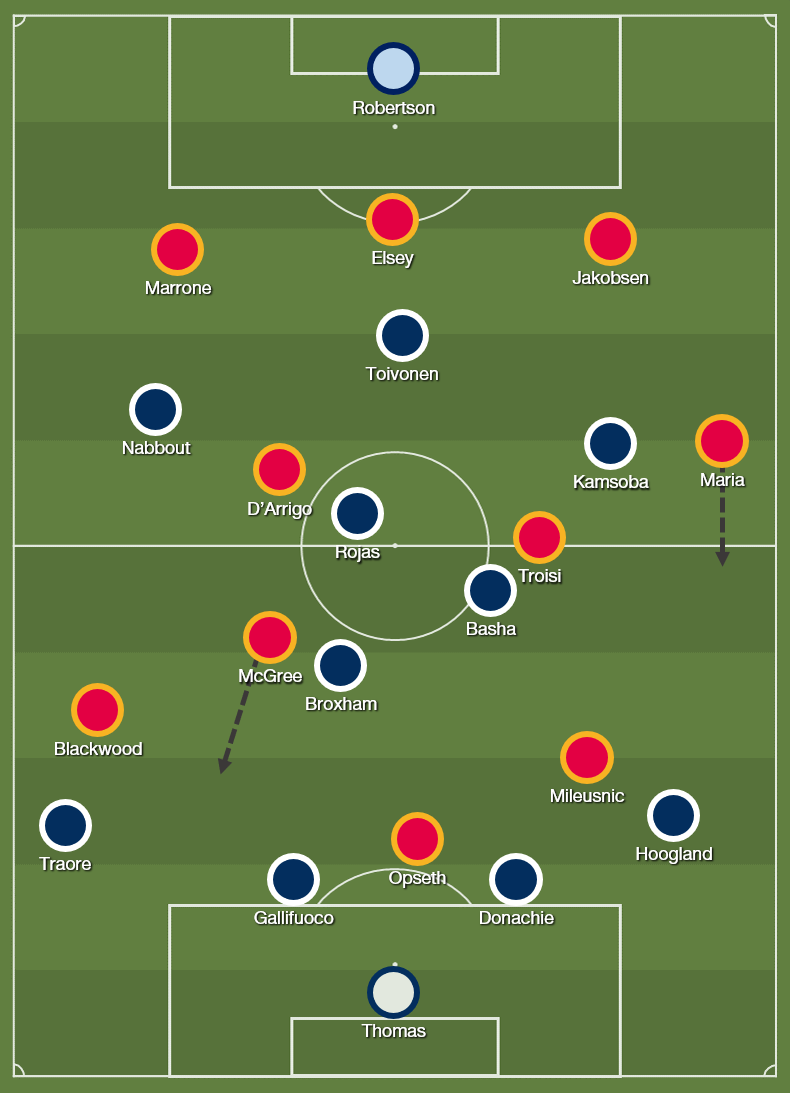
Adelaide United lined up in what was nominally a 4-3-3, but their actual attacking approach was quite different - it looked more like a 3-2-5 in possession. This shape is gaining popularity across Europe, with Man City, Arsenal and Tottenham playing in this shape in possession. The aim is to create a line of 5 across the pitch at the front, stretching the defensive line and asking questions in each of the channels - one in the middle, one on either flank by the touchline, and the other two in the spaces between CB and FB.
Maria at left back was tasked with pushing up beyond the midfield, while on the other side, Marrone tucked in to become a makeshift right sided CB, with the two centre backs Elsey and Jakobsen shifting over to the left accordingly to make it a flat back 3.
In midfield, Troisi dropped back to help circulate the ball and looked for long balls into the channels and spread the ball wide to the flanks, while McGree pushed up close to Opseth and looked for runs into the channels, most frequently on the inside right channel in between Gallifuoco and Traore.
This created 5 vertical channels up front, from left to right: Maria, Mileusnic, Opseth, McGree and Blackwood.
Opseth made a nuisance of himself, with Adelaide playing directly to him as a target man, attracting attention from both CBs Gallifuoco and Donachie. While he didn’t necessarily win a lot of these aerial duals, the pressure he put on the centre-backs made it difficult to clear well, with Adelaide’s midfield looking to pounce on the second balls.
McGree was the best person to take advantage of this, and Broxham was told to stay in the midfield, passing McGree off to his back line, creating a 2v2 situation of Gallifuoco and Donachie against McGree and Opseth. Adelaide looked to exploit this with patterns aimed to open up the channels in between CB and FB.
Pattern 1: Balls behind the fullback
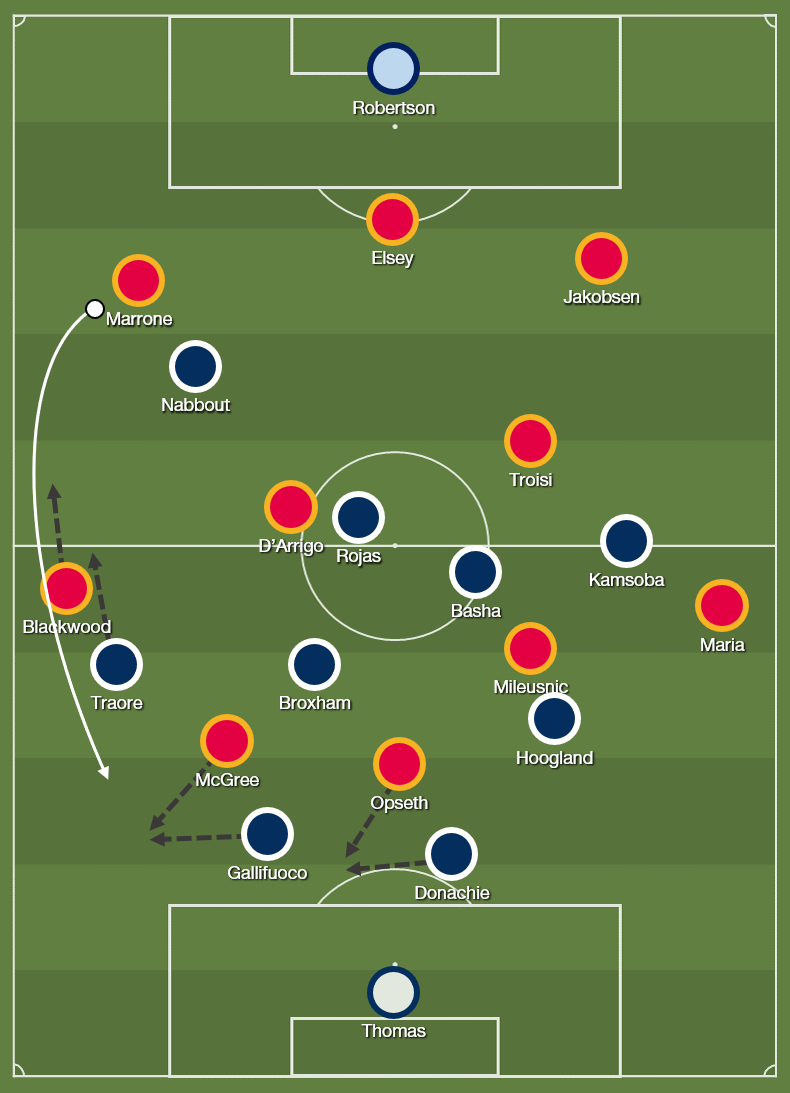
The ball is played to the outside centreback
The winger comes short, dragging the opposing fullback up the pitch
The centreback plays a long ball into the space behind the fullback
This happened both down the right (1 (notice McGree look up and see the space developing from Blackwood's run), 2) and down the left.
This is how the first goal is scored – Marrone (the right-sided centreback) plays a long ball into the outside right space vacated by Traore, where there is 2v2 situation between the two centrebacks and McGree and Opseth. Gallifuoco’s clearance is not good enough, and McGree pounces on it and drives into space. Donachie attempts to close him down aggressively, and in doing so, opens up a pocket of space for him to slot in Opseth for goal.
Pattern 2: LB Out-ball
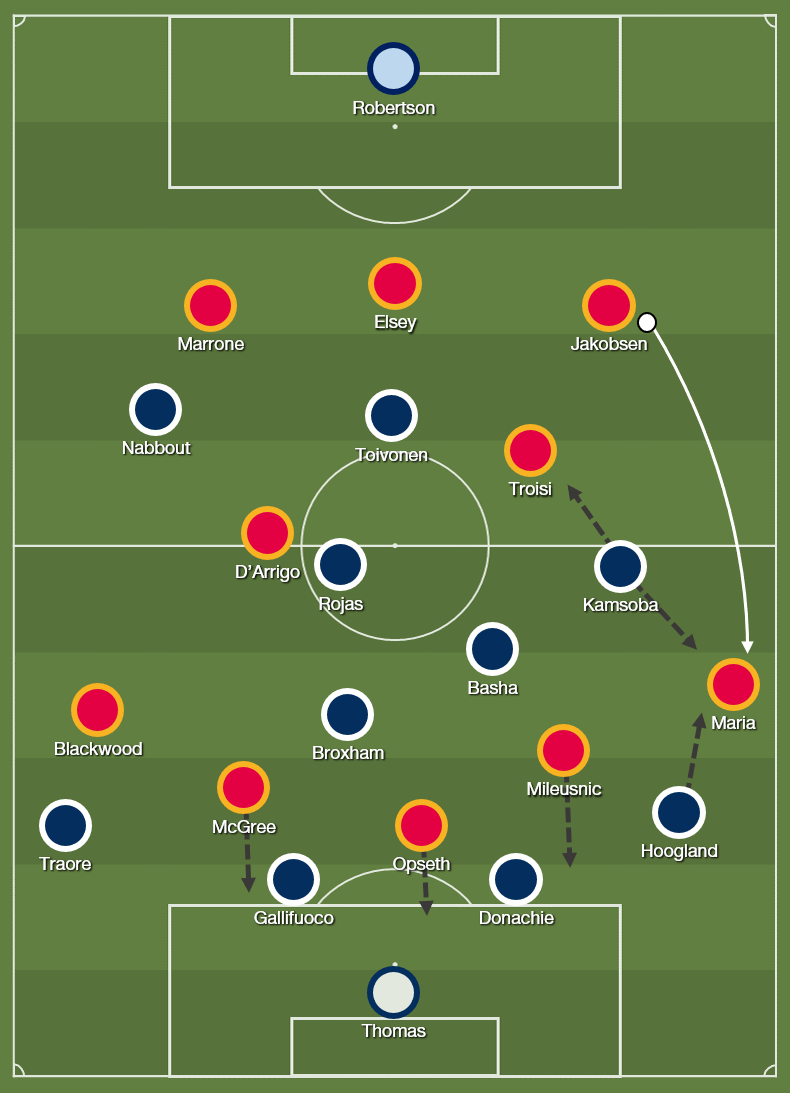
With McGree and Opseth pinning the two centrebacks, and the right-back Hoogland preoccupied by the left wing Mileusnic, Maria gunning forward presented a problem for Victory.
Troisi would come short towards the centrebacks, which left Kamsoba having to make a decision between cutting the passing lane to Troisi off, or tracking his direct opponent Maria, who would look to go past him. It seemed that Kamsoba was told to stay narrow to cut off balls into Troisi, and as a result, Maria was a fairly easy out-ball for the centre-backs. This resulted in a few good opportunities to bring the ball into promising positions. Unfortunately, they couldn’t make the most of this, thanks to Victory tactical fouls and poor final balls.
Melbourne Victory
Victory's tactics were quite boring in comparison.
Toivonen is an intriguing player, but doesn’t seem to fit into the system that Victory want to play. Perhaps he was being manhandled by the centrebacks and a bit unlucky with decisions, but he wasn’t really trying to win the many aerial balls that came his way.
In order to get involved with the play, he then came deep to receive the ball into feet where his best contributions were some very tidy flicks. Crucially, his contributions were more around bringing the ball up the field, and when he put his foot on the ball, he slowed play down quite significantly. He wasn’t really looking to bring his more direct playing colleagues - Rojas, Kamsoba or Nabbout into play.
Rojas didn’t manage to get much joy in the first half – he was marshalled by D’Arrigo, while the two centre-mids were also marked tightly. With Toivonen not being able to hold up play, there was difficulty in linking the play between defence and attack. Victory were only able to move the ball up on the flanks.
This resulted in Victory’s best opportunities coming through crossing – Kamsoba was the liveliest option on the right – but his and Victory’s final ball was quite poor on the night. With the ball out wide, Victory also managed to get the centre-mids up the pitch, and they had a few good chances when the midfield runners managed to escape their man-marking to arrive late in the box.
Second Half
The second half was a lot more boring tactically. Adelaide seemed to push Maria forward less, and he ended up staying back more permanently when the more direct Nabbout was switched to his side. Rojas benefited most from this, with Toivonen dropping deep and Kamsoba cutting inside from the left instead to give him people to play with, but again, the final ball was lacking.
Adelaide attacked the right flank, where Traore was subbed off at half time for Lauton. Lauton was a joy to watch on the ball, but it was clear he’s not a left-back. He was lucky to be unpunished by Blackwood, who was allowed the space to take a touch for two back post crosses but hit both against the bar. He also switched off a few times to allow runners in behind and was again lucky with poor final balls.
Adelaide later continued to attack the left flank through the direct running of Yengi and Toure who gave the defence a hard time with their pace and directness. The play became a bit scrappy, with Adelaide conceding more possession to Victory, but Victory were not able to cut through the packed midfield, and Toivonen still did not offer much as a target.
The second half looked like it was petering out with end-to-end play with no end product, except, of course, for Nabbout to settle it with a banger at the end from a counter.