Melbourne City 2-1 Western United
The A-League is back! The 2022-23 season kicked off with the 2021-22 Grand Final rematch: the premiers Melbourne City vs the A-League Champions Western United.
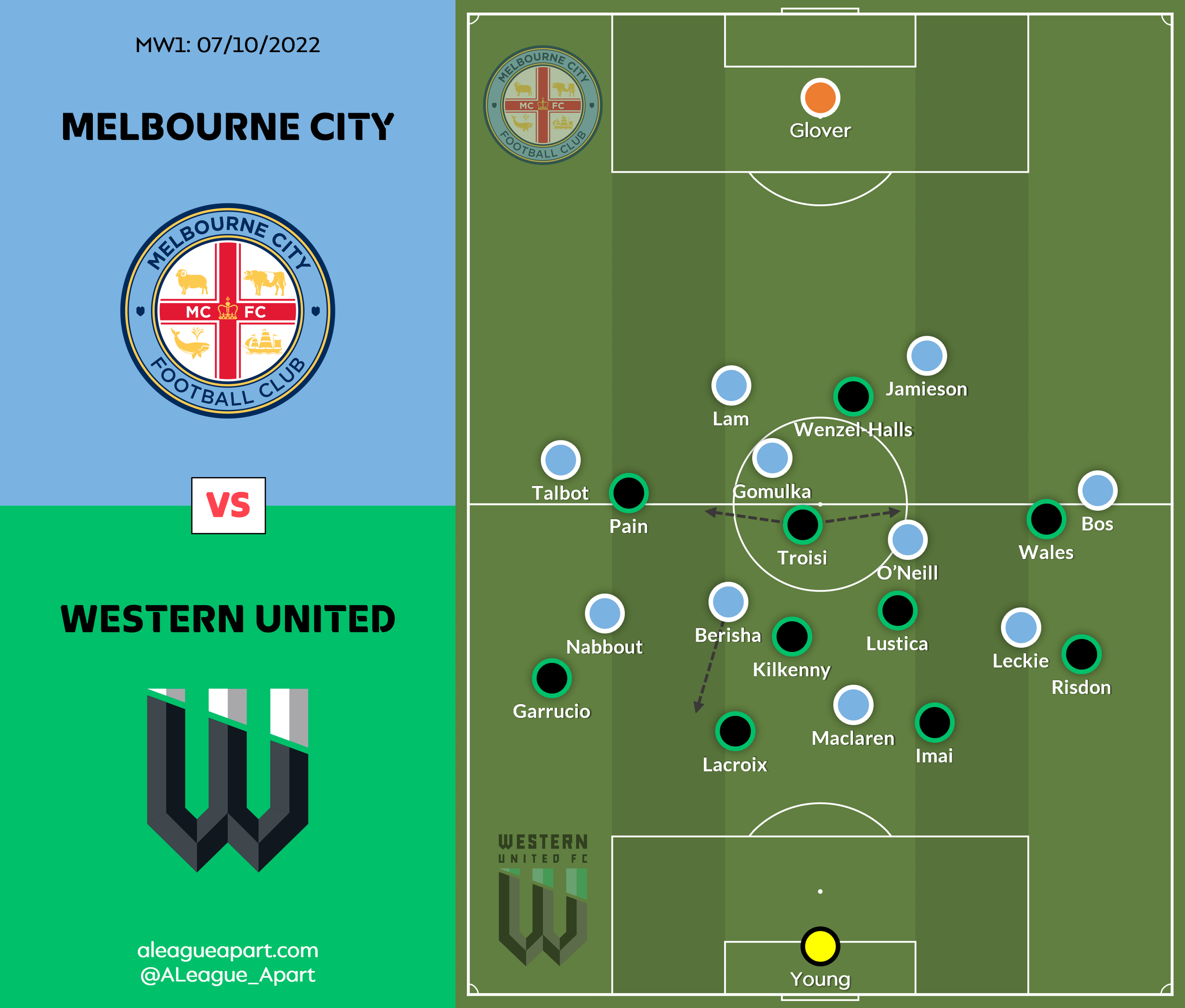
It was a new-look City in two areas - firstly, injuries in defence forced centre-back pairing of Thomas Lam & Scott Jamieson with new signing Callum Talbot starting at right-back and Jordan Bos filling in at left-back, and secondly, the debut of Valon Berisha in midfield with Florin Berenguer injured and Marco Tilio on the bench. Aside from those changes, the established attacking trident of Andrew Nabbout, Jamie Maclaren and Mathew Leckie led the line, with regulars Aiden O’Neill, Taras Gomulka and Thomas Glover rounding out the side.
Western United largely picked up where they left off last season - their first lineup this campaign saw nine of their regulars play: Ben Garrucio, Leo Lacroix, Tomoki Imai and Josh Risdon started in front of Jamie Young, with Connor Pain, Steven Lustica, Neil Kilkenny & Lachlan Wales in midfield. The only two talking points were James Troisi making his debut in a free 10 role, with Dylan Wenzel-Halls starting up top in place of Aleksander Prijovic, who’s staying, but still lacking match fitness.
The game started frantically, with Western United immediately catching City in transition and opening up an opportunity for Troisi on the edge of the box. Their early gameplan looked to be to attack down City’s left flank targeting the less-experienced Bos at left-back and the unfamiliar centre-back Jamieson. Wales provided an outlet for aerial balls, with Troisi drifting over to support and Risdon coming up on the underlap to find space in between City’s lines. Wenzel-Halls was energetic as usual, playing off the shoulder of the defence and pressing lost causes.
This was short-lived, partly due to the inconsistency of Wales and the other Western attackers’ ability to push on and convert possession in midfield into the final third, but mainly due to City finding their feet.
City control
City were able to get their foot on the ball and control the game more effectively. They built up in a 3-2 shape, with one of the full-backs staying in line with the centre-backs (usually Talbot), with the other (Bos) drifting further forwards. The two deeper midfielders, Gomulka and O’Neill provided a short option for line breaking passes and could help circulate the ball.
Western’s defensive structure was a 4-2-4 mid-block, with the front four holding off before pressing sideways and backwards passes, but otherwise shifting side-to-side. When the attackers moved forwards to press, it was the two central midfielders’ responsibilities to move up the field to cover City’s two deeper midfielders.
The wingers had decisions to make. Wales and Pain would join the press up front, but the full-backs would vary their positions to make them have to make a decision. If they pressed, they would leave space open for diagonals, while also isolating their own full-backs against City’s wingers. If they didn’t, the press would break down and City could easily control possession.

City complicated matters more on both flanks. On the left, Bos’ more attacking positioning meant he found himself behind Wales while Leckie would join in to overload Risdon. On the right, Nabbout was physically dominant in aerial contests against Garuccio, with Berisha joining him on the right to overload him further. Western’s midfielders had a huge defensive load - they not only had to cover the spaces behind the front four, but also be ready to drop in to help their defence in the channels between the centre-back and full-back.
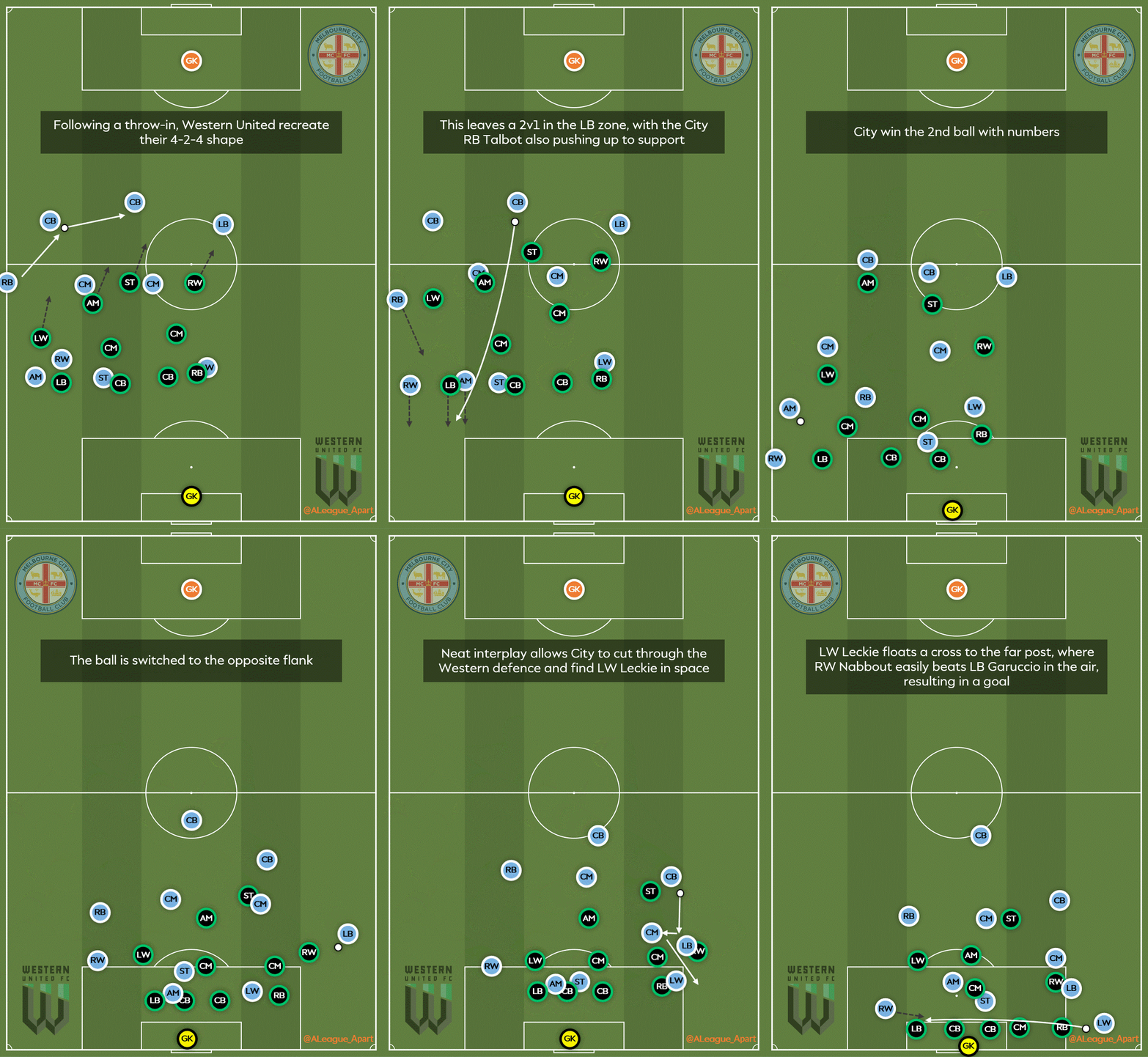
This played out multiple times, most notably in the disallowed goal, and the 1-0 goal. For the 1-0 goal, the first phase of play saw a City throw-in that got played back to Jamieson, with Western taking up their 4-2-4 defensive shape. With Kilkenny covering the midfield, Berisha and Nabbout were both able to overload Garrucio, and following a long ball, City had possession on the right flank. The ball was switched to the opposite flank, where some neat pass-and-move interplay managed to overload Risdon and get Leckie into an unpressured crossing position. The cross to the far post saw Nabbout beat Garrucio in the air, with the ball fortuitously ending in the goal following touches from Imai and Lacroix.
City press
City also controlled how United could play, through their strength in pressing.
Western United built up in a 4-2-3-1 shape, with the full-backs sitting deep and midfielders low and narrow. It seemed they wanted to force City’s attackers to press higher, allowing Troisi space to operate in midfield, and he drifted to the flanks to attempt to double up on the full-backs.
City’s defensive structure was a 4-1-3-2, with Berisha joining Maclaren up top and O’Neill pushing up to join Nabbout and Leckie. Gomulka was responsible for the spaces in midfield, and he invariably was the one who would move to close down Troisi as he popped up in between the lines.
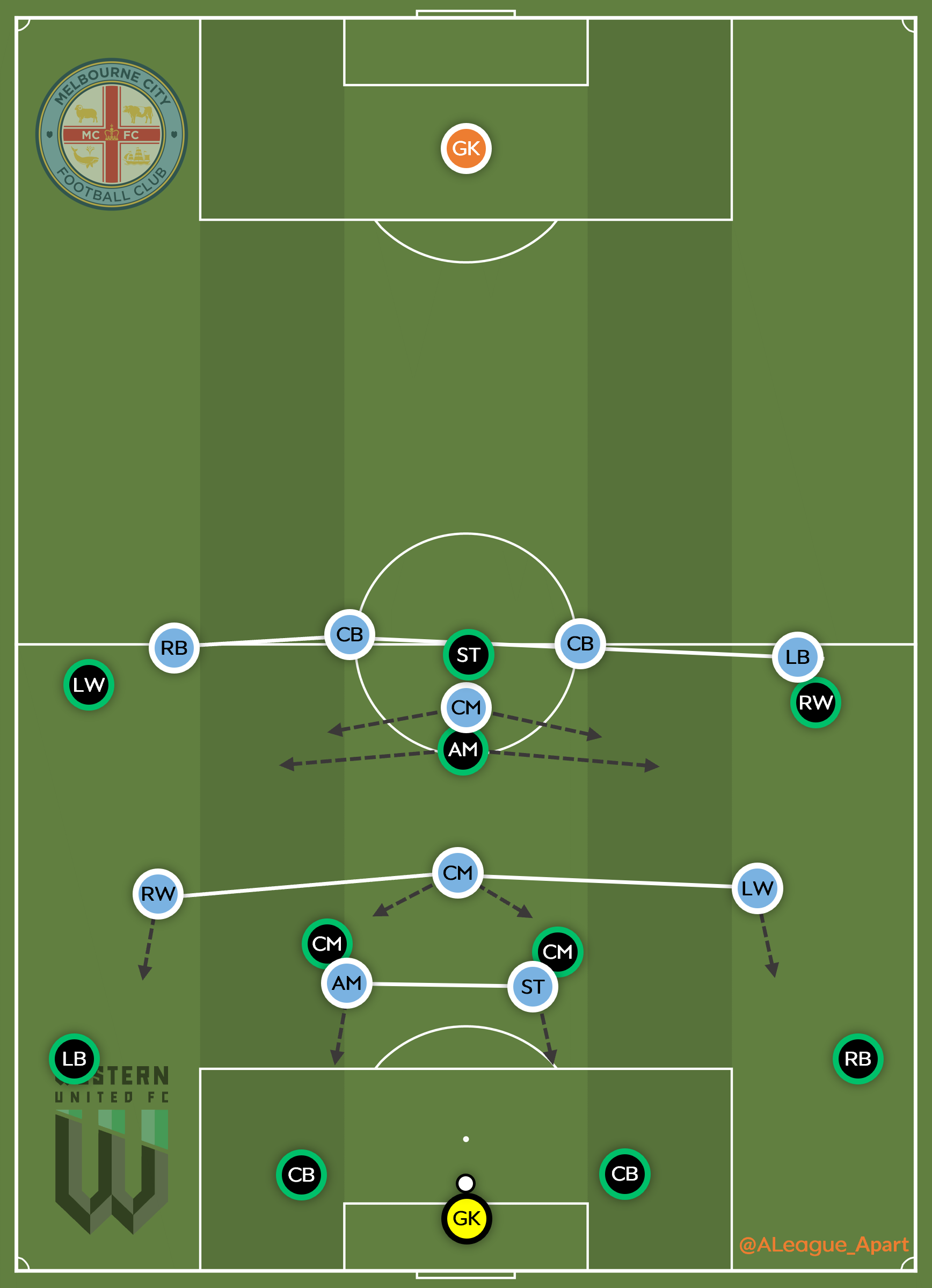
City’s press was well organised, with new-signing Berisha adapting perfectly to the defensive system. He pressed quickly and aggressively when needed, but also, along with Maclaren and O’Neill in support, prevented balls from arriving into the two Western midfielders. Perhaps partially due to the press, and partially due to their gameplan, Western played balls down the flanks through the full-backs, or played direct balls to Wales and Troisi.
The effectiveness of the defensive structure was such that Kilkenny, Western’s main deep playmaker, only managed to receive 6 passes in the entire first half - two of which were from kickoffs, and another two were part of defensive clearances. Next to him, Lustica received 7 passes in the first half - but none after the 19th minute.
Instead, United’s best first-half chances came from set pieces, with Lacroix having good chances on two occasions and Garuccio bending a long range shot agonisingly close.
Going into half-time, it was clear that Western United would need to be the ones to change something. The key questions they faced going into half-time were evident:
How could they get their two playmakers Kilkenny and Troisi on the ball?
Would they be able to continue to deal with overloads on their full-backs?
When would the added mobility and pace of Dylan Pierias and Tongo Doumbia enter the game?
Western United’s response works…
The first change was forced, with Nikolai Topor-Stanley came on at half-time for Imai, who’d injured his shoulder during an aerial challenge.
The solution was a subtle one - Kilkenny and Lustica swapped sides so that Kilkenny’s starting position would be covered by Maclaren rather than the energetic Berisha. This, combined with a switch from medium/long-range passing to more passing around the back aimed to draw City’s attackers out to press. The attackers would either have to concede space for the centre-backs to drive forward with the ball or would open up space for Kilkenny to receive between the lines.
Pain and Wales also made more movements in between the lines in conjunction with Troisi, with the winger on the opposite side tucking in to exploit spaces between the lines.
This worked - after an initial back and forth, there was a five minute period where Western managed to continually find Kilkenny and Troisi on the ball facing forwards, resulting in two excellent attacking opportunities.
…until it doesn’t
City’s second goal came out of one of these press-drawing situations, with Maclaren pressing a seemingly routine possession at the back. As Maclaren closed in, Lacroix faked the pass and attempted to dribble backwards, only for Maclaren to nip in and steal the ball and dink the ball over Young. While it was an inexplicable error by Lacroix, the first warning signs were in the 7th minute, when Lacroix got dispossessed in midfield, leading to a break in behind for Maclaren.
It’s not entirely unexpected - Lacroix has a tendency to take huge touches when he dribbles with the ball, knocking the ball well ahead of himself as he moves. The drawback is that he doesn’t have as much close control, and City’s press took full advantage.
Western also didn’t seem to have an answer for City targeting the full-backs. It got worse, with Risdon looking tired as early as the 50th minute. Leckie and Maclaren both aimed to take advantage of this, with the ball continually coming down his flank.
Substitutions
United were first to the subs bench, with Pierias and Doumbia replacing Wenzel-Halls and Lustica. Wales moved to play centrally, with Pierias taking Wales’ place on the right wing, while Doumbia for Lustica was a like-for-like swap.
City also made their substitutions - Lam coming off injured with Jordon Hall his replacement, and later Nabbout coming off with what looked like cramp, replaced by Tilio.
By this time, City had stopped pressing as relentlessly as before and started to drop deeper, with Western able to bring the ball forwards significantly easier.
Nicolas Milanovic came on for Wales as the last throw of the dice, but by this time City had regained control of the game. The slowed down the tempo to suit them, but still created a slew of dangerous chances - notably Leckie dancing through the defence, Tilio getting fouled while through on goal, a scooped volley free-kick(!), another Lacroix error almost leading to a goal, three shots in quick succession with a couple of top saves from Young - with a Milanovic consolation goal sandwiched in the middle.
Roundup
As John Aloisi mentioned in his post-match press conference, Western United certainly weren’t at their best on the night. It seemed like a combination of things - fitness, fluidity and most definitely, a Prijovic shaped hole in the lineup. Provided he returns to the squad soon, they shouldn’t have too many problems against other, less organised teams. We saw Kilkenny and Troisi showing the beginnings of a great playmaking partnership, Young’s shot stopping quality, and hopefully we’ll see a return to form for Lacroix, and a return from injury for Imai.
That’s not to take away from Melbourne City, who have definitely hit the ground running. Everyone played their roles perfectly - Jamieson slotted in flawlessly as a makeshift centre-back, Lam showed composure and technical quality from the back, Bos and Talbot seem to already have a good understanding of their roles, the midfield remains solid and the front three have continued on from last season. Berisha rightfully won the man of the match award, fitting right in with his technical quality and intelligence - both in attack, and equally impressively in the press.